Casebook Outline
Plus, view supplementary materials, topical updates and book errata with a click or tap.
Chapter 1. Public Land Law: An Introduction
-
The Field of Public Land Law
Professors George C. Coggins and Robert Glicksman's three volume treatise, Public Natural Resources Law is a useful complement to this casebook, covering all the topics addressed here in comprehensive fashion. Their Modern Public Land Law in a Nutshell, is also a helpful companion to this casebook.
-
The Federal Lands and Resources
In 2020, the Congressional Research Service provided federal land ownership data. It excludes lands on the Defense Department, which manages 8.8 million acres in the fifty states and D.C.
Robert B. Keiter, The Emerging Law of Outdoor Recreation on the Public Lands, Harv. Envtl. L. Rev. (2021).
John Leshy's Our Common Ground (2022) is a comprehensive treatment of the history of America’s Public Lands.
The periodic Public Land Statistics publication of the BLM is a treasure trove of facts and figures about federal land management.
The National Atlas provides downloadable files of federal lands for each state. All federal land management agencies consolidate their recreation information in one website. All students studying public land and resources law should visit a nearby federal site at some point during their semester!
The 2018 Bloomberg infographic on land use in the United States provides a helpful perspective on the size of the federal estate in the categories of timberlands, pasture/range, parkland, and wilderness.
-
Management: Federal Land Institutions
-
The National Forest System
The Forest Service home page is a hub of information about a range of issues and also includes a helpful interactive map.
The U.S. Forest Service posts yearly updates of land area of the National Forest System (LAR).
The Forest Service, which falls within the U.S. Department of Agriculture was established in 1905 with the mission to “sustain the health, diversity, and productivity of the Nation’s forests and grasslands to meet the needs of present and future generations.” The standard source for understanding the agency’s early years is Gifford Pinchot, Breaking New Ground (1947). An important secondary source for interpreting Pinchot’s biography is Char Miller, Gifford Pinchot And The Making Of Modern Environmentalism (2001). On the mid-century Forest Service, the best source is Glen O. Robinson, The Forest Service (1975). On the important legislative and regulatory reforms of the 1970s and early 80s, the key sources are Charles F. Wilkinson & H. Michael Anderson, Land And Resource Planning In The National Forests (1987), and Dennis C. Lemaster, Decade Of Change: The Remaking Of Forest Service Statutory Authority During The 1970s (1984). An excellent overview of the national forest history is Samuel P. Hays, The American People The National Forests (2009).
-
The BLM Public Lands
James R. Skillen wrote comprehensive, analytical history of the BLM. James R. Skillen, Bureau of Land Mgmt., The Nation’s Largest Landlord: The Bureau of Land Management in the American West (2009).
The BLM publishes the Public Land Statistics report annually.
The BLM manages National Conservation Lands, which include over 900 units covering 33 million acres to conserve special features.
The BLM maintains a central library of the forms required for access to the resources it conserves.
The development of the BLM as a modern, intensive natural-resources management agency is thoroughly covered in "Opportunity and Challenge" and related essays.
The Bureau of Land Management’s mission directs it, among other things, to sustain the productivity of America’s public lands. The Federal Land Policy and Management Act of 1976 sets out the BLM’s multiple-use mission, which mandates that public land resources are managed for a variety of uses. The BLM interprets its regulations through Instruction Memoranda, which can be found here.
-
The National Wildlife Refuge System
The National Wildlife Refuge System, managed by the U.S Fish and Wildlife Service, protects some of the country’s most iconic ecosystems and the species that rely on them.
The Fish & Wildlife Service's "Annual Report of Lands" documents the location and extent of the refuge system.
The National Wildlife Refuge System, a part of the U.S. Fish & Wildlife Service, follows the mission, “to administer a national network of lands and waters for the conservation, management, and where appropriate, restoration of the fish, wildlife, and plant resources and their habitats within the United States for the benefit of present and future generations of Americans. A standard source for NWRS land management is Robert Fischman, The National Wildlife Refuges (2003). A first-person account of early refuge management is Ira Gabrielson, Wildlife Refuges (1943). For a discussion on how the National Wildlife Refuge System should adapt to climate change, see Fischman & Adamcik, Beyond Trust Species: The Conservation Potential of the National Wildlife Refuge System in the Wake of Climate Change, 51 Natural Resources J. 1 (2011), and Jamie Iguchi, Improving the Improvement Act: Climate Change Management in the National Wildlife Refuge System, Environs Envtl. L. & Pol'y J. (2011).
-
The National Park System
The first national park was created in 1872 when Congress reserved Yellowstone county in the Wyoming and Montana territories as a public park. Because there were no state governments in place to manage the park, it remained in the care of the Department of the Interior. However, it was not until 1916 that President Wilson approved legislation creating the National Park Service, directing it “to conserve the scenery and the natural and historic objects and the wildlife therein and to provide for the enjoyment of the same in such manner and by such means as will leave them unimpaired for the enjoyment of future generations. Here is a sampling of the best overarching sources of background on the national parks:
- Joseph L. Sax, Mountains Without Handrails (1980).
- Dorceta E. Taylor, The Rise of the American Conservation Movement: Power, Privilege, and Environmental Protection (2016).
- Alfred Runte, Nat’l Park Serv., National Parks: The American Experience (4th ed. 2010).
- Robert B. Keiter, To Conserve Unimpaired: The Evolution of the National Park Idea (2013).
- Richard West Sellars, Preserving Nature in the National Parks (1997).
- National Park Service Acreage reports cover all national monuments, even those not managed by NPS.
- The National Park Service's Archeology Program publishes a monuments list that includes national monuments and their names, land calculations, and dates as specifies in presidents’ proclamations.
-
The Preservation Lands and Other Special Categories
The National Wilderness Preservation System is managed by four federal agencies: Bureau of Land Management, Fish and Wildlife Service, Forest Service, and the National Park Service. An interagency website maintains a database of wilderness areas and provides other useful information about wilderness management. The key intellectual history of the wilderness movement is Roderick Nash, Wilderness And The American Mind (5th ed. 2014).
-
The Legal Offices
The home page of the Interior Board of Land Appeals provides information about its jurisdiction and finding IBLA decisions. The guide to finding IBLA decisions is found here.
The Forest Service publishes its administrative appeals decisions electronically.
The Office of the Solicitor at Interior and Office of General Counsel at Agriculture both provide a modest amount of information on their websites. Solicitor's Opinions, 1993 to present, can be found here. Prior to that year, the opinions can be found in “Land Decisions” (at L.D.) here. The second Trump Administration broke with tradition and suspended the entire body of "M-opinions" issued by the Interior Solicitor during the Biden Administration (M-37065 through M-37084 issued between Jan. 20, 2021 and Jan. 20, 2025). The Feb. 28, 2025 Memorandum states that each solicitor's opinion suspension continues until the new solicitor determines whether it should be reinstated, modified, or revoked.
-
The United States Congress
Wilderness Connect provides fast facts about the beginnings of the national wilderness preservation system.
On the National Wild and Scenic Rivers Systems’ website, you can explore the national system and its designated rivers.
Cong. Rsch. Serv., R41330, National Monuments and the Antiquities Act (2018).
Appendix A of Robert B. Keiter, Toward a National Conservation Network Act, 42 Harv. Envtl. L. Rev. 61 app. A (2018) provides a table of total acreage of protected lands in the four systems.
Robert B. Keiter, Rethinking Federal Public Land and Resources Law in the American West: Time for Another Comprehensive Review?, 49 Envtl. Lᴀᴡ 1 (2019) (with Matt McKinney).
Robert B. Keiter, Landscape Conservation, Wildlife Management, and the Federal Public Lands, 56 Iᴅᴀʜᴏ Lᴀᴡ Rᴇᴠ. (forthcoming 2020) makes the case for a new National Conservation Network Act to legitimize and expand upon these protected areas.
-
The Special Case of Alaska
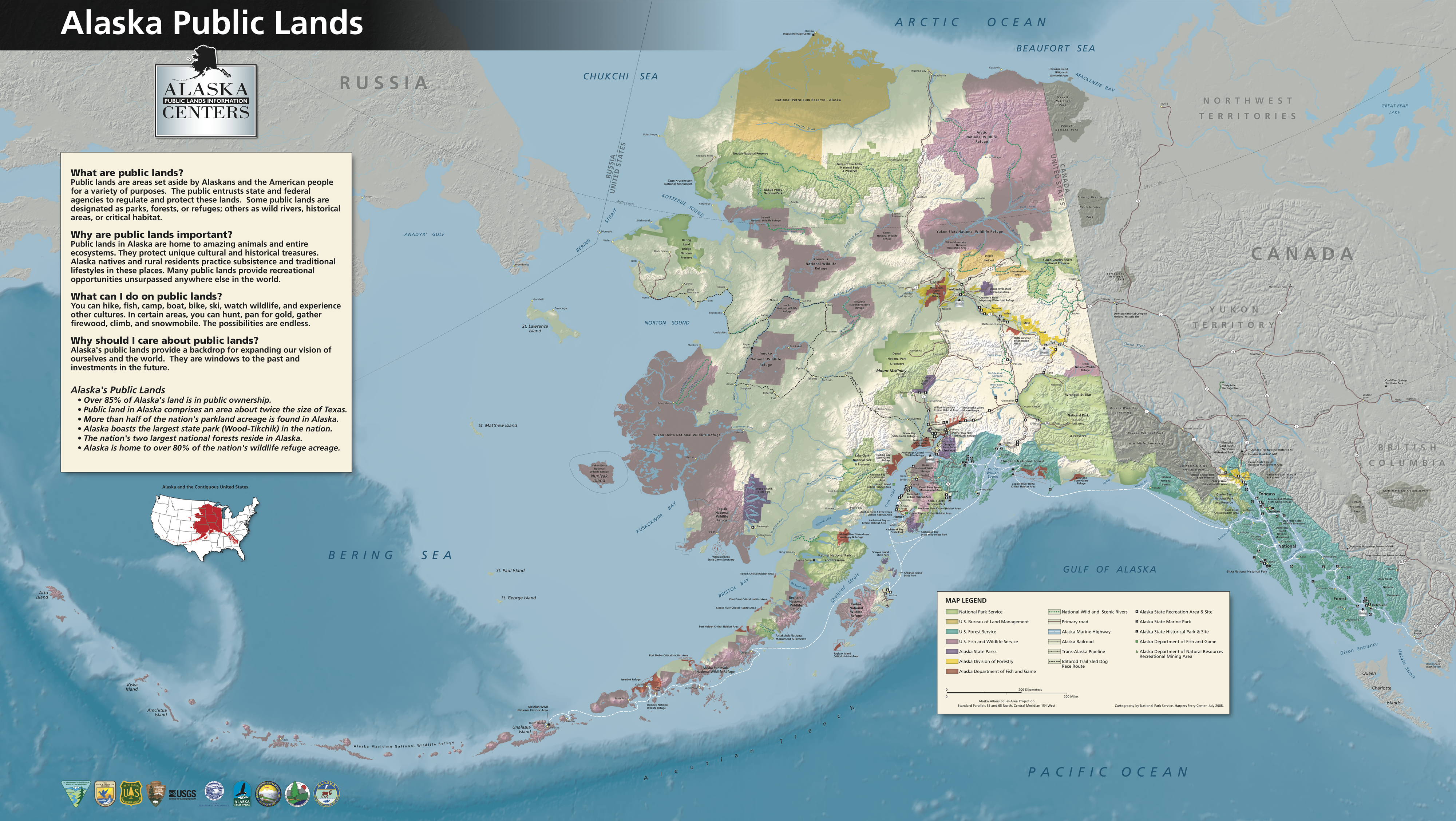
The federal land management agencies have a joint website providing information about Alaska public lands, including a helpful set of maps. The best overall map of Alaska public lands also shows state holdings.
The Superfreeze, along with other Public Land Orders from 1942 through April 2016 are found indexed here, showing Federal Register pages where they appear.
A helpful source for understanding the special case of Alaska is Stephen Haycox, Frigid Embrace: Politics, Economics And Environment In Alaska (2002).
-
Summary of Public Land Systems Today
The Congressional Research Service updated "Federal Land Designations: A Brief Guide" in 2023. It is a clear, concise explanation of the purposes and restrictions that attach to the diverse array of congressional and executive establishments of special public land units.
Wilderness Connect provides fast facts about the beginnings of the national wilderness preservation system.
On the National Wild and Scenic Rivers Systems’ website, you can explore the national system and its designated rivers.
Congressional Research Service, R41330, National Monuments and the Antiquities Act (2018).
Appendix A of Robert B. Keiter, Toward a National Conservation Network Act, 42 Harv. Envtl. L. Rev. 61 app. A (2018) provides a table of total acreage of protected lands in the four systems.
Robert B. Keiter, Rethinking Federal Public Land and Resources Law in the American West: Time for Another Comprehensive Review?, 49 Envtl. L. 1 (2019) (with Matt McKinney).
Robert B. Keiter, Landscape Conservation, Wildlife Management, and the Federal Public Lands, 56 Idaho L. Rev. 49 (2020) makes the case for a new National Conservation Network Act to legitimize and expand upon these protected areas.
-
The National Forest System
-
Principles of Resource Allocation and Management
The Financial Times published this succinct account of the overlap and differences between Garrett Hardin's views, as illustrated by his Tragedy of the Commons article, and Elinor Ostrom's Nobel Prize-winning work on managing common pool resources.
-
Solving the Tragedy of the Commons
On the relationship between economics and resource allocation and management, see Dan Cole and Peter Z. Grossman, Principles of Law and Economics (2nd ed. 2011) (good text for law students to understand the economic and utilitarian perspective on resource management) and Mark Sagoff, The Economy of the Earth (1988) (contrasts micro-economic approaches to natural resource and environmental management with a communitarian, deliberative approach).
Bryan G. Norton, Why Preserve Natural Variety (1987) covers a wide range of philosophical bases for conservation of biological diversity.
Casebook p. 35 on Aldo Leopold: Leopold succinctly summarized his view that “[w]e abuse the land because we regard it as a commodity belonging to us. Only when we see land as a community to which we belong, we may begin to use it with love and respect. There is no other way for land to survive the impact of mechanized man.”
Can you think of another way to conserve the land community? As you encounter law that resolves disputes over who can use federal lands and for what purposes, consider what it says about belonging. In other words, many statutes and judicial opinions allocating public goods implicitly circumscribe who counts as a community member.
-
Ecosystem Management
Gary K. Meffe et al., Ecosystem Management: Adaptive, Community-Based Conservation (2002) is the definitive text on ecosystem management.
- Robert B. Keiter, Toward a National Conservation Network Act
-
The Socio-Economics of Public Lands
Headwaters Economics explores federal lands in western rural counties.
-
Solving the Tragedy of the Commons
Chapter 2. History of Public Land Law: Ownership Rights and Obligations
-
Acquisition of the Public Domain
The rocky history of the U.S. Department of the Interior ("The Department of Everything Else") is recounted in this on-line report.
The Department's website offers a wide range of historical and current materials.
Wikipedia has a surprisingly thorough and graphically exciting entry on the United States territorial acquisitions from original colonies and foreign nations.
-
From the Original Colonies
This excellent map illustrates the broad outlines of the state land claims and subsequent cessions to the federal government.
Francisco Cantu, Dispossessions (New Yorker Jan. 18, 2021), asserts that when "the British imposed their Proclamation Line of 1763, banning settlement west of the Appalachians, it stoked early calls for revolution against the Crown, imprinting a violent appetite for land upon our nascent national psyche."
-
From Foreign Nations
President Jefferson initially thought that he would need a constitutional amendment to conclude the Louisiana Purchase with the French. But, he changed his mind when he learned that the French were having second thoughts. He wrote to Secretary of State, James Madison, "the less we say about constitutional difficulties respecting Louisiana the better." Jefferson commissioned Lewis and Clark's expedition even before the Senate ratified the treaty on Oct. 20, 1803.
A superb treatment of the foreign acquisitions is Richard Kluger, Seizing Destiny (2007).
This map shows the locations, dates, and sources of all the public land territory acquired by the United States from non-Indian foreign nations. It is from John K. Wright's 1932 Atlas of the Historical Geography of the United States, an excellent resource digitized by the University of Richmond's Digital Scholarship Lab. That Richmond Lab is also adding new, interactive maps to its historical atlas under the banner of "American Panorama." From the development of canals to the forced migrations of enslaved peoples, the interactive maps are fascinating and often bear on public land policy.
-
From Indian Tribes
The "LandBack" movement aims to return indigenous lands back into tribal control as a matter of social justice. An article in the High Country News traces the movement to federal property transfers by legislation (H.R. 471) in 1970 to return Blue Lake in New Mexico to the Taos Pueblo and by executive order in 1972 to return Mt. Adams in Washington to the Yakima Nation. Glendenning, Nie, & Mills, (Some) Land Back…Sort of: The Transfer of Federal Public Lands to Indian Tribes since 1970, 63 Nat. Res. J. 200 (2023), canvases all 44 statutes that transferred ownership interests in public lands to Indian tribes. Strictly speaking, the title remained in the United States. The transfers occurred through placing federal lands into a trust status for the benefit of a particular tribe or tribes. Most transfers contained some kind of limitation, such as "for traditional purposes only" or "solely for the care and maintenance of bison, wildlife, and other natural resources."
-
Johnson v. M’Intosh
Timothy Egan, After Five Centuries, a Native American with Real Power, N.Y.Times, Jan. 1, 2021, https://www.nytimes.com/2021/01/01/opinion/native-american-secretary-interior-deb-haaland.html (Stuart and Haaland's quotations).
Donald A. Grinde Jr., Taking the Indian Out of the Indian: U.S. Policies of Ethnocide through Education, 19 Wicazo SA Rev. 25 (Fall 2004) (Stuart and Haaland's quotations).
This interactive map from the Native Land project allows you to zoom in on any part of the United States to find which treaties or statutes cover a particular place. Links will take you to the text of the relevant treaties. The Forest Service operates a related mapping app that show highways and cities to better allow users to identify today's landmarks on the map.
This map shows the Indian cessions to the United States over time-paralleling the movement of the frontier. It is from John K. Wright's 1932 Atlas of the Historical Geography of the United States, an excellent resource digitized by the University of Richmond's Digital Scholarship Lab.
Eric Kades fills in the somewhat surprising historical facts surrounding the land grants in dispute in Johnson v. M'Intosh. You can access "History and Interpretation of the Great Case of Johnson v. M'Intosh," published in Law and History Review 19:1 (2001).
What exactly invokes the doctrine of discovery? In his classic study, La Salle and the Discovery of the Great West (1879), Francis Parkman described the scene of European "discovery" of much of the land later covered by the Louisiana Purchase. Here is an excerpt from Parkman's history, with the key legal language from the antiquated doctrine of discovery. The doctrine relied, in part, on legal commentators (such as Locke and Grotius) who believed it was a Christian duty to own and improve the New World lands. Even the European naming of the American continent and its regions pushed forward the doctrine, as a kind of claiming. Jean M. O'Brien, Firsting and Lasting: Writing Indians Out of Existence in New England (2010).
The Unitarian Universalist Association hosts a website on the Doctrine of Discovery, starting with Pope Nicholas V’s 1452 decree that sanctioned and promoted the conquest, colonization, and exploitation of non-Christian territories and peoples. In 2023 the Vatican finally repudiated Pope Nicholas V’s decree legitimizing the seizure of Indigenous lands in the Americas. Povoledo, Vatican Repudiates ‘Doctrine of Discovery,’ Used as Justification for Colonization, N.Y. Times (Mar. 30, 2023).
Chief Justice Marshall's slur on Indian tribes, referring to them as "fierce savages," had a long history. The 1776 Declaration of Independence cited, as one of the proofs of King George III's tyranny over the colonies, his permitting "the merciless Indian Savages" to wage war on frontier settlers.
Note 4: The United States finally resolved the last claim under the Indian Claims Commission Act in 2006. The Act is now removed from the U.S. Code. Instead of finding it at 25 U.S.C. 70-70v-1, look at the session law: Indian Claims Commission Act of 1946, Pub. L. No. 79-726, ch. 959, Act of August 13, 1946, 60 Stat. 1049.
Note 5. On the Dann sisters claims against the United States, see David Wilkins, Hollow Justice: A History of Indigenous Claims in the United States 190 (2013).
Note 5. The final report of the Inter-American Commission on Human Rights, Mary and Carrie Dann, Report 75/02, Case 11.140 (2002), can be found here.
Note 6: Justice Marshall refers to the power of the United States to grant lands to settlers. That is often called a "plenary" power of Congress in the Constitution's article IV property clause. Similarly, longstanding judicial interpretation of Congress' article I power to regulate commerce with "Indian Tribes" sustains a similar "plenary" power doctrine, which includes power to abrogate treaties with tribes. The Supreme Court recently reaffirmed the "plenary power" of Congress over Native peoples in Haaland v. Brackeen, 143 S. Ct. 1609,1627, 1638 (2023). Maggie Blackhawk, The Supreme Court, 2022 Term — Foreword: The Constitution of American Colonialism, 137 Harv. L. Rev. 1, 19 (2023), argues that the "plenary power" doctrine applicable in these and other Court doctrines add up to a constitution of colonialism that continues today. She explains that the plenary powers doctrine
is not constitutional law, but the absence of constitutional discourse. Instead, reliance on the plenary power of the political branches obscures the constitutional law, principles, and values of American colonialism that continue to shape our colonial relationships today, without addressing difficult questions of justification. It is an effort to fill the void left by the racialized hierarchy that many used to justify American colonialism and shield us from the difficult constitutional conversations that remain across the seemingly disparate, but ultimately connected “external” constitutional fields of federal Indian law, immigration, the law of the territories, foreign relations law, the treaty power, and the powers of war and exigency. Scholars have long drawn the plenary power doctrine as the common thread weaving together these fields but have puzzled over what we should make of the connection. I argue that the key is American colonialism — a constitution that we have yet to understand and explore. Recognition of this external constitution and the colonial project within it could offer the means to move toward resolution of American colonialism.
She argues that American constitutional colonialism should be modified by extending the liberal constitutional principles historically protecting only the colonists on the "inside" of U.S. institutions. Instead of plenary power, she urges adoption of such principles as "recognition of colonized peoples as political entities, preservation of those communities, support for self-determination, respect for the borders and jurisdiction of colonized peoples, collaborative lawmaking, and principles of nonintervention, that weigh against the imposition of the laws of one people upon another." Id. at 20. As you grapple with the materials in this casebook, consider how these principles might modify the judicial and legislative outcomes that resolve conflicts over federal resources.
Emilie Connolly’s readable history, Vested interests : trusteeship and native dispossession in the United States (2025), won the prestigious Bancroft Prize for American history. Here is a summary from the publisher:
From the earliest days of its founding, the United States set its sights on Native territory. Amid better-known "Indian wars," the federal government quietly built an empire by treaty, offering payments to Native peoples for their land. Routinely inadequate, these payments were nonetheless pivotal because federal officials chose not to deliver them as a lump sum. Instead, the government kept the bulk of payments owed to Native nations under its own control as a trustee, and made access to future installments contingent on Native compliance. In Vested Interests, Emilie Connolly describes how a system of "fiduciary colonialism" seized a continent from its original inhabitants--and, ironically, furnished Native peoples with financial resources that sustained their nations. Connolly documents two centuries of dispossession in the guise of fiduciary benevolence. Acting as both dispossessor and trustee, the federal government invested Native wealth in state bonds that financed banks, canals, and other infrastructural projects that enabled the country to expand further westward. Meanwhile, Native peoples protected the money they did receive for future generations, investing it in their own institutions and mounting legal challenges to hold their trustees accountable. Still, federal trusteeship placed tight constraints on Native economies with the aim of containing Native power, forcing nations to endure through sheer resilience and ingenuity. By chronicling the long history of Native land dispossession through financial paternalism, Vested Interests reveals the unequal dividends of colonialism in the United States
Note 8. Oklahoma bitterly complained that McGirt created public safety dangers by placing much of its territory beyond the reach of state prosecutors. Oklahoma v. Castro-Huerta, 142 S.Ct. 2486 (2022), over Justice Gorsuch’s dissent, held that the federal and the state governments both have concurrent jurisdiction to prosecute crimes committed by non-Indians against Indians in areas with an Indian reservation (including the lands restored to Indian jurisdiction in McGirt). The majority's sweeping opinion reversed the presumption against state jurisdiction on Indian reservations.
Charles Wilkinson, At Bears Ears We Can Hear the Voices of Our Ancestors in Every Canyon and on Every Mesa Top: The Creation of the First Native National Monument, 50 Ariz. St. L. Rev. 317 (2018) provides a first-hand account of that grassroots approach to the creation of a new model of tribal-federal management for national monuments.
Sarah Krakoff, Public Lands, Conservation, and the Possibility of Justice, 53 Harv. C.R.-C.L. L. Rev. 213 (2018), documents the injustices to Indian tribes in the course of public land law development. Even as public land law turned to conservation of Indian cultural resources, it largely did so in isolation from the tribes themselves, as part of a cultural narrative that eliminated the presence of indigenous peoples. Krakoff concludes by describing the formulation of the Bears Ears National Monument as a new, grassroots approach for the tribes themselves to inform public land classifications and to maintain religious/cultural uses in preservation designations. Charles Wilkinson, "At Bears Ears We Can Hear the Voices of Our Ancestors in Every Canyon and on Every Mesa Top": The Creation of the First Native National Monument, 50 Ariz. St. L. Rev. 317 (2018), provides a first-hand account of that grassroots approach to the creation of a new model of tribal-federal management for national monuments.
A 2022 article in the N.Y. Times describes how indigenous communities in Vancouver, Canada have succeeded in negotiating the purchase of former public (military and police) lands in the city slated for divestment. Vancouver has an overheated real estate market, so these First Nations stand to make a profit. The First Nations (what Canadians call Indian tribes) claim aboriginal title that was never ceded by treaty or abrogated by the Canadian government. One banker involved with the project stated:
Reconciliation isn't about recognizing what happened and saying, "That's terrible, I'm sorry, let's move on." … things will change only when Indigenous communities get power. Power can come in different forms, but economic power is probably top of the list."
Consider this in light of U.S. experiments with monetary compensation through the Indian Claims Commission (n.5, p. 56), or collaborative management of Bears Ears National Monument (n.6, p. 57). How do these forms of reconciliation differ?
Felix Cohen was the leading authority on Indian law in the twentieth century, and many of his original articles, such as Original Indian Title, 32 Minn. L.Rev. 28 (1947), remain important sources of commentary. His Handbook Of Federal Indian Law continues to be updated and is the best source for beginning research on any issue related to Indian title. For additional information on Johnson v. M'Intosh, see Eric Kades, History and Interpretation of the Great Case of Johnson v. M'Intosh, 19 Law & History Rev. 67 (2001).
On Indian natural resources management program, see e.g. Del-Rio Drilling Programs, Inc. v. United States, 146 F.3d 1358 (Fed. Cir. 1998). Michael Blumm, Elizabeth Ann Kronk, & Judith Royster have published a comprehensive treatment of the topic, Native American Natural Resources Law: Cases And Materials (3d ed. 2013).
Practical accommodations of Indian rights on federal lands is covered by Martin Nie, The Use of Co-Management and Protected Land Use Designations to Protect Tribal Cultural Resources and Reserved Treaty Rights on Federal Lands, 48 Nat. Res. J. 585 (2008).
-
Johnson v. M’Intosh
-
From the Original Colonies
-
Disposition of the Public Domain
-
The Disposition System
Abraham Lincoln wrote that, in 1816, his father moved the family from Kentucky to Indiana "chiefly on account of the difficulty in land titles" in Kentucky. The Collected Works of Abraham Lincoln 4:62 (Basler ed., 1953-55). At the time, purchasing land in Kentucky "was to buy a lawsuit. During Lincoln's boyhood, his father Thomas Lincoln owned three farms but lost two of them because of faulty titles. In Indiana, however, thanks to the federal land ordinances … [establishing rectangular surveys before sales, buyers acquired] secure titles." Eric Foner, The Fiery Trial: Abraham Lincoln And American Slavery 5 (2010).
Patricia Limerick, The Legacy of Conquest (1987), wrote: "If Hollywood wanted to capture the emotional center of Western history, its movies would be about real estate. … [W]eapons would be deeds and lawsuits, not six-guns. Moviemakers would have to find some cinematic way in which proliferating lines on a map could keep the audience rapt."
In 1796 land claims within the state of Georgia exceeded 29,000,000 acres, more than three times the total land area (8,717,960 acres). Roger Kain & Elizabeth Baigent, The Cadastral Map in the Service of the State: A History of Property Mapping 275 (1992).
Professors Gary Libecap and Dean Lueck research how different land demarcation systems (i.e., metes and bounds versus rectangular surveys) affect land values. One of their papers compares Ohio farms demarcated in both systems. They find that the benefits of the rectangular survey system are reflected in initial land values and that the differences persist to the present day. Gary Libecap & Dean Lueck, The Demarcation of Land and the Role of Coordinating Property Institutions, 119 J. Political Econ. 426 (2011).
The standard text on the method of the public land survey system is Lowell O. Steward, Public Land Surveys (1935, reprinted Arno Press 1979). A popular treatment of the subject is Andro Linklater, Measuring America: How An Untamed Wilderness Shaped The United States And Fulfilled the Promise Of Democracy (2002). A more scholarly source is Malcolm Rohrbough, the Land Office Business: The Settlement and Administration of American Public Lands 1789-1837 (1968).
John Baeten and the Historical Landscapes Laboratory created a richly annotated story-map of the hill country of southern Indiana, which covers pre-survey land grants, survey issues, and a host of natural and cultural sites.
-
The Survey and Early Land Laws
The Public Land Survey System website contains excellent explanations and diagrams of the rectangular survey system at different scales.
This single graphic shows all the important public land survey elements.
There is also some beauty to the regular pattern of the survey section lines.
- Disposition by Foreign Governments
-
The Survey and Early Land Laws
-
State Lands and Trust Doctrines
-
The Equal Footing Doctrine
John Leshy, Are U.S. Public Lands Unconstitutional?, 69 Hastings L.J. 499, 531-541 & 551-53 (2018), describes which aspects of Pollard v. Hagan constitute its enduring holding, and which dicta "had little influence on future public land" law and policy. Much of the dicta addressed federal power to prevent slavery in new states, an issue the Civil War resolved extra-judicially. See also James R. Rasband, The Disregarded Common Parentage of the Equal Footing and Public Trust Doctrines, 32 Land & Water L. Rev. 1 (1997). Today, Leshy notes, Pollard's narrow holding survives merely as a "default rule" establishing the presumption of state "title to submerged lands under waters that are navigable at statehood." Leshy at 553.
John Leshy, Are U.S. Public Lands Unconstitutional?, 69 Hastings L.J. 499, 507-12 (2018), explores the origin and application of the equal footing doctrine as a guarantee of political rights.
Mollison & Eddy, The Sagebrush Rebellion: A Simplistic Response to the Complex Problem of Federal Land Management, 19 Harv. J. on Legis. 97, 100, n. 14 (1982), catalogs demands to cede federal lands from the "old" western states of Alabama, Illinois, Indiana and Missouri.
On the sagebrush rebellion and states' rights, see John D. Leshy, Unraveling the Sagebrush Rebellion: Law, Politics and Federal Lands, 14 U.C. Davis L. Rev. 317 (1980); Robert L. Fischman & Jeremiah Williamson, The Story of Kleppe v. New Mexico: The Sagebrush Rebellion as Un-Cooperative Federalism, 83 U. Colo. L. Rev. 123 (2011).
The public trust doctrine is a favorite topic of discussion in law journals. At the dawn of modern environmental era, Professor Sax revived Illinois Central, identifying it as a taproot of resource protection law. Joseph L. Sax, The Public Trust Doctrine in Natural Resources Law: Effective Judicial Intervention, 68 Mich. L.Rev. 471 (1970). Sax emphasized the trust's utility as a mechanism for the courts to limit the discretion of executive branch agencies. Considerable scholarly debate followed.
Professor Huffman has been a persistent critic of the expansion of the public trust doctrine to include modern environmental concerns. He argues that the public trust doctrine is simply a run-of-the-mill easement under state property law to accommodate navigation and fishing. James L. Huffman, A Fish Out of Water: The Public Trust Doctrine in a Constitutional Democracy, 19 Envtl. L. 527 (1989). Professor Pearson is skeptical that the public trust doctrine will ever be a viable part of federal public land litigation. He argues that the courts will not second-guess Congress's implementation of its trust responsibility for federal lands, and concludes that the public trust notion "empowers the political branches of government to implement substantive choices despite objections in the judicial branch." He contrasts this with the doctrine's operation in state law, where it "empowers the judicial branch to overturn substantive choices made by the political branches.…Night, meet day." Eric Pearson, The Public Trust Doctrine in Federal Law, 24 J. Land, Resources & Envtl. L. 173, 176-77 (2004).
On the connection between Pollard and Illinois Central, see James R. Rasband, The Disregarded Common Parentage of the Equal Footing and Public Trust Doctrines, 32 Land & Water L.Rev. 1 (1997).
In 1990, history seemed to repeat itself when a federal district court applied the public trust doctrine to void the conveyance by Illinois of submerged lands under Lake Michigan to a university for expansion of its campus. Lake Michigan Fed'n v. U.S. Army Corps of Engineers, 742 F. Supp. 441 (N.D. Ill. 1990). Illinois Central continues to spawn re-examination. Douglas L. Grant, Underpinnings of the Public Trust Doctrine: Lessons from Illinois Central Railroad, 33 ARIZ. ST. L.J. 849 (2001); Joseph D. Kearney & Thomas W. Merrill, The Origins of the American Public Trust Doctrine: What Really Happened in Illinois Central, 71 U. Chicago L. Rev. 799 (2004). Kearney and Merrill have since published a book on the subject, Lakefront: Public Trust and Private Rights in Chicago (2021). On the role of public land policies, railroads, and shipping in the rise of Chicago, see William Cronon, Nature's Metropolis (1991).
Public Trust Doctrine Around the World: Several countries around the world have even extended the public trust doctrine to non-traditional resources that have little to do with channels of navigation and commerce. In India, for example, the public trust doctrine is not confined by the "navigable waters" limitations recognized in the United States; rather, it covers all natural resources including the general environment. See M.C. Mehta v. Kamal Nath, 1 SCC 388 (1997). And the decisions of the Indian Supreme Court reflect ecological and moral values - not just legal principles based on commercial production and property regimes. Likewise, in Oposa et. al. v. Fulgencio S. Factoran, Jr., et. al., (1993) 224 SCRA 792, the Supreme Court of the Philippines tethered the public trust doctrine to the fundamental constitutional right "to a balanced and healthful ecology in accordance with the rhythm and harmony of nature." It thus based the public trust doctrine on the moral and ecological values of the Filipino society, stating that preserving the "rhythm and harmony" of nature necessitate the "judicious disposition, utilization, management, renewal, and conservation of the country's forest, mineral, land, waters, fisheries, wildlife, off-shore areas, and other natural resources" so that their "utilization be equitably accessible to the present as well as future generations." And in South Africa, the legislature enacted the National Environmental Management Act, which expressly incorporated the public trust doctrine by declaring that the State is a "custodian holding the environment in public trust for the people." Notably, all these evolutions stem from the same Roman law system that provided us with our own version of the public trust doctrine.
-
Resistance to Federal Land Ownership
In August 2024 the State of Utah asked the U.S. Supreme Court for permission to file a complaint under the Court's original jurisdiction, seeking, in its words, to "challenge the United States' open and unapologetic policy of retaining in perpetuity some 18.5 million acres of unappropriated land within Utah's borders," which is most of the 22.8 million acres BLM manages in the state. Utah says it is not challenging lands "reserved by Congress or the President (under authority granted by Congress) for designated purposes, e.g., as National Parks, National Conservation Areas, and the like." Utah goes on to argue that the Federal Land Policy and Management Act of 1976 (FLPMA) is not itself an "appropriation" of these lands, even though FLPMA lays out a detailed framework directing how and for what purposes the BLM is to manage the lands it holds. It also argues that FLPMA's declaration that "public lands be retained in Federal ownership, unless…it is determined that disposal of a particular parcel will serve the national interest," 43 U.S.C. § 1701, is unconstitutional. It asks the Court to "[o]rder the United States to begin the process of disposing of its unappropriated federal lands within Utah, consistent with existing rights and state law."
On Jan. 13, 2025, the Court summarily denied Utah’s motion for leave to file a bill of complaint with no explanation.
The 2012 Utah legislation, Transfer of Public Lands Act, Utah Code Ann. § 63L-6-101 to -105, calls for the United States to "(a) extinguish title to public lands; and (b) transfer title to public lands to the state." The studies authorized by the legislation, which make the case for transfer, can be found on the web site of the state Public Lands Policy Coordinating Office. The closest state transfer efforts have come to congressional authorization occurred in March 2015, when the U.S. Senate approved (51-49) Sen. Murkowski's amendment to its budget resolution that called for subsequent legislation to "sell, or transfer to, or exchange with, a state or local government any Federal land that is not within the boundaries of a National Park, National Preserve, or National Monument…" S.Amdt.838 to S.Con.Res.11. John C. Ruple, The Transfer of Public Lands Movement, 29 Colo. Nat. Resources, Energy & Envtl. L. Rev. 1 (2018), describes this current iteration of the sagebrush rebellion, with special focus on Utah's legislation and litigation.
In 2014 Secretary of the Interior Jewell called the Utah effort a "waste of time" after studies revealed the costs to the state (PDF) and weaknesses of the legal arguments (PDF). John Leshy comprehensively critiqued the analysis of the Legal Consulting Services Team for the Utah Commission for the Stewardship of Public Lands (PDF) in response to the 2012 Utah statute., Are U.S. Public Lands Unconstitutional?, 69 Hastings L.J. 499 (2018).
In 2015 the Texas governor demanded in a letter (PDF) that the BLM stop asserting federal control over lands associated with non-navigable portions of the Red River bed that forms the boundary between Oklahoma and Texas (discussed in the casebook pp. 479-48). The southern boundary of Oklahoma is the centerline of the Red River but the northern boundary of Texas extends only to the south bank of the river, leaving a strip of territory remaining in federal control--administered by the BLM. Since statehood, the river has shifted course repeatedly, giving rise to the property disputes. The BLM explained its role on the Red River in 2014 congressional testimony (PDF). While BLM remains in the political crosshairs, many disputes are purely private, with overlapping ownership claims arising from inconsistent Texas and Oklahoma county plat maps. The BLM has mapped the places (PDF) where there are overlaps among private landowners and where private parcels overlap federal lands. In 2017 Texas (and Texas landowners) settled the lawsuit with the BLM. The settlement agreement (PDF) discusses the boundary dispute in detail, along with how Oklahoma v. Texas, 268 U.S. 252 (1925), should apply to the river banks and bed. The settlement does not resolve the location of the boundaries but instead provides a blueprint for further surveying and applying riparian boundary shifting principles. The omnibus public lands bill enacted as the 2019 John Dingell Conservation, Management, and Recreation Act, Pub. L. No. 116-9, 133 Stat. 580, section 1120 orders a commission to survey the south bank boundary line of the Red River to in order to resolve the locations of boundaries.
The intensive press coverage over the armed occupation of Malheur National Wildlife Refuge in Oregon by opponents of federal land management has revived popular interest in the issues of public land ownership. Typical of the states-rights view is Kris Anne Hall's video diatribe. Professor Michael Blumm penned a sober response that will resonate with students studying the legal issues. Robert W. Adler, Natural Resources and Natural Law Part I: Prior Appropriation, 60 Wm. & Mary L. Rev. 739 (2019), discusses the natural law argument that Bundy and others have used to justify grazing on federal lands without obtaining federal permits. He finds no support in the positive law for the asserted prior appropriation right to graze cattle. He also notes (at p. 779) that a basic tenet of natural law is that individuals must obey the positive law of the society in which they live, even if they disagree with its content.
At the end of the 2016 Malheur National Wildlife Refuge armed take-over, the Department of Justice began arresting and detaining the occupiers. One of the occupiers, Ammon Bundy, will move to dismiss charges against him on the grounds that the United States cannot constitutionally possess title to the refuge. We take up the constitutional basis for federal land ownership in Chapter 3A. United States v. Oregon, 295 U.S. 1 (1935) upheld federal ownership of parts of the refuge against a state challenge based on the Equal Footing doctrine granting the beds to navigable waters at the time of Oregon's statehood. On Oct. 27, 2016, a jury acquitted Ammon Bundy on all counts. Anthony McCann, Shadowlands: Fear and Freedom at the Oregon Standoff (2019), provides a detailed, sympathetic look at Ammon Bundy's leadership and philosophy entwined in the tragedy of the Malheur occupation, which resulted in violence and the death of one of the occupiers. United States v. Ehmer, 2023 WL 8468120 (9th Cir. 2023), upheld the convictions of four other people who occupied the Malheur refuge with Bundy.
Michael Blumm & James Fraser, "Coordinating" with the Federal Government: Assessing County Efforts to Control Decisionmaking on Public Lands, 38 Public Lands & Resources L. Rev. 1 (2017) describe a land-use ordinance enacted by Baker County, Oregon that seeks to bind federal land management along the same lines as Boundary County's failed effort. On the other hand, they cite the Malheur National Wildlife Refuge plan to illustrate how local interests can successfully influence federal land management through informal collaboration.
Also arrested was Cliven Bundy, whose famous 2014 Nevada stand-off with BLM officials over illegal grazing inspired the Malheur occupiers. The U.S. Attorneys' memorandum in support of a motion for pretrial detention outlines some of the criminal aspects of his and others' armed resistance to federal authorities. The magistrate judge granted the U.S. motion to detain Bundy on Feb. 16, 2016. The Feb. 17, 2016 indictment lists several offenses, mostly crimes directed against federal officers. Leah Sottile's multi-part reporting on the armed stand-offs and trials of the Bundys helps explain both the failure of the United States to convict them as well as their enduring appeal as political activists. Citing prosecutorial misconduct, the judge dismissed all the charges against Cliven Bundy in 2018. But, federal efforts to eject Bundy's cattle from federal lands continue sporadically. Relying heavily on United States v. Gardner, a state court in Bundy v. Nevada, 8th dist. ct. for Clark County No. A-18-779718C (Apr. 1, 2019), denied Cliven Bundy's request for declaratory relief that would have found all federal lands in the state are actually owned by the state of Nevada. The case followed three previous federal court decisions that similarly dismissed Bundy's constitutional theories. Yet, Bundy continues to graze cattle on federal land without permits. In April 2024, on the tenth anniversary of the failed federal enforcement effort, Ryan Bundy proclaimed "the truth still remains that we did in fact successfully defend our rights and are still here, ranching today, exercising them." Cliven Bundy and his family do continue to graze on BLM lands, including some areas within the Gold Butte National Monument. The federal government has not attempted to stop the illegal grazing, failing even to file a lien on the value of the cattle.
Uma Outka, State Lands in Modern Public Land Law, 36 Stan. Envtl. L.J. 147 (2017), reviews the differences between state and federal laws governing their respective public lands. The article focuses on the development of energy resources but also makes general observations about the greater emphasis on commodity development on state public lands.
- United States v. Gardner
-
The Scope of State Submerged Land Ownership
The 1972 Quiet Title Act's waiver of sovereign immunity.
The 1953 Submerged Lands Act grants to states ownership of submerged lands except for tracts filled in, built up or otherwise reclaimed by the United States for government use. 43 U.S.C. 1313(a). The United States created Wisteria Island with dredged sediment from Key West Harbor starting in the 1920s. At some point after WWII, the sediment emerged from sea and stabilized into an island. In 1967 F.E.B. Corporation acquired from the state of Florida a quitclaim deed (one with no warranties of title). F.E.B. claimed ownership of the island and paid state property taxes on the uninhabited land. But after it proposed to construct vacation homes in 2011, the United States in 2011 objected, claiming it owned the island because it reserved the island for the use of storing dredged sediment. F.E.B. Corporation claimed that the sediment was discarded and does not fall within the exception from state ownership for United States use.
F.E.B. responded to the federal government's objection with an action under the 1972 Quiet Title Act. F.E.B. Corp. v. United States, 818 F.3d 681 (11th Cir. 2016) held that the Quiet Title Act's twelve-year statute of limitations does not require an affirmative notice from the federal government to trigger the time when the plaintiff "should have known" of the government's claim. Instead, the statute of limitations begins to run when there is a reasonable awareness the United States claims some interest adverse to the plaintiff's. The court held that a 1951 letter from the United States to objecting to Florida's intention to sell the island triggered the twelve-year limitation, which applies to all successors in interest. Therefore, the court affirmed a district court dismissal of F.E.B.'s lawsuit without resolving who actually owns Wisteria Island.
In 2022 the dispute returned to the appeals court after the United States brought action seeking declaratory judgment that it held title to Wisteria Island. The court interpreted the Submerged Lands Act's exception to mean that not all storing of dredged material is a "use." The difference lies in the intent of future use. The court held that if the United States created the island with the intent of using it for other, future dredging projects in the harbor, then then it created the island "for its own use" under the 1953 Act. It remanded the case to the district court for further fact finding. United States v. F.E.B. Corp., 2022 WL 16557827 (11th Cir. 2022).
On Apr. 24, 1953, Oregon Senator Wayne Morse filibustered for 22 hours and 26 minutes against the Submerged Lands Act. Though elected and reelected to the Senate as a Republican, he resigned from the party in 1952 to protest Eisenhower's selection of Nixon as his running mate. Morse's oration remained the longest filibuster until bested by South Carolina Senator Strom Thurmond's 24 hours and 18 minute tirade against the 1957 Civil Rights Act, which also ultimately passed.
Kearney and Merrill, Lakefront: Public Trust and Private Rights in Chicago (2021) thoroughly covers the history of the Chicago Lakefront and the Illinois Central case.
- PPL Montana, LLC v. Montana
-
State Trust Obligations
Kearney and Merrill, Lakefront: Public Trust and Private Rights in Chicago (2021) thoroughly covers the history of the Chicago Lakefront and the Illinois Central case.
The essential source on state trust lands is Jon A. Souder & Sally K. Fairfax, State Trust Lands: History, Management, And Sustainable Use (1996).
Some statehood enabling acts not only set out detailed restrictions, but went further to require the new state to put identical restrictions in its state constitution. For an illustration of the politics behind this process, see John Leshy, The Making of the Arizona Constitution, 20 Ariz. St. L.J. 1, 7–27 (1988). See also Eric Biber, The Price of Admission: Causes, Effects, and Patterns of Conditions Imposed on States Entering the Union, 46 Am. J. Legal Hist. 119 (2004). The state constitutional restrictions lead to state Supreme Court decisions also strictly enforcing the terms of the federal land grants, as a matter of federal law (the enabling acts) or of state law (similar restrictions expressed in the state constitution or statutes). See, e.g., Oklahoma Educ. Ass’n, Inc. v. Nigh, 642 P.2d 230 (Okl. 1982).
Roger D. Billings, The Homestead Act, Pacific Railroad Act and Morrill Act, 39 N. Ky. L. Rev. 699 (2012), covers the history of all three of these important disposal programs.
-
Illinois Central Railroad Co. v. Illinois
Note 3: In 2024 the Ninth Circuit clarified and reiterated its dismissal of the Juliana case asserting a failure of a public trust duty against the federal government for failure to respond adequately to the drivers of climate change. The district court had allowed the plaintiffs to amend their complaint after the 2020 circuit court decision finding no standing. This time the Court of Appeals ordered the district court to dismiss the case "without leave to amend." United States v. U.S. District Court for the District of Oregon, No. 24-684 (May 1, 2024).
-
Illinois Central Railroad Co. v. Illinois
-
State Duties for Express Grants
The High Country News investigated state school section land management interspersed with Indian tribal lands. It found that ten states own 1.6 million acres of land within 83 Indian reservation. The reporting documents conflicts between state revenue objectives and tribal conservation goals.
Temple Stoellinger, et al., State Trust Land Revenue Diversification Through Conservation, 2025 Utah L. Rev. 1, reviews the state express trust mandates to consider revenue generation through conservation and other nonconsumptive uses. The article is a good source for examples of diversifying income through conservation projects and obstacles.
- Trust Problems
- Other Grants to States
-
The Equal Footing Doctrine
-
Grants to Private Parties
Michael Blumm and Kara Tebeau, Antimonopoly in American Public Land Law, 28 Georgetown Envtl. L. Rev.155 (2016), argue that the most pervasive theme throughout the history of federal public land law is preventing monopolistic control of land and resources. While most clearly evident in acreage limitations of disposal laws, safeguards against speculation and economic domination include the federal navigational servitude, diligent pursuit requirements (especially in homesteading and mining laws), and protection of public access to federal resources (the issue in Camfield, p. 103, and discussed at length in chap. 5A). The authors argue that the rise of intergenerational equity, first in progressive era legislation (such as the forest service organic act) and later in the statutes of the 1970s, is another facet of preventing one group (the current generation) from extracting disproportionate benefits from public resources relative to others (future generations).
Particularly useful sources include: Benjamin H. Hibbard, A History Of Public Land Policies (1924, U. Wis. ed., 1965); Jerry A. O'Callaghan, The War Veteran and the Public Lands, in The Public Lands 109-119 (V. Carstensen ed. 1968).
Abraham Lincoln was one of the 263,000 beneficiaries of the last major military bounty act (of Mar. 3, 1855) that provided veterans who served for as little as 14 days. His 1860 land patent for his service in the Black Hawk War amounted to 120 acres in Iowa. The mid-nineteenth century’s military bounty programs privatized well over 61 million acres of public domain
-
Farmers and Ranchers
Black homesteading after the Civil War, or more precisely after the 1866 Civil Rights Act and the 14th Amendment, became a way for Black people to flee the south and establish new and independent lives. Approximately 3,500 Black claimants obtained patents, and were granted ownership to roughly 650,000 acres. Most of the Black homesteading communities are now gone. Causes include abandonment of reconstruction policies; demise of the family farm generally; dustbowl and drought; lack of access to loans due to discriminatory policies.
Some view inclusive progressive solutions as key to addressing the structural racism of previous U.S. farm policies—something that nearly wiped out Black farmers.
-
Reclamation
On Powell's campaign to reform public land law, see Wallace Stegner, Beyond The Hundredth Meridian (1954); William Debuys, Seeing Things Whole: The Essential John Wesley Powell (2001).
The reclamation program is critically examined in the late Marc Reisner's now-classic work, Cadillac Desert (1993).
- Timber
-
Miners
The standard reference sources are Rodman W. Paul, Mining Frontiers of the Far West, 1848-1880 (1963); and Rodman W. Paul, California Gold: The Beginning Of Mining in the Far West (1947).
-
Railroads
At p. 102: The following sentence in the first full paragraph is missing its final word and period: "Schulenberg v. Harriman, 88 U.S. (21 Wall.) 44 (1874), held that only Congress, not the courts, could order that the granted lands be revested in the United States."
-
Camfield v. United States
The U.S. Code places the (still extant) Unlawful Inclosures Act of 1885 at 43 U.S.C. § 1061-66.
Robert C. Ellickson, Order Without Law: How Neighbors Settle Disputes (1991).
A popular treatment of the railroad grants is Richard White, Railroaded: The Transcontinentals and the Making of Modern America (2012). The particularly colorful history of the O & C railroad lands is covered in Michael C. Blumm & Tim Wigington, The Oregon & California Railroad Grant Lands' Sordid Past, Contentious Present, and Uncertain Future, 40 B.C. Envtl. Aff. L. Rev. 1 (2013).
On informal norms among ranchers for roaming livestock, see the classic study of Robert C. Ellickson, Order Without Law (1994).
-
Camfield v. United States
-
Farmers and Ranchers
-
The Disposition System
-
Withdrawal, Reservation, and Reacquisition
In his 2020 Pulitzer Prize-winning book, The End of the Myth, Yale historian Greg Grandin argues that the frontier myth "inured [the United States] to its brutality and accustomed [it] to a unique prerogative: its ability to organize politics around the promise of constant, endless expansion." Do you see illustrations of that hypothesis in contemporary public land management?
- United States v. Gratiot
-
United States v. Gettysburg Electric Railway Co
Kimberly K. Smith, The Conservation Constitution: The Conservation Movement and Constitutional Change, 1870-1930 (2019) covers many of the legal issues establishing stronger national authority over conservation of public resources.
Federal condemnation procedures are summarized in Kirby Forest Industries, Inc. v. United States, 467 U.S. 1 (1984), involving a Park Service acquisition to expand Big Thicket National Park in Texas.
William Baude, Rethinking the Federal Eminent Domain Power, 122 Yale L.J. 1738 (2013), describes the history of changing constitutional approaches to federal condemnation power.
-
Forests and Parks
-
United States v. Grimaud
The Supreme Court overruled the Chevron v. Natural Resources Defense Council and it's famous "Chevron doctrine" in Loper Bright Enterprises v. Raimondo, 2024 WL 3208360 (2024). Along with Citizens to Preserve Overton Park v. Volpe (establishing the modern test for arbitrary and capricious review) Chevron is probably the most cited decision in all the opinions discussed in this casebook.
Though Grimaud long predates Chevron, it is also a widely cited Supreme case that stands for broad and deferential delegation of authority to agencies to "fill in the details" that legislation does not precisely address. Loper Bright Enterprises v. Raimondo revived Skidmore v. Swift & Co., 323 U.S. 134 (1944). Going forward, federal courts reviewing a rule will not automatically defer to the agency's reasonable interpretation an ambiguous statute. Instead, federal
courts must exercise independent judgment in determining the meaning of statutory provisions. In exercising such judgment, though, courts may—as they have from the start—seek aid from the interpretations of those responsible for implementing particular statutes. Such interpretations "constitute a body of experience and informed judgment to which courts and litigants may properly resort for guidance." … And interpretations issued contemporaneously with the statute at issue, and which have remained consistent over time, may be especially useful in determining the statute's meaning.
The Loper Bright opinion addressed only the situation where deference to agency interpretation of statutes was implied by the Court absent any signal from the legislation. The Court seemed open to some continuing deference to agency legal interpretations where
the agency is authorized to exercise a degree of discretion. Congress has often enacted such statutes. For example, some statutes "expressly delegate[ ]" to an agency the authority to give meaning to a particular statutory term. Others empower an agency to prescribe rules to "fill up the details" of a statutory scheme or to regulate subject to the limits imposed by a term or phrase that "leaves agencies with flexibility," such as "appropriate" or "reasonable."
When the best reading of a statute is that it delegates discretionary authority to an agency, the role of the reviewing court under the APA is, as always, to independently interpret the statute and effectuate the will of Congress subject to constitutional limits. The court fulfills that role by recognizing constitutional delegations, "fix[ing] the boundaries of [the] delegated authority" and ensuring the agency has engaged in " ‘reasoned decisionmaking' " within those boundaries.
Do you think the 1897 Organic Act's text is an express delegation (consistent with the block quotation above) to the Forest Service to 1) create a grazing permit program and 2) charge grazing fees? Recall the key delegation passage in the statute giving the Forest Service, though the secretary, authority to: "make such rules and regulations … as will insure the objects of such reservations; namely, to regulate their occupancy and use and to preserve the forests from destruction"
It is likely that the coming years will require the Court to review appellate application of this carve-out for some degree of deference to the agency interpretations of the statutes it is charged with implementing. Because the statutes at issue in this casebook frequently delegate to agencies and department secretaries the power to engage in management with phrases that such flexible phrases, the impact of Loper Bright will not come into focus for several years. In other words, Loper Bright will shift the focus of disputes over to the authorizing statutes and the constitutional limitations that might constrain congressional delegation. Grimaud's pragmatism and deference seems at odds with the Loper Bright focus on statutory text. Yet, the Loper Bright majority took pains to limit its decision to future judicial review of agency rules. The Court wrote that
we do not call into question prior cases that relied on the Chevron framework. The holdings of those cases that specific agency actions are lawful—including the Clean Air Act holding of Chevron itself—are still subject to statutory stare decisis despite our change in interpretive methodology. Mere reliance on Chevron cannot constitute a "special justification" for overruling such a holding, because to say a precedent relied on Chevron is, at best, "just an argument that the precedent was wrongly decided." That is not enough to justify overruling a statutory precedent.
Courts must exercise their independent judgment in deciding whether an agency has acted within its statutory authority, as the APA requires. Careful attention to the judgment of the Executive Branch may help inform that inquiry. And when a particular statute delegates authority to an agency consistent with constitutional limits, courts must respect the delegation, while ensuring that the agency acts within it. But courts need not and under the APA may not defer to an agency interpretation of the law simply because a statute is ambiguous.
What would be a "special justification" for overruling Grimaud?
Note 4: West Virginia v. EPA, 142 S. Ct. 2587 (2022), overturned an EPA regulation to control carbon dioxide emissions from existing power plants under the Clean Air Act. In doing so, the Court applied a muscular "major questions doctrine" (MQD) that operates as an exception to the Chevron rule of deference to permissible agency interpretation of statutes where they do not precisely answer the question at issue. The Court held that, because the EPA rule made an unprecedented, transformative expansion of regulatory power (a claim disputed by a fierce dissent), a MQD applies. Under the W.V. v. EPA formulation, the MQD requires that Congress must "speak clearly" to "delegate decisions of vast economic and political significance" or extraordinary decisions. In W.V. v. EPA, the Court determined that the EPA asserted highly consequential power beyond what Congress could reasonably be understood to have granted.
Justice Gorsuch penned a concurrence joined by Justice Alito that emphasized the basis for the MQD lies in separation of powers. In his view, the MQD helps police executive branch overreach into areas the Founders intended to be the province of Congress. When the Court decides Sackett v. EPA in the Oct. 2022 term, other justices may reveal their views of the extent Congress may delegate authority to agencies. Sackett v. EPA concerns the jurisdictional extent of the Clean Water Act under the statute's definition of "waters of the United States." Some Court-watchers are expecting the new activist majority on the Court to revive delegation concerns.
-
Light v. United States
Ever since Grimaud and Light upheld broad administrative discretion to create rules the violation of which may be enforced through criminal penalties, critics have accused bureaucrats of extending criminal law beyond what Congress should reasonably delegate. Daniel Richman, Defining Crime, Delegating Authority—How Different are Administrative Crimes, 39 Yale J. on Regulation 304 (2022), surveys the debate. Current Forest Service general regulations include a prohibition on “possessing or leaving refuse … in an exposed or unsanitary condition” and “failing to dispose of all garbage, including any paper.” 36 C.F.R. 261.11. These and a host of other, easily violated, prohibitions in the general regulations are punishable as crimes with penalties of up to six months of imprisonment, pursuant to the same 1897 provision at issue in Grimaud and Light. 16 U.S.C. 551.
On the origins of the national forests and the conservation movement, see Samuel P. Hays, Conservation and the Gospel of Efficiency 47 (1959).
For a history of the National Park Service, See Barry Mackintosh, Interpretation in the National Park Service: A Historical Perspective.
The Encyclopedia of Arkansas provides an excellent history of both Native American and early United States uses of the Hot Springs Reservation, which became today's Hot Springs National Park. To prevent local privatization of the popular hot springs, Congress reserved the land for use as a hospital. The 1832 statute provided for federal leasing of the springs to private parties in the interim. 4 Stat. 505. It took another half-century to build the hospital, which followed a Supreme Court decision holding that the United States had better title than many rival, private claimants who entered the area. 92 U.S. 698 (1875).
This collection of Carleton Watkins photographs from the early 1860s contain some of the images that helped convince President Lincoln and Congress to protect Yosemite Valley as a public park. Photography was still young. But striking, realist images began to influence politics and public opinion.
The Library of Congress in 2022 published "A Tour Through Yellowstone: Tracing the Park’s Legislative History on Its 150th Anniversary," which contains many helpful links to primary sources. A useful secondary source is a case study of "Indigenous Homelands in Yellowstone National Park," which focuses on the history of dispossession but also includes some information on current co-management issues. On co-management between tribes and federal agencies, see Monte Mills and Martin Nie, Bridges to a New Era: A Report on the Past, Present, and Potential Future of Tribal Co-Management on Federal Public Lands.
On John Muir, see Stephen Fox, The American Conservation Movement: John Muir and His Legacy (1981).
On national monuments, see generally Hal Rothman, America's National Monuments (1989), and Mark Squillace, The Monumental Legacy of the Antiquities Act of 1906, 37 Ga. L. Rev. 473 (2003).
-
United States v. Grimaud
-
Mineral Resources
-
United States v. Midwest Oil Co
On mineral withdrawals, see Gordon Morris Bakken, The Mining Law of 1872: Past, Politics, and Prospects (2008), and John D. Leshy, The Mining Law: A Study in Perpetual Motion (1987).
-
United States v. Midwest Oil Co
-
Grazing
-
Omaechevarria v. Idaho
Similar state statutes to the one prohibiting ranchers from grazing sheep on land that had been grazed by cattle (the source of dispute in Omaechevarria v. Idaho) were adopted by Arizona and Oregon. For a brief history of those statutes, as well as a summary of the litigation that followed, see 70 A.L.R. 410 (Originally published in 1931). See also, John J. Hasko, Cattle v. Sheep: The Idaho Experience, 3 The Crit: Critical Stud. J. 79 (2010).
An essential source is E. Louise Peffer, The Closing Of The Public Domain: Disposal And Reservation Policies 1900-50 (1951).
-
Omaechevarria v. Idaho


Chapter 3. Federal and State Authority on the Public Lands
-
Federal Powers Applied Through the Supremacy Clause
-
Jurisdiction Within Federal Enclaves
-
Fort Leavenworth R.R. Co. v. Lowe
The 6 percent proportion of enclaves on federal lands (p. 142) is an estimate about a half-century old, and includes a good many lands that were, but are no longer, under the jurisdiction of the Defense Department. Some of those former military lands are now managed by other federal agencies like the Park Service and may remain enclaves, as the district court held in the 2006 Presidio decision (Note 9, p. 148). But others have passed out of United States ownership. That suggests that today’s proportion is smaller than 6 percent enclave.
The challenge of determining whether a particular tract of public lands is or is not in “enclave” status remains. Moreover, even if an area is deemed to be an “enclave,” some state laws may still apply to it through reservations of authority by the states or as the result of specific acts of Congress. The complexities in the area are explored in Roger W Haines, Jr., Federal Enclave Law (Atlas Books 2011).
After the Supreme Court’s decision in Collins v. Yosemite (Note 4, pp. 146-47), Congress enacted 40 U.S.C. 255. It reaffirmed that the U.S. need not obtain “exclusive jurisdiction” over lands (or interests therein) it has acquired. But it also gives federal agencies broad power to accept a state’s “cession of such jurisdiction, exclusive or partial,” over any such lands as the agency “may deem desirable.” It specifies that the federal acceptance of such cessions shall be signified by filing a notice with the governor or in such other manner as state law may prescribe. Finally, it provides that, absent such U.S. acceptance, “it shall be conclusively presumed that no such jurisdiction has been accepted.” U.S. v. Gabrion, 517 F.3d 839 (6th Cir. 2008), held that the U.S. need not affirmatively show acceptance of state cessions of jurisdiction that occurred prior to enactment of this statute in 1940.
40 U.S.C. § 3112 clarifies that the United States may acquire real property interests without obtaining exclusive jurisdiction under the Enclave Clause. That is the normal course of events. The same provision also requires the agency or department head to accept exclusive jurisdiction offered by a state before exclusive jurisdiction applies.
If you really want to nerd out on federal enclaves, consider the problem of Yellowstone National Park, all of which is in the federal district of Wyoming. But the park encompasses two slivers of land that later became part of the states of Idaho and Montana. What happens when a crime occurring in one of those slivers is prosecuted before the federal district court of Wyoming? The Sixth Amendment guarantees a right to a trial by "an impartial jury of the state and district wherein the crime shall have been committed, which district shall have been previously ascertained by law." Brian Kalt considered the issue as a hypothetical in The Perfect Crime, 93 Georgetown L.J. 675 (2005). This fun podcast tells a true story of the jurisdictional gap for one criminal.
In 2022 the Idaho House of Representatives enacted a resolution (House Joint Memorial 3) asking Congress to place Idaho's 50 square mile area of Yellowstone NP under the jurisdiction of the federal district of Idaho to cure the Sixth Amendment defect described in the Kalt article. Currently, all of Yellowstone NP is in the federal district of Wyoming, preventing fulfillment of the amendment's requirement that a jury be from both the state and the district in which the crime was committed. The overlap between Idaho and the federal district of Wyoming has a population of zero people.
- Comment: Assimilation of State Law in Federal Enclaves
-
Fort Leavenworth R.R. Co. v. Lowe
-
The Property Clause
For an argument that the decline of the Enclave Clause and the ascent of the Property Clause in the Supreme Court has moved generally in parallel with the evolution of congressional policy over federal lands from a vendor to a custodian to an active manager, see Eugene R. Gaetke, Refuting the "Classic" Property Clause Theory, 63 N.C. L. Rev. 617 (1985).
For a comprehensive history and ringing endorsement of a broad interpretation of the Property Clause, see Peter Appel, The Power of Congress "Without Limitation": The Property Clause and Federal Regulation of Private Property, 86 Minn. L.Rev. 1 (2001). For an argument that the Property Clause frames an attitude through which the Supreme Court has fashioned a kind of constitutional common law that favors retention of federal land in national ownership, national over state and local authority, and environmental conservation, see John D. Leshy, A Property Clause for the Twenty-First Century, 75 U. Colo. L. Rev. 1101-25 (2004).
Eric Biber, The Property Clause, Article IV, and Constitutional Structure, 71 Emory L.J. 739 (2022), emphasizes the significance of the placement of the clause in art. IV, as opposed to art. I. Article IV is less about the power of the legislative branch and more about limits of state authority within the federal system. A structural interpretation therefore supports both an executive role in managing federal lands and federal power to retain public lands despite objections of host states. Anthony Moffa, Constitutional Authority, Common Resources, and the Climate, 2022 Utah L. Rev. 169, employs history, text and precedent to argue for broad federal power under the Property Clause, which could reach beyond land management to support climate change (and other environmental) legislation. The only recent article dissenting from this line of scholarship supporting a broad reading of the Property Clause is Jeffrey M. Schmitt, Limiting the Property Clause, 20 Nevada L.J. 145 (2019).
Peter Appel, The Power of Congress "Without Limitation": The Property Clause and Federal Regulation of Private Property, 86 Minn. L. Rev. 1, 125-27 (2001) analyzes the development of the Property Clause, analogizes the federal government's authority under the Property Clause to the spending power, and applies this view of the Property Clause power.
Eugene Gaetke, Refuting the Classic Property Clause Theory, 63 N.C. L. Rev. 617 (1985) argues that the Supreme Court's expansive view of the Property Clause is consistent with the Framers' intentions and that this broad view of the power has been the classic property clause all along.
John D. Leshy, A Property Clause for the Twenty-first Century, 75 U. Colo. L. Rev. 1101 (2004) endorses the Supreme Court's broad interpretations of the Property Clause.
John D. Leshy, Are U.S. Public Lands Unconstitutional?, 69 Hast. L.J. 499 (2018) disputes the position that U.S. public lands are unconstitutional using history of the nation and public lands.
Jeffrey Schmitt, Limiting the Property Clause, 20 Nev. L.J. 145 (2019) argues against the Court's precedent finding broad powers granted to Congress under the Property Clause.
Anthony Moffa, Constitutional Authority, Common Resources, and the Climate, 2022 Utah L. Rev. 169, analyzes the history of the Property Clause, specifically focusing on congressional reliance on the Property Clause in the face of threats to the natural environment.
-
Activities on Federal Land
-
Kleppe v. New Mexico
Safari Club International v. Haaland, 2022 WL 1132810, --- F.4th ---- (9th Cir. 2022), upheld a FWS rule limiting certain state-approved hunting practices in the Kenai National Wildlife Refuge against challenges by several plaintiffs, including the state of Alaska. The ANILCA savings clause states "[n]othing in this Act is intended to enlarge or diminish the responsibility and authority of the State of Alaska for management of fish and wildlife on the public lands." 16 U.S.C. 3202. It is similar to the NWRIA savings clause. Citing Kleppe v. New Mexico, 426 U.S. 529 (1976), the court held that the savings clause does not block agencies from exercising their preemptive power delegated by Congress under the Property Clause. The court concluded that the federal land manager need not defer to state hunting regulations when implementing a conservation mandate from Congress.
The ecological effects of wild horse and burro grazing on western public lands exacerbate some of the climate-change harms to vegetation, soil, hydrology, and other wildlife. Robert L. Beschta et al., Adapting to Climate Change on Western Public Lands: Addressing the Ecological Effects of Domestic, Wild, and Feral Ungulates, 51 Envtl. Mgt. 474 (2013).
The financial costs to the BLM for implementing the WFRHBA continue to rise. That issue, as well new technology related to contraceptive tools to reduce feral animal populations, are addressed in Robert Garrott & Madan Oli, A Critical Crossroad for BLM's Wild Horse Program, 341 Science 847 (2013). The BLM publishes data on wild horses and burros.
-
Comment: Nuclear Waste Disposal on Federal Lands
Nordhaus, McBride, and Epifani, Nuclear Power at the Crossroads, 30 Envtl. Forum, Mar./Apr. 2013 at 34, discusses both recent developments in the Yucca Mtn. dispute as well as their relationship to revival of the atomic power industry.
-
Kleppe v. New Mexico
-
Activities on Non-Federal Land
-
Minnesota v. Block
Other decisions reach similar results as Minnesota v. Block. In Free Enterprise Canoe Renters Association v. Watt, 549 F. Supp. 252 (E.D. Mo. 1982), aff'd, 711 F.2d 852 (8th Cir. 1983), the court relied on Minnesota v. Block to hold that the National Park Service could prohibit the use of state roads within the Ozark National Scenic Riverway for canoe pickups by canoe renters who lacked a Park Service permit. United States v. Lindsey, 595 F.2d 5 (9th Cir. 1979) was a repeat of Alford, upholding the prosecution of a person who built a campfire without permission on state land within the boundaries of Hells Canyon National Recreation Area, contrary to a Forest Service regulation.
Note 6: The Sawtooth National Recreation Area's establishment legislation that provided direct Forest Service zoning authority over private inholdings held the public spotlight briefly in 2025. President Trump nominated Michael Boren as Dept. of Agriculture Under Secretary for Natural Resources and Environment, a position overseeing the Forest Service. Days before his confirmation hearing, the N.Y. Times reported that his ranch in the Sawtooth NRA had constructed a landing strip, fuel tanks, and hanger without necessary approvals. He is also involved in legal tussles over blocking access of a Forest Service road that crosses another ranch that he co-owns and a construction of a cabin on national forest land.
Note 13: Dark Skies. Professor Salzman addresses the light pollution threat to the night sky posed by the increase in satellite systems, such as Starlink. Other than 51 U.S.C. 50911, banning federal licensing "for the launch of a payload containing any material to be used for the purposes of obtrusive space advertising," there is no legislation on the issue. His essay primarily addresses relevant international law. Astronomers failed to overturn an FCC license for a SpaceX satellite system under a NEPA categorical exclusion despite the light pollution from the orbiting satellites. International Dark-Sky Ass'n v. Federal Communications Comm'n, 106 F.4th 1206 (D.C. Cir. 2024).
-
Minnesota v. Block
-
Activities on Federal Land
-
Other Constitutional Authorities
On the relative reach of the Commerce and Property clauses, see Columbia River Gorge United- Protecting People and Property v. Yeutter, 960 F.2d 110, 113-14 (9th Cir. 1992) (federal legislation authorizing the establishment of a bi-state commission to regulate land use along the scenic Columbia River Gorge, which includes federal, state, and private lands along the river, was upheld under the Commerce Clause, the court noting that the Property Clause might also have been used, although it did not decide that question).
See also Peter Appel, The Power of Congress "Without Limitation": The Property Clause and Federal Regulation of Private Property, 86 Minn. L. Rev. 1, 122 (2001) ("Congress could prohibit individuals from harming endangered and threatened species off federal property if members of those species sometimes occupy federal lands and if Congress reasonably concludes that extraterritorial preservation of such species preserves the overall value of federal lands"); Holly Doremus, Patching the Ark: Improving Legal Protection of Biological Diversity, 18 Ecology L.Q. 265, 292 (1991) (Kleppe's reasoning "could justify federal protection of virtually any biological resource").
For other engaged judicial opinions on how the Commerce Clause supports (or limits) the reach of the ESA, see National Assoc. of Home Builders v. Babbitt, 130 F.3d 1041 (D.C. Cir. 1997) (Endangered Species Act's application to protect a species of fly with a small, wholly intrastate habitat was within Congress's constitutional power to regulate interstate commerce); Gibbs v. Babbitt, 214 F.3d 483 (4th Cir. 2000) (same result with respect to prohibition of taking endangered red wolf on private land, with Judge Luttig explicitly acknowledging in a dissent that Congress "could plainly regulate" in the area of endangered species under the Property Clause, at 509).
See Michael C. Blumm and George Kimbrell, Gonzalez v. Raich, the Comprehensive Scheme Principle, and the Constitutionality of the Endangered Species Act, 35 Envtl. L. 491 (2005).
-
Jurisdiction Within Federal Enclaves
-
Preemption, Immunity & Federalism
-
Federal Preemption
Robert Fischman and Angela King, Savings Clauses and Trends in Natural Resources Federalism, 32 William And Mary Environmental Law & Policy Review 129 (2007) describes the various interpretive approaches courts apply to make sense of savings clauses.
- California Coastal Commission v. Granite Rock Co
- South Dakota Mining Ass’n, Inc. v. Lawrence Cnty
- Bohmker v. Oregon
-
Comment: Preemption Under the Mineral Leasing Act
The controversy over "fracking," the now-common practice of extracting hydrocarbons using hydraulic fracturing (covered in Chapter 8A), has led a number of local governments to ban or tightly regulate the practice, leading the industry to claim that such local regulation is preempted by state law. Swepi, LP v. Mora County, N.M., 81 F.Supp.3d 1075 (D.N.M. 2015), held that a county ordinance banning corporations from using water in oil/gas extraction was preempted by a state law recognizing property rights in mineral leases. In 2019 Colorado reallocated state powers between the Colorado Oil and Gas Conservation Commission and local governments. State law now allows all local land-use regulating jurisdictions to control siting of oil/gas facilities to minimize adverse impacts to public safety, health, welfare, and the environment. Colo.Rev.Stat. 29-20-104, 104.5. The law also grants local governments broad power to regulate surface impacts of oil/gas operations in a reasonable manner and allows those jurisdictions to inspect facilities, levy fines, and impose fees to cover costs of permitting and regulation. Id.
In 2022 California enacted Chapter 365 of 2022 (SB 1137), which bans new oil well permits within designated health protection zones. Health protection zones are areas within 3,200 feet of buildings or facilities used for certain purposes such as housing, education, health care, or businesses that are open to the public. The statute contained no exemptions for federal lands. Under the State Constitution, a new state law could be placed before voters as a referendum to determine whether the law can go into effect. Though a referendum on SB 1137 qualified for the November 2024 ballot, the oil industry decided to withdraw the ballot measure in July 2024. When a referendum on a state law qualifies for the ballot, the law does not go into effect until voters decide whether to approve or reject it. Withdrawing the ballot measure allowed it to go into effect. The oil industry decided to challenge the law in the courts of law rather than the courts of public opinion.
-
Federal Immunity and Cooperative Federalism
-
North Dakota v. United States
States and successors-in-interest landowners still bicker over the scope of the conservation easements owned by the United States to protect wetland habitat for migratory birds. A 2024 rule clarifying where federal easements prevent the placement of drainage tiles is currently under legal challenge. 89 Fed. Reg. 41345 (2024). New set back requirements limit installation of drain-tiles near protected wetlands because of their off-site drying effects. 50 C.F.R. 25.24.
On the tax consequences of North Dakota's limitation on the term of conservation easements, See Jon J. Jensen, Limitations on Easements in North Dakota May Have Unintended Consequences for Qualified Conservation Easement Charitable Contributions, 87 N.D. L. Rev. 343 (2011).
On the use of conservation easements to protect federal interests, especially in connection with the Biden Administration's America the Beautiful initiative aimed at protecting 30% of the nation's land and marine areas by 2030, see Burnett, Leshy and McLaughlin, Building Better Conservation Easements for America the Beautiful, Harvard Environmental Law Review online (2021).
Little Lake Misere Land Co. and North Dakota v. United States are discussed in John D. Leshy, A Property Clause for the Twenty-First Century, 75 U. Colo. L.Rev. 1101, 1117-23 (2004), as examples of the Court developing a kind of "constitutional common law" that calls close questions in favor of national rather than state or local control over national lands (an idea contrary to the general notion that most property law in the country is state law), and calls close questions in favor of conservation rather than development of those lands.
On federal reserved water rights of the type not recognized in state water law, see John D. Leshy, Water Rights for Federal Land Conservation Programs: A Turn-of-the-Century Evaluation, 4 Water L.Rev. 273 (2001).
-
Cooperative Federalism
-
Revenue Sharing
When it opened the Arctic National Wildlife Refuge to oil and gas leasing in 2018, Congress reduced the state's share of royalty payments for any production that might occur from the Refuge as a result from 90% to 50%. Pub.L. No. 115-97.
In Lawrence County v. Lead-Deadwood School Dist., 469 U.S. 256 (1985), the Court held that counties are free to spend PILT funds for any governmental purposes, and that the states cannot place restrictions on such county expenditures. The Court reviewed the legislative history showing concern for "the local governments that bore the brunt of the expenses associated with federal lands, such as law enforcement, road maintenance, and the provision of public health services."
Other forms of federal-lands-based aid to state and local governments are somewhat more obscure. The Federal Highway Act has traditionally increased the federal contributing share for construction of interstate and other federal highways in any state where the percentage of federal and Indian landholdings in that state (other than national forests, parks, and monuments) exceeded 5 percent of the state's total land area. 23 U.S.C. § 120.
The Congressional Research Service prepares useful reports describing various federal revenue sharing programs of land management agencies. The most recent is M. Lynne Corn, PILT (Payments in Lieu of Taxes): Somewhat Simplified (7-5700 RL31392) (July 25, 2012).
-
Management and Planning
As budget cuts strain the ability of federal conservation agencies to manage public lands, the Forest Service signed a "Shared Stewardship Agreement" with the state of Montana in June 2025. The first major step (promised in 2026) will be to designate a 200,000 acre national forest parcel where the Service's Good Neighbor Authority will allow the state to undertake management and projects normally accomplished by the Service. The landscape-scale work will be conducted over twenty years.
The Contested Use of Collaboration and Litigation, 46 Envtl. L. Rep. 46, 10208, 10208-21. (2016) and Mills, M. & M. Nie, Bridges to a New Era: A Report on the Past, Present, & Potential Future of Tribal Co-Management on Federal Public Lands, 44 Public Land & Resources L. Rev. 49 (2021), speak to the problems with special legislation or administrative arrangements that create special management units within federal public land systems.
Michael C. Blumm & Joshua D. Smith, Protecting the Columbia River Gorge: A Twenty-Year Experiment in Land-Use Federalism, 21 J. Land Use & Envtl. L. 201 (2006) provides a two-decade review of efforts to implement the Gorge Act, which establishes the Columbia River Gorge National Scenic Area, focusing especially on judicial interpretation.
Brian Upton, Returning to a Tribal Self-Governance Partnership at the National Bison Range Complex: Historical, Legal, and Global Perspectives, 35 Pub. Land & Res. L. Rev. 52, 85-91 (2014) examines cooperative federalism on the National Bison Range.
On place-based legislation, see John Nagle, Site-specific Laws, 88 Notre Dame L.Rev. 2167 (2013); Martin Nie & Michael Fiebig, Managing the National Forests Through Place-Based Legislation, 37 Ecology L.Q. 1 (2010).
-
Revenue Sharing
-
Delegation
The emergence of public-private collaborations has scarcely been confined to federal lands and resources. Compare "negotiated rulemaking" that was somewhat in vogue in administrative law circles a few years back. There is a burgeoning general commentary on the subject; e.g., Jody Freeman, Collaborative Governance in the Administrative State, 45 U.C.L.A. L.Rev. 1 (1997) (collecting many sources). For a discussion of some recent federal lands collaborative exercises, see Keeping Faith with Nature 273-327 (2003).
- National Parks & Conservation Association v. Stanton
-
Forest Service Employees for Environmental Ethics v.
U.S. Forest Service
Note 7: Tribal Co-management
With the renewal of a tribal co-management framework of the Bears Ears National Monument in 2021 (Chapter 14A), there is a revival of interest in involving Native Americans in federal land management, including turning over some federal properties to tribal governments. In many cases, federal reservation of public lands for conservation purposes displaced Native Peoples, creating what Mark Dowie called "conservation refugees." This 2022 cooperative agreement for management of Bears Ears may serve as a model for other land units. In January 2025, in the twilight of the Biden Administration, the BLM and Forest Service each approved relevant unit-level plan amendments to guide management of the Bears Ears monument. The agencies adopted the guidance as amendments to the BLM resource management plan and to the Forest Service land and resource management plan. The plan is of special interest as a new, leading example of a unit-level federal land comprehensive plan that conserves cultural resources and incorporates traditional indigenous knowledge.
Insightful scholarship includes the following:
- Brian Upton, Returning to a Tribal Self-Governance Partnership at the National Bison Range Complex: Historical, Legal, and Global Perspectives, 35 Pub. Land & Res. L. Rev. 52, 85-91 (2014) examines cooperative federalism on the National Bison Range.
- Mills, M. & M. Nie, Bridges to a New Era: A Report on the Past, Present, & Potential Future of Tribal Co-Management on Federal Public Lands, 44 Public Land & Resources L. Rev. 49 (2021).
- Practical accommodations of Indian rights on federal lands is covered by Martin Nie, The Use of Co-Management and Protected Land Use Designations to Protect Tribal Cultural Resources and Reserved Treaty Rights on Federal Lands, 48 Nat. Res. J. 585 (2008).
- Kevin Washburn, Engage Tribes in Managing Public Lands, The Environmental Forum, Jan/Feb. 2022, at 37.
-
North Dakota v. United States
-
Federal Preemption
Chapter 4. Overarching Legal Issues
-
The APA and Judicial Review
-
Barriers to Judicial Review: The Procedural Obstacle Course
The 1972 Quiet Title Act's waiver of sovereign immunity.
The 1953 Submerged Lands Act grants to states ownership of submerged lands except for tracts filled in, built up or otherwise reclaimed by the United States for government use. 43 U.S.C. 1313(a). The United States created Wisteria Island with dredged sediment from Key West Harbor starting in the 1920s. At some point after WWII, the sediment emerged from sea and stabilized into an island. In 1967 F.E.B. Corporation acquired from the state of Florida a quitclaim deed (one with no warranties of title). F.E.B. claimed ownership of the island and paid state property taxes on the uninhabited land. But after it proposed to construct vacation homes in 2011, the United States in 2011 objected, claiming it owned the island because it reserved the island for the use of storing dredged sediment. F.E.B. Corporation claimed that the sediment was discarded and does not fall within the exception from state ownership for United States use.
F.E.B. responded to the federal government's objection with an action under the 1972 Quiet Title Act. F.E.B. Corp. v. United States, 818 F.3d 681 (11th Cir. 2016) held that the Quiet Title Act's twelve-year statute of limitations does not require an affirmative notice from the federal government to trigger the time when the plaintiff "should have known" of the government's claim. Instead, the statute of limitations begins to run when there is a reasonable awareness the United States claims some interest adverse to the plaintiff's. The court held that a 1951 letter from the United States to objecting to Florida's intention to sell the island triggered the twelve-year limitation, which applies to all successors in interest. Therefore, the court affirmed a district court dismissal of F.E.B.'s lawsuit without resolving who actually owns Wisteria Island.
In 2022 the dispute returned to the appeals court after the United States brought action seeking declaratory judgment that it held title to Wisteria Island. The court interpreted the Submerged Lands Act's exception to mean that not all storing of dredged material is a "use." The difference lies in the intent of future use. The court held that if the United States created the island with the intent of using it for other, future dredging projects in the harbor, then then it created the island "for its own use" under the 1953 Act. It remanded the case to the district court for further fact finding. United States v. F.E.B. Corp., 2022 WL 16557827 (11th Cir. 2022).
The 1972 Quiet Title Act's waiver of sovereign immunity and the U.S. Supreme Court
In 2023 the Supreme Court held that the 12-year time bar in the QTA does not deprive federal courts of subject matter jurisdiction but instead constitutes a "nonjurisdictional claim-processing rule'' that seeks to promote the orderly progress of litigation by requiring that parties take certain procedural steps at certain specified times. The QTA states that "[a]ny civil action ..., except for an action brought by a state, shall be barred unless it is commenced within twelve years of the date upon which it accrued." 28 U.S.C. 2409a(g). The 6-3 decision in Wilkins v. United States (2023) arose from a challenge to a Forest Service easement over private lands. In 1962 the United States acquired the easement from Wilkins' predecessors in interest. The Service has marked the road as a public right-of-way on maps since 1972. But Wilkins claimed that a more recent increase in road users' frequency and intensity should relieve him of strictly meeting the statute of limitations as a jurisdictional issue. He challenges the public access dimension of the easement. The majority rejected the United States' position that that the 12-year statute of limitations created a jurisdictional bar, preventing federal courts from hearing Wilkins' claim after 1974 (long before he purchased the property). The court remanded the case to the court of appeals. Wilkins will be able to return to court to press his claims on the challenge to the scope of the federal easement.
On adverse possession, compare Symposium, Time, Property rights, and the Common Law, 64 Wash. U.L.Q. 793, 832-33 (1986) (Prof. Ellickson discussing reasons for not allowing adverse possession of government lands) with Walter Q. Impert, Whose Land Is It Anyway? It's Time to Reconsider Sovereign Immunity from Adverse Possession, 49 UCLA L. Rev. 447 (2001).
Before the modern era, sovereign immunity was employed with some frequency in public land cases. See generally Antonin Scalia, (yes, that Scalia), Sovereign Immunity and Nonstatutory Review of Federal Administrative Action: Some Conclusions from the Public Lands Cases, 68 Mich. L. Rev. 867 (1970).
-
Standing
-
Lujan v. National Wildlife Federation
Note 6: In 2024 the Ninth Circuit clarified and reiterated its dismissal of the Juliana case asserting a failure of a public trust duty against the federal government for failure to respond adequately to the drivers of climate change. The district court had allowed the plaintiffs to amend their complaint after the 2020 circuit court decision finding no standing. This time the Court of Appeals ordered the district court to dismiss the case "without leave to amend." United States v. U.S. District Court for the District of Oregon, No. 24-684 (May 1, 2024).
James M. McElfish Jr., Developments in Standing for Public Lands and Natural Resources Litigation, 48 Envt'l. L. Rptr. 11098 (2018), comprehensively surveys the trends in standing over the past two decades.
The quotation and idea for property rights in public lands as a basis for standing (in Note 3 following Lujan) comes from Cass Sunstein, What's Standing After Lujan? Of Citizen Suits, Injuries, and Article III, 91 Mich. L. Rev. 163, 234 (1992).
Prof. Richard J. Pierce, Jr. has stated that "[m]odern standing law is closer to a part of the political system than to a part of the legal system. It is characterized by numerous malleable doctrines and numerous inconsistent precedents. Judges regularly manipulate the doctrines and rely on selective citation of precedents to further their own political preferences." Is Standing Law or Politics?, 77 N.C. L. Rev. 1741, 1786 (1999).
Bennett v Spear, while broadening the zone of interests test, may also have broadened the second prong of constitutional standing by distinguishing traceable causation from the more limited, common-law proximate causation. See Bradford C. Mank, Standing for Private Parties in Global Warming Cases: Traceable Standing Causation Does Not Require Proximate Causation, 2012 Mich. State L. Rev. 869.
Procedural standing became easier to establish following Federal Election Commission v. Akins, 524 U.S. 11 (1998), where plaintiffs obtained standing to challenge an agency failure to make certain records public pursuant to election law. The Court held that the plaintiffs' "injury in fact" was their "inability to obtain information" required by statute. 524 U.S. at 21. A survey of more recent cases is Bradford C. Mank, Informational Standing After Summers, 39 Boston College Environmental Affairs L. Rev. 1 (2012).
Mausolf v. Babbitt, 125 F.3d 661 (8th Cir. 1997), explores the prospect of third party public interest groups as intervenors appealing decisions unfavorable to the government--even when the government decides not to appeal. For an analysis of this case, see Michael K. Horn, Standing in When the Government Bows Out: Mausolf v. Babbitt, 3 Great Plains Nat. Resources J. 72 (1998).
-
Lujan v. National Wildlife Federation
-
Exhaustion and Ripeness
- Ohio Forestry Association, Inc. v. Sierra Club
-
Reviewable Agency Actions
-
Norton v. Southern Utah Wilderness Alliance
Audubon of Kansas v. U.S. Dept. of the Interior, --- F.4d ----, 2023 WL 3444354 (10th Cir. 2023), held that the judiciary lacked APA jurisdiction to review a claim that the Interior Department violated federal conservation law statutes by failing to assert a national wildlife refuge's water rights. The court relied on Norton v. Southern Utah Wilderness Alliance to find that the failure to act to secure water to which the refuge is entitled is not a failure to take an action that is both discrete and legally required. Therefore the agency inaction does not fall under APA §706(1)'s grant of jurisdiction for courts to "compel agency action unlawfully withheld or unreasonably delayed."
More specifically, Audubon of Kansas sought to prod the Interior Department to assert its water rights for Quivira National Wildlife Refuge in Kansas. The Refuge lands were purchased pursuant to the Migratory Bird Conservation Act beginning in 1955, and eventually totaled more than 22,000 acres. The refuge is a Wetland Site of International Importance because of its value for migrating birds, including a number of endangered species. In 1957, the refuge acquired a relatively senior water right in Rattlesnake Creek, which is its principal source of water. But beginning in the 1980s, groundwater pumping by junior water right holders deprived the Refuge of a considerable amount of water to which it was entitled. The FWS engaged in decades of discussion which led to ineffectual efforts by the state and the local water district to solve the problem. In 2016, the state prepared a report finding that the Refuge's water supply was "regularly and substantially impacted by junior groundwater pumping." But the state took no concrete steps to solve the problem because of, among other things, political pressure. In 2019 FWS withdrew its request for action. Instead, in 2020, the FWS signed an agreement with the local water district to seek a "local, voluntary, collaborative solution." The suit, filed in 2021, alleged a failure to act under the 1997 National Wildlife Refuge System Improvement Act. Audubon argued that the failure of the Interior Department to exercise its water rights through state procedures could be remedied by APA section 706(1)." Citing Norton v. SUWA, (casebook, pp. 249-53), the court denied relief. It noted that the NWRSIA, 16 USC 668dd(a)(4)(G) (quoted in the casebook, bottom p. 493), "require[d] the Service to acquire water rights to protect wildlife refuges." But this did not, the court concluded, "require the discrete, legally required action that Audubon seeks: full annual enforcement of the Refuge water right," because--considered as a whole--Congress had required the agency to "balance" several "competing interests." Therefore, the NWRSIA left "room for agency discretion" in deciding whether "full annual enforcement" was necessary. The court explicitly refrained (in footnote 9) from expressing an opinion whether the NWRSIA "may provide other discrete, legally required actions" that might serve as grounds for the courts to enforce the APA. Its conclusion that the FWS decision "to temporarily refrain from enforcing its water right is unfit for judicial review under the APA" seems melancholy and unsatisfying, given that the record recounted at some length in its opinion showed that the water right had gone partially unsatisfied for several decades.
If Audubon had sought an Order requiring FWS to compel some concrete action from the state and local water district to protect its water right by a date certain, or seek the aid of the courts in compelling that result, might the outcome have been different?
For a comparison and summary of administrative appeals systems, see Bradley C. Bobertz and Robert L. Fischman, Administrative Appeal Reform: The Case of the Forest Service, 64 U. Colo. L. Rev. 372 (1993). Forest Service administrative appeals were reformed by legislation in 1994 (106 Stat. 1419) and substantially modified in 2003. See Healthy Forests Restoration Act, 117 Stat. 1887 (codified at 16 U.S.C. § 6501 et seq.); 68 Fed. Reg. 33581 (2003). Bret Birdsong argues that, by Scalia's "reckoning, the discretion how to achieve the object…becomes discretion not to achieve it-at least, so far as a court is concerned." Bret C. Birdsong, Justice Scalia's Footprints on the Public Lands, 83 Denv. U. L. Rev. 259 (2005). Professor Birdsong notes that Justice Scalia wrote extensively on public lands issues as a young professor. Professor Birdsong explores the apparent paradox that Professor Scalia seemed to favor judicial review of public lands matters, while Justice Scalia seems to abhor it. Or as Birdsong put it: "Justice Scalia's footprints on the public lands led in 1970 to the door of the federal courthouse. Today they lead away from it." Professor Birdsong argues Professor Scalia was defending the right of public lands users with property-like claims to seek judicial review of agency action; Justice Scalia has tried to limit the scope of judicial review when sought by representatives of the broader public interest-private attorneys general without property claims. More broadly, Justice Scalia has used the public lands context to mount a counter- reformation to the celebrated "reformation" of administrative law-a reform that opened it to broader judicial review- fashioned by courts and commentators in the 1970s.
Note 3: Daniel E. Walters, Rulemaking Petitions in a World Without Deference to Agencies, Nat. Res. & Env't (Spr. 2025), at 9, argues that the two 2024 Supreme Court blockbuster administrative law decisions of Loper Bright Enterprises v. Raimondo and Ohio v. EPA could increase the effectiveness of APA rulemaking petitions. The decline of judicial deference to agencies opens a window for presenting courts with arguments rejected by agencies. By advancing their own statutory interpretations, petitioners can now expect to receive a friendlier hearing with a lighter burden of persuasion from federal courts. On petitioning generally, see Maggie McKinley, Petitioning and the Making of the Administrative State, 127 Yale L.J. 1538 (2018).
-
Norton v. Southern Utah Wilderness Alliance
-
Standing
-
The Scope of Judicial Review
The Supreme Court overruled the Chevron v. Natural Resources Defense Council and it's famous "Chevron doctrine" in Loper Bright Enterprises v. Raimondo, 2024 WL 3208360 (2024). Along with Citizens to Preserve Overton Park v. Volpe (establishing the modern test for arbitrary and capricious review) Chevron is probably the most cited decision in all the opinions discussed in this casebook.
In place of the Chevron two-step test (discussed and applied in Northern California River Watch v. Wilcox and many other opinions excerpted in subsequent pages of this casebook), Loper Bright Enterprises v. Raimondo revived Skidmore v. Swift & Co., 323 U.S. 134 (1944). Going forward, federal courts reviewing a rule will not automatically defer to the agency's reasonable interpretation an ambiguous statute. Instead, the Court held that the APA section 706 incorporated
the traditional understanding of the judicial function, under which courts must exercise independent judgment in determining the meaning of statutory provisions. In exercising such judgment, though, courts may—as they have from the start—seek aid from the interpretations of those responsible for implementing particular statutes. Such interpretations "constitute a body of experience and informed judgment to which courts and litigants may properly resort for guidance" consistent with the APA. Skidmore, 323 U.S. at 140. And interpretations issued contemporaneously with the statute at issue, and which have remained consistent over time, may be especially useful in determining the statute's meaning.
The Loper Bright decision addressed only the situation where deference to agency interpretation of statutes was implied by the Court absent any signal from the legislation. The Court seemed open to some continuing deference to agency legal interpretations where
the agency is authorized to exercise a degree of discretion. Congress has often enacted such statutes. For example, some statutes "expressly delegate[ ]" to an agency the authority to give meaning to a particular statutory term. Others empower an agency to prescribe rules to "fill up the details" of a statutory scheme or to regulate subject to the limits imposed by a term or phrase that "leaves agencies with flexibility," such as "appropriate" or "reasonable."
When the best reading of a statute is that it delegates discretionary authority to an agency, the role of the reviewing court under the APA is, as always, to independently interpret the statute and effectuate the will of Congress subject to constitutional limits. The court fulfills that role by recognizing constitutional delegations, "fix[ing] the boundaries of [the] delegated authority" and ensuring the agency has engaged in " ‘reasoned decisionmaking' " within those boundaries.
It is likely that the coming years will require the Court to review appellate application of this carve-out for some degree of deference to the agency interpretations of the statutes it is charged with implementing. Because the statutes at issue in this casebook frequently delegate to agencies and department secretaries the power to engage in management with phrases that such flexible phrases, the impact of Loper Bright will not come into focus for several years. In other words, Loper Brightwill shift the focus of disputes over agency interpretation of statutes from the APA to the authorizing statutes and the constitutional limitations that might constrain congressional delegation. The latter is a major concern in Justice Thomas' concurrence in Loper Bright and Justice Gorsuch's concurrence (joined by Justice Alito) in West Virginia v. EPA, 142 S.Ct. 2587 (2022).
The Loper Bright majority took pains to limit its decision to future judicial review of agency rules. The Court wrote that
we do not call into question prior cases that relied on the Chevron framework. The holdings of those cases that specific agency actions are lawful—including the Clean Air Act holding of Chevron itself—are still subject to statutory stare decisis despite our change in interpretive methodology. Mere reliance on Chevron cannot constitute a " ‘special justification' " for overruling such a holding, because to say a precedent relied on Chevron is, at best, "just an argument that the precedent was wrongly decided." That is not enough to justify overruling a statutory precedent.
In summary,
Courts must exercise their independent judgment in deciding whether an agency has acted within its statutory authority, as the APA requires. Careful attention to the judgment of the Executive Branch may help inform that inquiry. And when a particular statute delegates authority to an agency consistent with constitutional limits, courts must respect the delegation, while ensuring that the agency acts within it. But courts need not and under the APA may not defer to an agency interpretation of the law simply because a statute is ambiguous.
Justices Thomas and Gorsuch joined Chief Justice Robert's majority opinion and wrote additional concurring opinions.
Justice Kagan wrote a scathing dissent for herself and Justices Sotomayor and Jackson. When a statute has more than one reasonable reading, the dissenters argue the courts should cede the primary interpretive role to a reasonable choice taken by an agency.
This Court has long understood Chevron deference to reflect what Congress would want, and so to be rooted in a presumption of legislative intent. Congress knows that it does not—in fact cannot—write perfectly complete regulatory statutes. It knows that those statutes will inevitably contain ambiguities that some other actor will have to resolve, and gaps that some other actor will have to fill. And it would usually prefer that actor to be the responsible agency, not a court. Some interpretive issues arising in the regulatory context involve scientific or technical subject matter. Agencies have expertise in those areas; courts do not. Some demand a detailed understanding of complex and interdependent regulatory programs. Agencies know those programs inside-out; again, courts do not. And some present policy choices, including trade-offs between competing goods. Agencies report to a President, who in turn answers to the public for his policy calls; courts have no such accountability and no proper basis for making policy. And of course Congress has conferred on that expert, experienced, and politically accountable agency the authority to administer—to make rules about and otherwise implement—the statute giving rise to the ambiguity or gap. Put all that together and deference to the agency is the almost obvious choice, based on an implicit congressional delegation of interpretive authority. We defer, the Court has explained, "because of a presumption that Congress" would have "desired the agency (rather than the courts)" to exercise "whatever degree of discretion" the statute allows.
The dissent argues that there will not generally be a single, best legal interpretation discernable by employing the traditional tools of statutory construction for any legislation failing to satisfy the Chevron step one criterion of Congress unambiguously speaking to the precise question at issue.
She predicts chaotic, inconsistent judicial resolution of cases involving agency interpretation of statutes in rulemakings. She sees the overruling of Chevron as a capstone the Courts' recent, cavalier attitude toward stare decisis and disregard for massive shocks to the legal system. Kagan writes of the Chevron era:
Those were the days, when we knew what we are not. When we knew that as between courts and agencies, Congress would usually think agencies the better choice to resolve the ambiguities and fill the gaps in regulatory statutes. Because agencies are "experts in the field." And because they are part of a political branch, with a claim to making interstitial policy. And because Congress has charged them, not us, with administering the statutes containing the open questions. At its core, Chevron is about respecting that allocation of responsibility—the conferral of primary authority over regulatory matters to agencies, not courts.
Today, the majority does not respect that judgment. It gives courts the power to make all manner of scientific and technical judgments. It gives courts the power to make all manner of policy calls, including about how to weigh competing goods and values. (See Chevron itself.) It puts courts at the apex of the administrative process as to every conceivable subject—because there are always gaps and ambiguities in regulatory statutes, and often of great import. * * * In every sphere of current or future federal regulation, expect courts from now on to play a commanding role. It is not a role Congress has given to them, in the APA or any other statute. It is a role this Court has now claimed for itself, as well as for other judges.
Professor Craig concisely summarizes the impact of the shift in power from agencies to courts: Loper Bright "will make it easier for federal judges to focus on the exact meaning of Congress' individual words, rather than on [what agencies tend to emphasize:] Congress' goals or the real-life workability of federal laws." Professor Farber helpfully distills a new, 3-step method of judicial review of agency interpretation of statutes that the Roberts Court now expects lower courts to undertake.
On remand from the Supreme Court's decision in Loper Bright Enterprises v. Raimondo, the district court applied the new test to exercise its independent judgment in interpreting the 1976 Magnuson–Stevens Fishery Conservation and Management Act. It concluded that the Act did indeed authorize the Department of Commerce to issue its final rule requiring vessel owners to bear costs associated with mandated at-sea monitors. Relentless Inc. v. U.S. Dep't of Commerce, 2025 WL 1939025 (D.R.I. July 15, 2025).
-
Northern California River Watch v. Wilcox
Note 7: Friends of Alaska National Wildlife Refuges v. Haaland, 29 F.4th 432 (9th Cir. 2022), reversed the 2020 district court decision. It found that Secretary Bernhardt complied with both the APA and the Alaska National Interest Lands Conservation Act in justifying the land exchange based on a change in policy that placed greater weight on the economic/social needs of Alaskans. The majority criticized the district court's interpretation of State Farm. The appeals court agreed that State Farm required the agency record to display awareness that it is changing its position and must show that there are good reasons for the new policy. But the court emphasized limiting language from FCC v. Fox Television Stations, 556 U.S. 502, 515 (2009) that the agency "need not demonstrate to a court's satisfaction that the reasons for the new policy are better than the reasons for the old one." Under this standard, the record supported Secretary Bernhardt's land exchange order.
Judge Wardlaw dissented, noting that the Bernhardt record asserted facts that contradicted the 2013 ROD. Judge Wardlaw criticized the majority for sweeping aside Secretary Bernhardt's factual findings as "beside the point" because the secretary invoked "the magic words" of finding the decision met the "public interest" standard of the authorizing statute. She complained that the majority "allows agencies to evade Fox's explanation requirement so easily that it actually eliminates it."
Friends of Alaska National Wildlife Refuges v. Haaland, 54 F.4th 608 (9th Cir. 2022), ordered the decision be reheard en banc. In the meantime, the three-judge panel's earlier 2022 decision is vacated.
Note 3: West Virginia v. EPA, 142 S. Ct. 2587 (2022), overturned an EPA regulation to control carbon dioxide emissions from existing power plants under the Clean Air Act. In doing so, the Court applied a muscular "major questions doctrine" (MQD) that operates as an exception to the Chevron rule of deference to permissible agency interpretation of statutes where they do not precisely answer the question at issue. The Court held that, because the EPA rule made an unprecedented, transformative expansion of regulatory power (a claim disputed by a fierce dissent), a MQD applies. Under the W.V. v. EPA formulation, the MQD requires that Congress must "speak clearly" to "delegate decisions of vast economic and political significance" or extraordinary decisions. In W.V. v. EPA, the Court determined that the EPA asserted highly consequential power beyond what Congress could reasonably be understood to have granted.
Justice Gorsuch penned a concurrence joined by Justice Alito that emphasized the basis for the MQD lies in separation of powers. In his view, the MQD helps police executive branch overreach into areas the Founders intended to be the province of Congress.
A year later, Sackett v. EPA, 598 U.S. ---, 2023 WL 3632751 (2023), carved out another exception from the Chevron rule of deference. The Court rejected the EPA and Army Corps of Engineers' interpretation of the scope of Clean Water Act, which states that agency jurisdiction extends to "waters of the United States." The Court held that agency interpretations of legislation that would "significantly alter the balance between federal and state power and the power of the Government over private property" must be based on "exceedingly clear language" in a statute. In Sackett, the Court found that EPA failed to "provide clear evidence" that it was authorized to regulate the plaintiff's privately owned wetland.
For other interesting observations about agency expertise, congressional delegation, and Chevron deference, see Elena Kagan, Presidential Administration, 114 Harv. L. Rev. 2245, 2372-84 (2001).
Courts deciding whether manuals are binding look at both substantive and procedural aspects of the administrative material. The substantive dimension is the content of the manual policy. It is concerned with whether the policy encodes, through particular standards, methods, and binding language, duties an agency must meet. The procedural dimension is the manner in which the agency promulgates the manual provision. Robert L. Fischman, From Words to Action: The Impact and Legal Status of the 2006 National Wildlife Refuge System Management Policies, 26 Stan. Envtl. L.J. 77 (2007).
Note 3: Jerry L. Mashaw, Between Facts and Norms: Agency Statutory Interpretation as an Autonomous Enterprise, 55 U. Toronto L.J. 497 (2005) explains the difference between agency and judicial interpretive perspectives.
Note 6 after Northern California River Watch: The Department of the Interior publishes its Solicitor's Opinions, 1993 to present, on its website. Prior to 1993, the opinions can be found in "Land Decisions" (at L.D.).
-
Northern California River Watch v. Wilcox
-
Barriers to Judicial Review: The Procedural Obstacle Course
-
The National Environmental Policy Act (NEPA)
Columbia Law School's Sabin Center breaks down the various "emergency" and "alternative NEPA compliance procedures" that the Interior Department announced it will use to speed approval of energy development projects (excluding solar and wind power generation). All cabinet departments are expected to make similar announcements pursuant to President Trump's January 2025 declaration of a national energy emergency.
As part of the 2023 legislation avoiding a default on national debt, Congress passed the Builder Act, which contains the most extensive amendments to NEPA since its first enactment in 1969. Fiscal Responsibility Act, Pub. L. No. 118-5, Division C, Title III, §321. Though none of the provisions calls into question any of the legal principles discussed in this casebook, they may change some agency practices. Daniel A. Farber, Rewriting NEPA: Statutory Continuity and a Disruption in a Polarized Era, 14 Mich. J. Envtl. & Admin. L. 75 (2024), summarizes and analyzes how the 2023 legislation modifies, clarifies, and (in places) confuses the existing NEPA process. It also describes how the 2023 legislation modifies and clarifies the existing NEPA process.
As part of the 2025 “One Big Beautiful Bill” that enacted tax cuts and approved appropriation recissions, Congress again amended NEPA. Pub. L. No. 119-21, 139 Stat. 72. Section 60026 of the huge statute provides project sponsors the opportunity to pay an “opt-in” fee to expedite NEPA reviews. This pay-to-play program will gives the CEQ just 15 days to notify an interested sponsor of the fee and sets deadlines of 180 days (after the fee is paid) for EA completion and 365 days (after the publication of the notice of intent to prepare) for EIS completion. The fees are set by the statute at 125 percent of the cost to prepare the analysis. Presumably, the 2023 amendments that provide a project sponsor a right to petition a court for review of failure to meet an applicable deadline will apply to the 2025 opt-in program. 16 U.S.C. 4336a(g)(3).
The EPA maintains a database of all draft and final EISs.
In addition to David E. Adelman & Robert L. Glicksman, The Limits of Citizen Environmental Litigation, Natural Resources & Environment (ABA), Spr. 2019, pp. 17-21, cited in the text, John C. Ruple & Kayla M. Race, Measuring the NEPA Litigation Burden: A Review of 1,499 Federal Court Cases, 50 Envt'l. L. 479 (2020) is the best source of information about NEPA litigation.
-
The CEQ Regulations: Timing and Scope of NEPA Analyses
A 2026 final rule revoked the CEQ NEPA regulations, making permanent an interim final rule published 11 months early. 91 Fed. Reg. 618 (Jan. 8, 2026). The interim and final rules mark the first time since 1978 that agencies will implement their NEPA obligations without the binding constraints of CEQ regulations. The position of the CEQ is now that NEPA's plain text does not give CEQ authority to issue binding regulations.
In the meantime, public land agencies are beginning to implement their new counterpart regulations that excise many historic NEPA practices, such as preparing a draft EIS for comment before approving a final EIS. Among the early projects proceeding directly from scoping to final EISs are two BLM mining projects, South Railroad Mine Project in Nevada and the Lisbon Valley Mining Company Plan Modification in Utah.
Agencies remain legally obligated to follow their own, counterpart NEPA regulations — until they revise them to achieve consistency with the Trump Administration's orders. By August 2025 the Interior, Agriculture, Defense, and Energy departments all used the same "interim final rule" approach from the APA "good cause" exception to notice-and-comment procedures (5 U.S.C. 553) to apply new, stripped-down, NEPA rules immediately. E.g., Department of the Interior, National Environmental Policy Act Implementing Regulations, 90 Fed. Reg. 29498 (July 3, 2025) (codified at 43 C.F.R. pt. 46). After public comment, final rules will follow. So, few counterpart regulations based on the CEQ rules remain applicable to major federal actions proposed after August 2025. The biggest NEPA issue that courts will grapple with in the coming years will be how to balance deference to new agency rules with NEPA precedent that relied, in part, on the former CEQ rules. A threshold issue, likely to be resolved sooner, is whether the counterpart rules promulgated under the “good cause” exception are valid exercises of APA informal rulemaking.
President Trump's 2025 executive order "Declaring a National Energy Emergency," requires agencies to use their emergency authorities, including the emergency consultation provisions of the ESA "to facilitate the identification, leasing, siting, production, transportation, refining, and generation of domestic energy resources." A separate order, "Unleashing American Energy," requires the CEQ to "propose rescinding its NEPA regulations." It instructs agencies in NEPA reviews to "adhere to only the relevant legislated requirements for environmental considerations and any considerations beyond those requirements are eliminated." Moreover, in section 5, it revokes President Carter's 1977 executive order directing CEQ to "[i]ssue regulations to Federal agencies for the implementation of the procedural provisions of the Act" and directing agencies to "comply with the regulations issued by the Council" Exec. Order No. 11,991, 42 Fed. Reg. 26967 (May 24, 1977). That order led directly to the original 1978 CEQ regulations and ultimately to the current version.
State of Iowa v. Council on Environmental Quality, 1:24-cv-00089 (D.N.D. Feb. 3, 2025), held that the 2024 CEQ regulations exceeded the power Congress delegated to the CEQ. The court interpreted NEPA's plain text to conclude that "the statute does not give CEQ authority to issue binding regulations. NEPA only authorizes CEQ to make recommendations to the President. Therefore, the Court finds that CEQ does not have authority under NEPA to issue regulations." This ruling is similar to a short-lived precedent in the D.C. Circuit. Marin Audubon Soc'y v. FAA, 121 F.4th 902 (D.C. Cir. 2025), found (in a 2-1 ruling) that CEQ had no rulemaking authority under NEPA. An en banc panel subsequently denied review of the holding. But a 7-judge en banc majority wrote that the portion of the three-judge panel's decision about the CEQ authority was not entitled to be treated as binding precedent because the question of CEQ's statutory authority was not properly before the court. It had not been briefed and was not necessary to resolve the question presented to the court.
A redline version of 1986 CEQ regulations shows changes made in the 2020 rule. The first of two promised Biden CEQ rulemakings revoked most of the significant changes made in 2020. 87 Fed. Reg. 23453 (Apr. 20, 2022). To the surprise of some, the 2022 CEQ rule leaves intact the Trump CEQ page limits on EAs and EISs. 40 C.F.R.1502.7. But those limits hardly matter, as extra material migrates to massive appendices accompanying the page-limited documents.
The 2022 rule makes three major changes to the 2020 rule:
- For NEPA compliance on an application (such as for a permit), the agency need not simply accept the stated goal of the application as a basis for the purpose and need of the NEPA analysis. Instead, the agency may consider a variety of factors to assess the range of reasonable alternatives that may satisfy the purpose and need of the project. This is designed to prevent an applicant from cramping the range of alternatives based on a very narrow statement of goals. 40 C.F.R. 1502.13, 1508.1(z).
- The rule allows departments or agencies to promulgate counterpart regulations that go beyond the CEQ requirements. The CEQ requirements are a floor, not a ceiling for NEPA analysis. 40 C.F.R. 1507.3.
- And most consequentially, the 2020 rule restored to the definition of "effects" the inclusion of indirect and cumulative impacts. Though the CEQ retained the requirement that effects be "reasonably foreseeable," it eliminated the 2020 constraint of a "reasonably close and causal relationship" between the action and the effects to be considered. The CEQ justified its new definition on judicial decisions, including Robertson v. Methow Valley Citizens Council, which confirm the exclusion of effects "too attenuated" from the proposed action through a reasonable foreseeability standard. But the CEQ went on to clarify that environmental review under NEPA embraces a wider scope of effects than tort law, citing Metropolitan Edison Co. v. People Against Nuclear Energy, 460 U.S. 766, 775, n. 7 (1983). 87 Fed. Reg. at 23465. The 2022 rule explains why the Trump rule was wrong to interpret Department of Transportation v. Public Citizen, 541 U.S. 752 (2004), as imposing a "but for" causal requirement on NEPA analysis. 87 Fed. Reg. at 23464. Indirect and cumulative impacts are the types of effects that may be excluded from tort proximate causation but that are appropriate for agencies to consider in NEPA analysis. 40 C.F.R. 1508.1(g).
In 2024 the Biden CEQ promulgated its second (and final) major set of NEPA regulatory changes, which it called the "Bipartisan Permitting Reform Implementation Rule." 89 Fed. Reg. 35442 (May 1, 2024). Many of the revisions derive from congressional amendments to NEPA from the Fiscal Responsibility Act of 2023, which saved the United States from default to its creditors by extending the debt ceiling. 42 U.S.C. 4332(2)(C)-(D) and 4336-4336e. Among the 2023 NEPA amendments were mandates for the CEQ to clarify how complex projects can be considered in a single environmental document, prescribe page limits, and establish deadlines. The CEQ helpfully published a redline version of the final rule, showing how it changes the existing CEQ regulations.
The 2024 rule made extensive changes to the CEQ regulations:
- It allowed agencies to exempt a decision from the EIS/EA process by allowing them to adopt categorical exclusions not in their own counterpart regulations. Especially relevant for public land management agencies, the rule now allows agencies to establish categorical exclusions "through a land use plan, a decision document supported by a programmatic environmental impact statement or programmatic environmental assessment, or other equivalent planning or programmatic decision for which an environmental document has been prepared, so long as the agency" complies meets a list of criteria. 40 C.F.R. 1501.4(c), 1507.3.
- It codified the mitigated FONSI (see subchapter B.3) by expressly recognizing that mitigation incorporated into the agency action may lower the impact threshold below the level of significance. 40 C.F.R. 1501.6. Mitigation must be enforceable, with monitoring and funding requirements. The 2024 rule mandated that each FONSI "shall state the enforceable mitigation requirements or commitments that will be undertaken and the authority to enforce them, such as terms and conditions or other measures in a relevant permit, incidental take statement, or other agreement, and the agency shall prepare a monitoring and compliance plan..." 1501.6.
- On the other hand, 40 C.F.R. 1501.3(d) now states that "agencies shall not offset an action's adverse effects with other beneficial effects to determine significance (for example, an agency may not offset an action's adverse effect on one species with its beneficial effect on another species)." 1501.3(d). The rule restored the 1978 framework for determining significance via context and intensity factors. It defined significant effects triggering an EIS as "adverse effects". 40 C.F.R. 1508.1. This definition may allow agencies to avoid time-consuming analysis for actions to benefit the environment.
- The rule restored a NEPA policy section (40 C.F.R. Part 1500.2), which had been part of the CEQ regulations since 1978 but revoked in the 2020 revisions). It added new material on: mandating meaningful engagement with communities beyond inviting written comments (1500.2(d)), inviting indigenous knowledge as a source of expertise (40 C.F.R. 1501.8, 1502.15, 1506.6), and prioritizing the development of alternatives that reduce climate-change impacts on communities already experiencing a disproportional burden of environmental problems (1500.2(d), (e)). The final rule address environmental justice a dozen times throughout the regulations.
- It required agencies to set deadlines and schedules for NEPA procedures. 40 C.F.R. 1501.10 The default deadline for completing an EA is 1 year and an EIS is 2 years, though there are provisions for extensions. 1501.10(b). This will be a challenging mandate for understaffed agencies, especially when they are responding to a project proposed by a third party who may not provide adequate information in the initial application. The 2024 rule also overhauled the 2020 rule's tiering provision. The new provision discussed tiering in the context of a programmatic environmental document. 40 C.F.R. 1501.11. Programmatic review is probably the most effective means of avoiding needless redundancy and delay. The rule instructed agencies to incorporate NEPA into other agency processes to avoid duplication. 1500.2(c), 1506.4.
- It established limits of 150 pages for ordinary EISs and 300 pages for extraordinary ones. 40 C.F.R. 1502.7. Agencies will likely continue the trend to moving additional analyses into appendices, which are excluded from the page limits. The new rule mandates agencies to "concentrate on the issues that are truly relevant to the action in question, rather than amassing needless detail." 1500.1(b).
- The final rule dropped a proposed provision that would have allowed an agency considering a response to "extreme environmental challenges" to ask the CEQ to authorize an "innovative approach to NEPA compliance" that departs from the usual regulatory procedures. The proposal included examples of such challenges as related to "sea level rise, increased wildfire risk, or bolstering the resilience of infrastructure to increased disaster risk due to climate change; water scarcity; degraded water or air quality; disproportionate and adverse effects on communities with environmental justice concerns; imminent or reasonably foreseeable loss of historic, cultural, or Tribal resources; species loss; and impaired ecosystem health." Ultimately, the CEQ decided that the mechanisms it did codify in the final rule, "including updated provisions on programmatic environmental reviews and agency NEPA procedures that should be tailored to agencies' unique programs and actions, as well as new methods of establishing or adopting CEs, provide agencies sufficient flexibility to innovate and address extreme environmental challenges." 89 Fed. Reg. at 35530.
Sam Kalen, NEPA's Trajectory: Our Waning Environmental Charter from Nixon to Trump?, 50 Envtl. L. Rep. 10398 (2020) presents ideas for reforming the CEQ NEPA regulations.
Ruple and Tanana, Debunking the Myths Behind the NEPA Review Process, 35 Nat. Res. & Env't (2020) argues that NEPA is working more efficiently than critics claim and that aggressive streamlining is not warranted. John Ruple followed up with Ruple, Pleune, and Heiny, Evidence-Based Recommendations for Improving National Environmental Policy Act Implementation, 47 Columbia J. Envtl. L. 273 (2022), showing that less rigorous analysis in NEPA decisions does not correlate with faster decisions. Instead, their analysis of over 41,000 Forest Service decisions shows that delays are only tangentially related to NEPA. Delay results most often from inadequate agency budgets, staff turnover, slowness in receiving information from permit applicants, and compliance with other laws. The authors recommend improving agency capacity as the best path to speeding decision-making under NEPA.
The reported NEPA decisions and commentary on them are voluminous. For general reference, see Daniel Mandelker, NEPA Law and Litigation (2d ed.).
The Supreme Court's extensive record of interpreting NEPA narrowly is thoroughly analyzed in Richard J. Lazarus, The Power of Persuasion Before and Within the Supreme Court: Reflections on NEPA's Zero for Seventeen Record at the High Court, 2012 U. Ill. L. Rev. 231 (2012).
Is NEPA just an example of proliferating paperwork and red tape that contributes to governmental inefficiency and frustration of citizens' legitimate aims? Joseph L. Sax, one of the pioneers of legal theories allowing citizens to protect the environment from ill-considered projects admitted in The (Unhappy) Truth About NEPA, 26 Okla. L. Rev. 239, 239 (1973) the lack of "solid evidence to support the belief that requiring articulation, detailed findings or reasoned opinions enhances the integrity or propriety of the administrative decisions. I think the emphasis on the redemptive quality of procedural reform is about nine parts myth and one part coconut oil." But since the time that Sax wrote, social scientists established metrics to apply to evaluate the success of decision-making. One of those scientists, whose early empirical work supported the theory that considering a wide range of alternative projects to achieve an objective summarized the research in Paul C. Nutt, Comparing the Merits of Decision-making Processes, in Handbook of Decision Making (Paul C. Nutt & David C. Wilson eds., 2010) pp. 449-500. It turns out that a "discovery" process that solicits potential courses of action from a variety of outsiders has more success in achieving objectives than "idea imposition" that considers just whether or not to support a single "ready-made" action.
There are numerous examples where NEPA prompted the government to think more broadly and deeply about environmental consequences and values. See NEPA Success Stories: Celebrating 40 Years of Transparency and Open Government (2010 Envtl. L. Inst.).
-
What Must an Adequate EIS Discuss?
Seven County Infrastructure Coalition v. Eagle Cnty, Colorado, 2025 WL 1520964 (S.Ct. 2025), likely reverses the steady movement (especially in the D.C. Circuit) to require federal land managers to consider the down-stream effect of greenhouse gas emissions when considering actions (like leasing oil and coal) that would foreseeably bring more fossil fuels to market. It likely overturns many lower court decisions such as the principal case of WildEarth Guardians v. U.S. Bureau of Land Management, 870 F.3d 1222 (10th Cir. 2017), casebook pp. 283-291, which held that federal coal leasing NEPA analysis must consider the impacts of subsequent, private combustion of the coal mined.
Eagle County challenged the U.S. Surface Transportation Board's approval of a new, 88-mile railroad line that would run through it. The new rail line would connect Uinta Basin oil fields with the existing interstate rail network. The Infrastructure Coalition represented seven Utah counties that sought increased oil production that would foreseeably occur if a railroad line could transport the crude directly from the well fields to refineries.
The Board prepared an EIS on the proposed rail line that excluded analysis of effects of increased upstream oil drilling in the Basin and downstream oil refining of the crude transported. In limiting the scope of the EIS, the Board noted that it could play no role in approving or regulating the production, refining, or use of the crude oil. The D.C. Circuit held that the EIS was inadequate because NEPA requires analysis of indirect yet reasonably foreseeable consequences of an agency action—even if the agency "lacks authority to prevent, control, or mitigate those developments." 82 F.4th 1152, 1180 (2023). The D.C. Circuit held that the Board's authority to license railroad construction and operation based on "public convenience and necessity" encompasses consideration of all reasonably foreseeable environmental harms. Id.
The Court (with Justice Gorsuch recusing himself) unanimously reversed the court of appeals. All the deciding justices agreed that Department of Transportation v. Public Citizen, 541 U.S. 752 (2004), described in the casebook on pp. 299-300, supported the Board's decision to exclude the (indirect) environmental effects of oil production and refining because the Board "had no authority to reject [the application]… on account of the indirect harm." Public Citizen held that even "but-for" causation of environmental harms can be excluded from the scope of an EIS if an agency could not lawfully deny an application based on those environmental impacts.
But a majority of the Court went much further in explaining its rationale. Justice Kavanaugh delivered an opinion joined by Roberts, Thomas, Alito, and Barrett that suggests major changes in both (1) judicial review standards for NEPA challenges and (2) substantive NEPA law on the scope of impacts agencies must consider in EISs.
(1) On judicial review, the Court emphasized deference. Even though the central dispute over the adequacy of an EIS turns on the meaning of the ambiguous statutory term "detailed statement" (42 U.S.C. § 4332(2)(C)), Justice Kavanaugh refused to apply the Loper Bright principle that courts should determine the best meaning of the term de novo. Instead, the opinion explained that determining the adequacy of an EIS involves primarily issues of fact. The Court concluded that the judiciary should play a modest role and "defer to agencies' decisions about where to draw the line—including (i) how far to go in considering indirect environmental effects from the project at hand and (ii) whether to analyze environmental effects from other projects separate in time or place from the project at hand." The opinion continued:
When assessing significant environmental effects and feasible alternatives for purposes of NEPA, an agency will invariably make a series of fact-dependent, context-specific, and policy-laden choices about the depth and breadth of its inquiry—and also about the length, content, and level of detail of the resulting EIS. Courts should afford substantial deference and should not micromanage those agency choices so long as they fall within a broad zone of reasonableness.
Overall, the theme of Justice Kavanaugh's opinion is that NEPA is "purely procedural." If one did not read the text of NEPA, one might assume from the opinion that it says nothing about environmental objectives, but see, e.g., 42 U.S.C. § 4331. The majority's view raises questions about the continuing vitality of Robertson v. Methow Valley's NEPA principle that "the sweeping policy goals announced in § 101 of NEPA are thus realized through a set of ‘action-forcing' procedures that require that agencies take a ‘hard look' at environmental consequences." Casebook excerpt pp. 279. Even the "hard look" doctrine of judicial review from Preserve Overton Park, Inc. v. Volpe, 401 U.S. 402 (1971), may now be up for grabs.
(2) On the scope of impacts agencies must consider in EISs, Justice Kavanaugh described the 2023 "Builder Act" amendments as strongly reinforcing the basic principles of NEPA and stated that his opinion "applies to NEPA as amended." But he did not discuss the 2023 amendment's provision that clarified the test for which indirect impacts agencies must consider in EISs: "reasonably foreseeable environmental effects of the proposed agency action." Pub. L. No. 118-5, section 321 (2023) (codified 42 U.S.C. 4332(2)(C)). With the exception of the brief period when the Trump Administration's 2020 NEPA regulations were in effect, this now-codified statutory test had always defined the scope of NEPA analysis for discretionary agency actions.
Instead, the majority opinion limited the effects an EIS must consider by cutting off analysis where a reasonably foreseeable effect is caused by a separate project, "for example, a housing development that might someday be built near a highway—the agency need not consider the environmental effects of that separate project. To put it in legal terms, the separate project breaks the chain of proximate causation between the project at hand and the environmental effects of the separate project." Such growth-inducing effects of highways, or refining effects of oil transport railways, were formerly considered just the sort of indirect impacts an EIS must consider, as long as they were reasonably foreseeable. 40 C.F.R. § 1508.1(i)(2). After Seven County Infrastructure, agencies are likely to be tempted to segment projects to dodge big-picture, comprehensive analysis of environmental impacts, as the Forest Service attempted to do in Thomas v. Peterson. See casebook pp. 273-74.
Yet, as Professors Biber and Farber point out, Justice Kavanaugh conceded that there may be circumstances where
projects may be interrelated and close in time and place to the project at hand" such that there "is a single project within the authority of the agency in question." As an example of such a situation, the Court cites Robertson v. Methow Valley, 490 U.S. 332 (1989) [casebook pp. 275-280], in which the Court considered the adequacy of NEPA review for a ski project on federal land. In Robertson, the Court explicitly noted, and endorsed, NEPA review of the follow-on residential development that would occur from the ski area. The problem is, as the Court in Robertson itself noted, the residential development that would have occurred would not have been on federal land, but on private land, under state and local regulation.
Requiring consideration of downstream impacts relevant to statutory objectives early in multi-step agency decision-making such as the Forest Service planning process in Robertson remains valid NEPA law. Even cases requiring NEPA analysis of foreseeable, downstream greenhouse gas emissions, such as Vecinos para el Bienestar de la Comunidad Costera v. FERC, 6 F.4th 1321 (D.C. Cir. 2021), might survive the Supreme Court's new scope of NEPA analysis if courts determine that legislation permits FERC to consider downstream climate-change impacts in its permitting decisions. This is because the majority opinion finds that the "ultimate question is not whether an EIS in and of itself is inadequate, but whether the agency's final decision was reasonable and reasonably explained."
Sierra Club v. Federal Energy Regulatory Comm'n, 2025 WL 2779345, --- F.4th ---- (D.C. Cir. 2025), emphasized that Seven County Infrastructure Coalition vs. Eagle County overturned the line of precedent that required analysis of downstream emissions for project approvals. The court explained that, "after Seven County, agencies are no longer “required to analyze the effects of projects over which they do not exercise regulatory authority.”" In dictum, the court summarized the overall impact of the latest Supreme Court NEPA decision: "After Seven County, the era of searching NEPA review is over — or at least it should be."
You can find PDFs of all EISs published since 2012 in the EPA's database.
-
Robertson v. Methow Valley Citizens Council
On the importance of adaptive management and post-decision monitoring to ecosystem management, refer back to the Fischman and Keiter excerpts in Chapter 1.
Bradley C. Karkkainen, Toward a Smarter NEPA: Monitoring and Managing Government's Environmental Performance, 102 Colum. L. Rev. 903, 908 (2002) proposes retooling NEPA by requiring follow-up monitoring, adaptive mitigation, and an environmental management systems-oriented approach.
J.B. Ruhl and Robert L. Fischman, Adaptive Management in the Courts, 95 Minn. Law Rev. 424 (2010), explains that courts enthusiastically support the theory of adaptive management but are underwhelmed at agencies' implementation of it in the field.
Robert L. Fischman and J.B. Ruhl, Judging Adaptive Management Practices of U.S. Agencies, 30 Conservation Biology 268-75 (2016).
Robin Kundis Craig and J.B. Ruhl, Designing Administrative Law for Adaptive Management, 67 Vanderbilt L. Rev. 1 (2014) argues that conventional administrative law has unnecessarily limited the use of adaptive management but suggests that through an "adaptive management track" administrative law can be implemented in a way better allowing for adaptive management.
On whether paperwork actually helps protect the environment, the late Professor Joseph Sax once wrote that NEPA's "emphasis on the redemptive quality of procedural reform is about nine parts myth and one part coconut oil." The (Unhappy) Truth about NEPA, 26 Okla. L. Rev. 239, 239 (1973).
The role of contractors and information disclosure: David Owen, Consultants, the Environment, and the Law, 61 Ariz. L. Rev. 823 (2019) looks at the environmental consultant industry to argue that private actors can bolster public law. Some argue that documents prepared by private entities for NEPA's environmental impact proceeds should be reachable by the Freedom of Information Act.
-
WildEarth Guardians v. U.S. Bureau of Land Management
Seven County Infrastructure Coalition v. Eagle Cnty, Colorado, 2025 WL 1520964 (S.Ct. 2025), described in the update above, likely reverses the steady movement (especially in the D.C. Circuit) to require federal land managers to consider the down-stream effect of greenhouse gas emissions when considering actions (like leasing oil and coal) that would foreseeably bring more fossil fuels to market. It likely overturns many lower court decisions like the principal case of WildEarth Guardians v. U.S. Bureau of Land Management, 870 F.3d 1222 (10th Cir. 2017), casebook pp. 283-291, which held that federal coal leasing NEPA analysis must consider the impacts of subsequent, private combustion of the coal mined.
Center for Biological Diversity v. U.S. Dep't of the Interior, 144 F.4th 296 (D.C. Cir. 2025), dismissed a challenge to BLM permits for oil/gas drilling for lack of standing. The plaintiffs had challenged over 4000 permits from four BLM field offices for failure to adequately consider climate and environmental justice impacts from the wells. The court faulted the complaints and affidavits for failing to allege sufficient injury-in-fact from the permits and failing to establish a causal link between approval of wells and alleged injuries. The decision, along with the restrictive interpretation of NEPA in Seven County Infrastructure Coalition v. Eagle Cntv., will limit the otherwise strong precedent in the D.C. Circuit for consideration of greenhouse gas emissions in federal oil/gas development.
President Trump began his second term with a slew of executive orders. One of them "Unleashing American Energy", calls for revocation of all the existing OMB guidance on the social cost of carbon in rulemaking reviews. It calls upon the OMB to default back to the Bush II administration's 2003 guidance. Finally, the order states:
The calculation of the "social cost of carbon" is marked by logical deficiencies, a poor basis in empirical science, politicization, and the absence of a foundation in legislation. Its abuse arbitrarily slows regulatory decisions and, by rendering the United States economy internationally uncompetitive, encourages a greater human impact on the environment by affording less efficient foreign energy producers a greater share of the global energy and natural resource market. Consequently, within 60 days of the date of this order, the Administrator of the EPA shall issue guidance to address these harmful and detrimental inadequacies, including consideration of eliminating the "social cost of carbon" calculation from any Federal permitting or regulatory decision.
Though the president has plenary control over the White House review of rules, any statutorily mandated cost-benefit analysis of regulations must comply with the congressional instructions and the Administrative Procedure Act.
In September 2023 President Biden expanded federal use of the welfare economic approach to addressing greenhouse gas emissions. The Office of Management and Budget had already required agencies to estimate the total social cost of carbon emissions (SCC) produced and saved for major rules. Now the President has ordered agencies to consider SCC in NEPA analyses, agency programs (e.g., grants), and penalty calculations (which often seek to recoup harm to the public). But the most eye-popping part of the new announcement is that SCC will now be part of federal procurement (to the extent permitted by statutes). The United States government is the world's largest consumer, spending about $630 billion annually. It will now attempt to consider the climate-related costs not incorporated in market price, such as respiratory injury from increased wildfire smoke and property damage from more powerful storms.
In 2024 the CEQ revised its NEPA regulations to state that environmental consequences of an action to be evaluated "shall include":
Where applicable, climate change-related effects, including, where feasible, quantification of greenhouse gas emissions, from the proposed action and alternatives and the effects of climate change on the proposed action and alternatives;
Where applicable, energy requirements and conservation potential of various alternatives and mitigation measures"
40 C.F.R. 1502.16(a)(6) & (7). How should agencies determine where these consequences are "applicable" to a NEPA analysis?
Michael Burger and Jessica Wentz address perfect substitution in Downstream and Upstream Greenhouse Gas Emissions: The Proper Scope of NEPA Review, 41 Harv. Envtl. L. Rev. 109, 150-52 (2017). In a later paper, Michael Burger & Jessica Wentz, Evaluating the Effects of Fossil Fuel Supply Projects on Greenhouse Gas Emissions and Climate Change under NEPA, 44 Wm. & Mary Envtl. L. & Pol'y Rev. 423 (2020), they review the current analytical techniques for and caselaw on assessing cumulative GHG emissions from federal fossil fuel leasing. They recommend best practices, including the use of social cost metrics to help determine how much GHG emission is required to trigger the significance threshold for preparing an EIS.
The U.S. Energy Information Administration publishes current energy consumption statistics.
The 2023 Fifth National Climate Assessment provides clear explanations of how the United States is experiencing, adapting to, and addressing climate change.
The Intergovernmental Panel on Climate Change is a United Nations group that assesses climate change science.
President Biden issued an executive order restoring federal social cost of carbon in federal regulatory analysis in 2021. Until 2022, the United States will use the $51/ton SCC (inflation-adjusted) estimate from the Obama Administration. Richard Revesz, et al., Best Cost Estimate of Greenhouse Gases, 357 Science 655 (2017), defended the then-current estimate of $50/ton against the Trump Administration's roll-back. In 2021 a debate erupted between the eminent economists Nicholas Stern and Joseph E. Stiglitz, who argue against the SCC approach, preferring an analysis that focuses on least-cost approach to achieving a particular level of total carbon emissions, and Joseph E. Aldy, Matthew J. Kotchen, Robert N. Stavens, and James H. Stock, who defend the SCC method of policy analysis.
In 2022 Professor Sunstein, who pioneered the application of SCC when he headed OMB’s Office of Information and Regulatory Affairs in the Obama Administration, analyzed which aspects of SCC analysis are most and least vulnerable to judicial review. Cass R. Sunstein, Arbitrariness Review and Climate Change, 170 U. Penn. L. Rev. 991 (2022). Here is an excerpt from his abstract:
For climate change in particular, the "social cost of carbon," or more broadly the "social cost of greenhouse gases," is sometimes described as "the most important number you’ve never heard of." A key reason is that within the executive branch, the stringency of regulation of greenhouse gases emissions sometimes depends on that number. In the United States, the relevant numbers were challenged in court under the administrations of Barack Obama (where they were upheld), Donald Trump (where they were struck down), and Joseph Biden (where they were struck down, though the ultimate fate of the relevant ruling is unclear). Legal challenges to the social cost of carbon raise fundamental questions about the role of science, economics, and politics in judicial review of agency action, and about the relationship between courts and the administrative state.
With respect to the social cost of carbon, I aim to defend the following propositions: (1) A decision to use the global number, as opposed to the domestic number, would be straightforward to defend against an arbitrariness challenge; a decision to use the domestic number, as opposed to the global number, would be more challenging to defend against an arbitrariness challenge. (2) A decision to use a low discount rate, such as two percent, would be straightforward to defend against an arbitrariness challenge; a decision to use a very low discount rate, such as one percent, or a high discount rate, such as seven percent, would be exceedingly difficult to defend against an arbitrariness challenge. (3) A wide range of decisions—involving, for example, climate sensitivity and the damage function—raise difficult questions in science and economics; they should be straightforward to defend against an arbitrariness challenge, but only if they follow from a reasoned justification. (4) Approaches that take account of equity—including "prioritarianism"—should be defensible against an arbitrariness challenge, as should be a refusal to adopt such approaches, but here again, a reasoned justification is required. (5) A decision to "back out" a social cost of carbon, from some specific target, would be challenging to defend against an arbitrariness challenge.
The Columbia Law School Sabin Center for Climate Change Law conducted a systematic analysis of WildEarth Guardians v. Zinke and other climate-change litigation during the Trump Administration. Other papers from the Sabin Center explore how the Environmental Impact Statements (EISs) required under NEPA, and under state law NEPA analogs, treat the issue of climate change. This Sabin Center page collects cases concerning whether the impact of climate change on projects (as opposed to the other way around) needs to be considered in the environmental impact review process. This Sabin Center site collects guidelines for assessing the impact of climate change on projects.
Just as federal resource management may increase greenhouse gas emissions through actions (such as oil/gas development), it may also sequester carbon via forest protections. Sequestering pulls carbon dioxide out of the atmosphere through photosynthesis and stores it in trees. Duncanson, et al., The Effectiveness of Global Protected Areas for Climate Change Mitigation, Nature Communications (2023), estimated that greenhouse gas emissions avoided via protected area designations for forests amounts to about the annual global fossil fuel use.
Other nations also grapple with environmental analysis of downstream effects of fossil fuel extraction and transportation. In "R (on the application of Finch on behalf of the Weald Action Group) (Appellant) v Surrey County Council and others (Respondents)" [2002] the United Kingdom Supreme Court held that national and EU law require consideration of downstream greenhouse gas emissions resulting from petroleum development.
Note 5: The D.C. Circuit had been inching its way closer to requiring agencies to engage with the social cost of carbon (SCC). But Seven County Infrastructure Coalition v. Eagle Cnty, Colorado, 2025 WL 1520964 (S.Ct. 2025), described in the update above, likely overturns many of the decisions requiring agencies to consider the reasonably foreseeable, indirect, downstream effects of increasing combustion and resulting greenhouse gas emissions under NEPA. Vecinos para el Bienestar de la Comunidad Costera v. FERC, described below, would survive the Supreme Court’s new scope of NEPA analysis only if courts determine that legislation permits FERC to consider downstream climate-change impacts in its permitting decisions.
Vecinos para el Bienestar de la Comunidad Costera v. FERC, 6 F.4th 1321 (D.C. Cir. 2021), remanded to FERC its NEPA analyses for construction and operation of three liquefied natural gas (LNG) export terminals and associated pipelines in Texas. The NEPA issue concerned FERC's application of the 2020 version of the CEQ regulation requiring certain evaluations where information relevant to reasonably foreseeable impacts cannot be obtained. 40 C.F.R. 1502.21(c). Each challenged EIS stated it was "unable to determine the significance of the Project's contribution to climate change," that "there is no universally accepted methodology to attribute discrete, quantifiable, physical effects on the environment to [the] Project's incremental contribution to [greenhouse gas emissions]," and that therefore "it is not currently possible to determine localized or regional impacts from [greenhouse gas] emissions" 6 F.4th at 1329-30.
The court found that FERC failed to respond to arguments made in public comments that 1502.21(c) required the use of either SCC or some other generally accepted method to assess impacts of emissions. In this case, FERC failed to adequately evaluate "impacts based on theoretical approaches or research methods generally accepted" under 1502.21(c). The court explained:
Although we have previously held that the Commission was not required to use the social cost of carbon protocol where the Commission gave the same three reasons for not using the protocol that it gave in its orders denying Petitioners' rehearing requests, the petitioners in that case presented no argument concerning 40 C.F.R. § 1502.21(c), and so our decision did not address the significance of that regulation * * *. Moreover, if the protocol is a generally accepted method for estimating the impact of greenhouse gas emissions-as the Commission has previously declined to dispute-and if Petitioners' reading of 40 C.F.R. § 1502.21(c) is correct, then the Commission may have been obligated to use the social cost of carbon protocol in its EIS, notwithstanding its concerns that no consensus exists as to an appropriate discount rate, that the tool provides a dollar estimate but does not measure the actual incremental impacts of a project on the environment, and that there are no established criteria for evaluating whether a given monetary cost is "significant." For instance, [the Commission could have] used a range of rates, and articulated its own criteria for assessing the significance of the projected costs of the projects' greenhouse gas emissions. Of course, we do not hold that the Commission was indeed required to do any of that. But we do hold that the Commission was required to address Petitioners' argument concerning the significance of 40 C.F.R. § 1502.21(c), and that its failure to do so rendered its analyses of the projects' greenhouse gas emissions deficient. On remand, the Commission must explain whether 40 C.F.R. § 1502.21(c) calls for it to apply the social cost of carbon protocol or some other analytical framework, as "generally accepted in the scientific community" within the meaning of the regulation, and if not, why not.
6 F.4th at 1329-30.
Note 2: The resumption of offshore leasing ordered by State of Louisiana v. Biden, 2021 WL 4312502 (W.D. La.) (overturning President Biden's "pause" on mineral leasing) resulted in the largest offshore oil/gas lease sale in U.S. history. The 81 million acres sold at auction in Nov. 2021. Before the leases could be awarded, Friends of the Earth v. Haaland, 2022 WL 254526 (D.D.C. 2022), vacated the sale for failing to comply with NEPA. Finding persuasive the reasoning of Ctr. for Biological Diversity v. Bernhardt, 982 F.3d 723 (9th Cir. 2020) (discussed in note 2, p.292, in the casebook's NEPA materials), the court held that the Interior department acted arbitrarily in assuming that foreign oil consumption would remain static irrespective of whether the lease produced oil. This "perfect substitution" assumption that reduction in supply from the United States would not affect the price because equal quantities would be produced elsewhere was not supported by the record.
Note 2: An Alaska federal district court found BLM's EIS on the Willow oil development project in the National Petroleum Reserve in northwest Alaska inadequate, in part, for the imperfect substitution problem described by Center for Biological Diversity v. Bernhardt (note 2, p. 292). Sovereign Inupiat for a Living Arctic v. BLM, 555 F.Supp.3d 739 (D. Alaska, August 18, 2021).
In 2022 the Interior Department replaced the Trump Administration's (2020) comprehensive plan for leasing and developing the National Petroleum Reserve in Alaska. The plan shrinks the amount of subsurface acreage eligible for leasing from about 82% to about 52%.
-
Robertson v. Methow Valley Citizens Council
-
Mitigated FONSIs
The 2024 NEPA regulations codified the mitigated FONSI by expressly recognizing that mitigation incorporated into the agency action may lower the impact threshold below the level of significance. 40 C.F.R. 1501.6. Mitigation must be enforceable, with monitoring and funding requirements. The 2024 rule mandated that each FONSI "shall state the enforceable mitigation requirements or commitments that will be undertaken and the authority to enforce them, such as terms and conditions or other measures in a relevant permit, incidental take statement, or other agreement, and the agency shall prepare a monitoring and compliance plan..." 1501.6.
On the other hand, 40 C.F.R. 1501.3(d) now states that "agencies shall not offset an action's adverse effects with other beneficial effects to determine significance (for example, an agency may not offset an action's adverse effect on one species with its beneficial effect on another species)." 1501.3(d). Would the offset limitation have limited the Army Corps' mitigated FONSI in Friends of Back Bay?
The rule restored the 1978 framework for determining significance via context and intensity factors. It defined significant effects triggering an EIS as "adverse effects". 40 C.F.R. 1508.1. This definition may allow agencies to avoid time-consuming analysis for actions to benefit the environment
-
Friends of Back Bay v. U.S. Army Corps of Engineers
Kurt Repanshek highlights some concerns about the rise of Friends Groups in an era of declining agency budgets.
The CEQ's non-binding 2011 guidance, Appropriate Use of Mitigation and Monitoring and Clarifying the Appropriate Use of Mitigated Findings of No Significant Impact, is a good summary of current practice in this widely used NEPA tool.
On the role agency comments play in NEPA litigation, see Michael C. Blumm & Marla Nelson, Pluralism and the Environment Revisited: The Role of Comment Agencies in NEPA Litigation, 37 Vermont L. Rev. 5 (2012).
Note 7: Departments list their categorical exclusions through rulemaking. The Interior Department's list can be found at 43 C.F.R. 42.210. But manuals, guidance, and handbooks often provide more detail on applying the general categories in the context of each agency's activities. The Interior Department's Fish and Wildlife Service has a special provision in the Departmental Manual explaining when a categorical exclusion may apply to a proposed rulemaking dealing with management of a national wildlife refuge. 561 D.M. 8. Safari Club International v. Haaland, 2022 WL 1132810, --- F.4th ---- (9th Cir. 2022), upheld a FWS rule limiting certain state-approved hunting practices in the Kenai National Wildlife Refuge. Plaintiffs argued that the FWS violated NEPA by categorically excluding the rule from the need for an EIS. But the court upheld the rule as fitting in a category set out in 561 D.M. 8.5(C)(3) for "special regulations for public use of Service-managed land, which maintain essentially the permitted level of use and do not continue a level of use that has resulted in adverse environmental effects."
Note 7: The 2023 Builder Act, inserted into the massive statute that resolved the United State debt limit for the next two years, states the term "categorical exclusion" means "a category of actions that a Federal agency has determined normally does not significantly affect the quality of the human environment within the meaning of section 102(2)(C)." It goes on to state that an agency is not required to prepare "an environmental document" if "the proposed agency action is excluded pursuant to one of the agency's categorical exclusions, another agency's categorical exclusions consistent with section 109 of this Act, or another provision of law." Fiscal Responsibility Act, Pub. L. No. 118-5, Div. C., Tit. III, § 321. Daniel A. Farber, Rewriting NEPA: Statutory Continuity and a Disruption in a Polarized Era, 14 Mich. J. Envtl. & Admin. L. 75, 122-125 (2024), considers how this new provision might broaden the ability of agencies to employ categorical exclusions.
The 2024 CEQ regulations revisions codified the categorical exclusion amendments to NEPA. It allowed agencies to adopt categorical exclusions not in their own counterpart regulations. Especially relevant for public land management agencies, the rule now allows agencies to establish categorical exclusions "through a land use plan, a decision document supported by a programmatic environmental impact statement or programmatic environmental assessment, or other equivalent planning or programmatic decision for which an environmental document has been prepared, so long as the agency" complies meets a list of criteria. 40 C.F.R. 1501.4(c), 1507.3. One of those criteria is that the agency must publish "a list of all categorical exclusions established through these mechanisms on its website." 1501.4(c)(6). This saves the public from having to comb through unit-level, resource-management plans looking for CEs.
-
Friends of Back Bay v. U.S. Army Corps of Engineers
-
The CEQ Regulations: Timing and Scope of NEPA Analyses
-
The Endangered Species Act
-
Introduction and Overview
In 2022 the FWS formally delisted the snail darter as recovered. 87 Fed. Reg. 60298 (Oct. 5, 2022).
There is a huge volume of commentary on the Act. The most recent overview is an ABA book Endangered Species Act: Law, Policy, and Perspectives (Donald C. Baur & Ya-Wei Li eds. 3d ed. 2021). Useful discussions can be found in Michael Bean and Melanie Rowland, The Evolution of National Wildlife Law 192-276 (3d ed. 1997); Oliver A. Houck, The Endangered Species Act and its Implementation by the U.S. Departments of Interior and Commerce, 64 U. Colo. L.Rev. 278 (1993); Endangered Species Act: Law, Policy, and Perspectives (Donald Baur & Robert Irvin, eds. 2002); Symposium, The Endangered Species Act Turns 30, 34 Envtl. Law 287-744 (2004).
-
Section 4: Listing and Delisting Species
Niederman et al., US Imperiled Species and the Five Drivers of Biodiversity Loss, BioScience (Apr. 24, 2025) analyzes the most recent data on the causes of species imperilment. The study finds (p. 3) that habitat modifications cause declines in 90% of listed species. More startlingly, climate change is a driver of imperilment for an uncertain estimate of 58% to 91% of ESA-listed species. Id.
For a comparison between the ESA and Canada's approach to listing, see Waples et al., A Tale of Two Acts: Endangered Species Listing Practices in Canada and the United States, 63 Bioscience 723 (2013).
Candidate Conservation Agreements (CCAs) are voluntary conservation agreements between the U.S. Fish and Wildlife Service (Service) and one or more public or private parties. The Service works with its partners to identify threats to candidate species, plan the measures needed to address the threats and conserve these species, identify willing landowners, develop agreements, and design and implement conservation measures and monitor their effectiveness. If the CCA works as designed, it will prevent species on the verge of listing from declining to the point of needing ESA protection, thus avoiding less flexible regulation.
-
In re Polar Bear Endangered Species Act Listing and § 4(d)
Rule Litigation
Note 1: For decades, Congress has formally excluded questions about the economic value of species and the costs of their protection from agency decisions about whether a species should be listed under the ESA. Recently, however, a number of federal legislators have sought to incorporate their own ad hoc views about the value of individual species in peril, and the costs of protecting such species, into listing decisions. Zachary Bray, The Hidden Rise of "Efficient' (De)listing, 73 MD. L. Rev. 389 (2014).
Note 1: In 2024 the FWS revised its rule governing species listings and critical habitat designations. 89 Fed. Reg. 24300. Among other changes, it restored "without reference to possible economic or other impacts" as a constraint on the factors the FWS shall consider in making listing decisions. 89 Fed. Reg. at 24304-05 (discussing 50 C.F.R. 424.11).
Center for Biological Diversity v. U.S. Dept. of the Interior, 2026 WL 898264 (N.D. Cal. 2026), reviewed the most controversial provisions of the 2019 and 2024 ESA regulations. It concluded that the Services complied with NEPA by categorically excluding the rules from an environmental impact statement.
For the regulations implementing section 4, the court upheld the definition of the “foreseeable future” time frame in which the Services must analyze whether any species should be listed as threatened because it “is likely to become and endangered species” 16 U.S.C. § 1532(20). The 2024 rule defined the foreseeable future to extend “as far into the future as the Services can make reasonably reliable predictions about the threats to the species and the species’ responses to those threats.” 50 C.F.R. § 424.11(d). The court rejected the plaintiff’s theory that the regulatory definition ran afoul of the “best available evidence” rule of the ESA. The court emphasized that the “reasonably reliable prediction” standard does not exclude consideration of evidence. It agreed with the 2009 Interior solicitor’s view that “reliable” does not mean certain; “it means sufficient to provide a reasonable degree of confidence in the prediction, in light of the conservation purposes” of the ESA. 89 Fed. Reg. 24300, 24307 (2024) (citing Solicitor’s Opinion M37021).
It also rejected a challenge to the regulation that guides when concurrent designation of critical habitat should be postponed because not prudent under 16 U.S.C. § 1533.Note 3: The 2024 joint NMFS & FWS revisions to the rule governing species listings and critical habitat designations altered the 2019 definition of "foreseeable future." 89 Fed. Reg. 24300. The definition now states that the "foreseeable future extends as far into the future as the Services can make reasonably reliable predictions about the threats to the species and the species' responses to those threats." 50 C.F.R. 424.11(d). The 2024 rule drops the phrase that threats and species' responses to "threats are likely." A 2009 Interior Solicitor's M-Opinion (M37021) provides guidance on how to approach the foreseeability determination. Jessica Wentz, Climate Change Attribution Science and the Endangered Species Act, 39 Yale J. Reg. 1043 (2022), highlights the mismatch between the science of attributing habitat shifts from climate change and the "threats are likely" standard.
Note 7: The 2024 FWS revisions to rule governing species listings and critical habitat designations revoked the 2019 provisions discussed in Note 7. 89 Fed. Reg. 24300. The new regulation on criteria for designating critical habitat provided instead that
After identifying areas occupied by the species at the time of listing, the Secretary will identify … specific areas outside the geographical area occupied by the species at the time of listing that the Secretary determines are essential for the conservation of the species. Such a determination must be based on the best scientific data available.
In other words, there is no longer a two step process: critical habitat outside of the current species' range is based solely on the determination of whether it is essential for recovery.
A 2022 FWS rule revoked a 2020 regulation defining habitat for the purposes of designating critical habitat as "habitat is the abiotic and biotic setting that currently or periodically contains the resources and conditions necessary to support one or more life processes of a species" (emphasis added). The 2022 rule simply removes that definition entirely, allowing the FWS to resume consideration of habitat that may in the future support a species because of climate change or some other environmental disturbance, such as fire. 87 Fed. Reg. 37757 (June 24, 2022). Unoccupied habitat has always constituted a relatively tiny proportion of all designated critical habitat.
-
Greater Yellowstone Coalition v. Servheen
Regarding Note 1 of Greater Yellowstone Coalition, Thomas France and Dan Brister, Bringing Back the Great Bear: Challenges and Opportunities of Grizzly Restoration in the Northern Rockies, 42 Pub. Land & Resources L.Rev. 15 (2020) updates the administrative developments following Servheen and Crown Indian Tribe.
Note 7: You can read more about Oren Lyons in Mary Wood, Nature's Trust (2013).
Note 7. In 2022 the FWS listed the whitebark pine as a threatened species. 87 Fed. Reg. 76882. Among the threats leading to listing is climate change. "Whitebark pine is potentially particularly vulnerable to warming temperatures because it is adapted to cool, high-elevation habitats. Therefore, current and anticipated warming is expected to make its current habitat unsuitable for whitebark pine." Id. At 76888.
Note 3: Center for Biological Diversity v. Haaland, 2023 WL 311212 (9th Cir. 2023), relied on the non-binding nature of recovery plans to find that denial of a petition to amend/supplement the 1993 Grizzly Bear Recovery Plan is not subject to APA judicial review because it is not a final agency action. Judge Sung dissented, relying on the text of APA section 553(e) to hold that a denial of a rulemaking petition is always a reviewable final agency action, even if the underlying rule (e.g, a recovery plan) is non-binding.
-
In re Polar Bear Endangered Species Act Listing and § 4(d)
Rule Litigation
-
Section 7: The Action Agency’s Duty to Consult
-
Thomas v. Peterson
Columbia Law School's Sabin Center breaks down the expedited ESA compliance procedures that the Interior Department announced it will use to speed approval of energy development projects (excluding solar and wind power generation). All cabinet departments are expected to make similar announcements pursuant to President Trump's January 2025 declaration of a national energy emergency.
Note 2: Counterpart Regulations - Natural resources agencies frequently involved in consultation have begun adopting special rules called "counterpart regulations." Such regulations were contemplated by the original consultation rule adopted to implement the ESA in the 1970s, but were not developed for several decades. Notwithstanding arguments that informal consultation frequently involves interagency negotiations that produce commitments to adopt effective mitigation measures, the Bush Administration's "Healthy Forests" initiative led to 2003 counterpart regulations. The rules relaxed the general requirement that the wildlife agency provide written concurrence of action agency "not likely to adversely affect" findings for certain land management activities aimed at reducing fire loads on lands managed by the U.S. Forest Service and the BLM. 68 Fed. Reg. 68254 (2003). The ostensible goal was to make consultation more efficient in situations where prompt action is advisable to reduce fire danger, although the generic regulations governing consultation have long had an exception for emergencies. 50 C.F.R. § 402.05 (authorizing informal consultation through "alternative procedures" in "situations involving acts of God, disasters, casualties, national defense or security emergencies, etc." though formal consultation must follow "after the emergency is under control"). The counterpart regulations required the action agency to make the "not likely to adversely affect" decisions by the same standards that would apply to the FWS. Defenders of Wildlife v. Salazar, 842 F.Supp.2d 181 (D.D.C. 2012), overturned the "Healthy Forests" counterpart regulations. A similar rule waiving the concurrence requirement of a "not likely to adversely affect" determination by the EPA in its pesticide regulation program had also failed judicial review. Washington Toxics Coalition v. U.S. Dept. of the Interior, 457 F.Supp.2d 1158 (W.D.Wash.2006), found the concurrence role of the FWS to be essential to the framework of consultation established by the ESA.
Note 9: Climate Change. A helpful on-line model for down-scaling the effects of climate change to particular regions of United States is The Nature Conservancy's ClimateWizard.
Center for Biological Diversity v. U.S. Dept. of the Interior, 2026 WL 898264 (N.D. Cal. 2026), reviewed the most controversial provisions of the 2019 and 2024 ESA regulations. The court rejected the Service’s request for a remand rather than vacatur of the consultation regulations that the court found to conflict with the statute. The court applied the Loper Bright principle to say that remand “will not assist the agencies in statutory interpretation or otherwise obviate the need for the Court to pass on the legality of the challenged regulations. Better that the Court provide the agencies with its reading now so the agencies can consider it as they undertake their review, rather than after further modifications that might bake in—or even exacerbate—any problems the Court might find.”
1) Effects Analysis
The court vacated that part of the consultation regulation that accounted for only effects “reasonably certain to occur” in making jeopardy determinations. Recall that the 2019 rulemaking replaced a previous interpretation that required the Service to consider “direct and indirect effects of an action on the species or critical habitat, together with the effects of other activities that are interrelated or interdependent with that action.” The 2019 rule created a new scope for effects analysis: “all consequences to listed species or critical habitat that are caused by the proposed action, including the consequences of other activities that are caused by the proposed action” and provided that a “consequence is caused by the proposed action if it would not occur but for the proposed action and it is reasonably certain to occur.” 50 C.F.R. § 402.02 (2019). The 2024 rulemaking retained this 2019 definition.
The court cited two courts of appeals circuits that interpret reasonable certainty for ESA take liability under ESA § 9 as requiring a degree of certainty higher than “likely,” the word Congress used in ESA § 7(a)(2). The court rejected the Services’ argument that the best reading of section 7 is to apply common law principles of proximate cause. Instead, “whether a proximate cause requirement should be imported into a statute prohibiting, and authorizing civil penalties for, private conduct has no bearing on whether a statute requiring an agency to consider the effects of an action should be read to limit those effects to ones that would be cognizable in an action for negligence.” Therefore, the court vacated the “reasonably certain to occur” standard.
2) Critical Habitat Analysis
The court addressed the consultation duty to protect critical habitat from likely destruction or adverse modification. Before 2019, the regulations defined “destruction or adverse modification” to “mean[ ] a direct or indirect alteration that appreciably diminishes the value of critical habitat for the conservation of a listed species.” 50 C.F.R. § 402.02 (2018). In 2019, the Services altered the definition to “a direct or indirect alteration that appreciably diminishes the value of critical habitat as a whole for the conservation of a listed species.” 50 C.F.R. § 402.02 (2019) (emphasis added). The 2024 rulemaking retained this provision.
The court found persuasive plaintiffs’ arguments that the “as a whole” modifier contradicts the ESA because it allows adverse modification to critical habitat where it may not also appreciably diminish its overall value. The court quoted Gifford Pinchot Task Force v. U.S. FWS, 378 F.3d 1059, 1075 (9th Cir. 2004), that focusing “solely on a vast scale can mask multiple site-specific impacts that, when aggregated, ... pose a significant risk to a species.” The court distinguished Butte Environmental Council v. U.S. Army Corps of Engineers, 620 F.3d 936 (9th Cir. 2010), as merely observing “that not every instance of destruction of habitat rises to the level of adverse modification.”
The court did not agree with the plaintiffs’ position that the statute requires that the Services separately define “destruction” and adverse modification.
3) Non-binding Expected Future Actions
The court also vacated a provision of the regulations instructing the Services in consultation to “give appropriate consideration to any beneficial actions as proposed or taken by the Federal agency or applicant.” 50 C.F.R. § 402.14(g)(8) (2025). The court cited National Wildlife Federation v. National Marine Fisheries Serv., 524 F.3d 917 (9th Cir. 2008), for the principle that even a sincere, general commitment fails to satisfy an agency’s “obligation under Section 7 to insure against harm to species or habitat by resting its conclusions on “plans” that are merely proposed and non-binding.”
Note 3: Timing and scope of consultation. The 2024 joint consultation regulation revision (89 Fed. Reg. 24268) left intact the 2019 limitation of "effects of the action" to those that "would not occur but for the proposed action and [are]… reasonably certain to occur." 50 C.F.R. 402.02. Are the "but for" and "reasonably certain" standards for the scope of consultation consistent with the ESA's mandate for agencies to "insure" their authorized actions do not jeopardize species or result in adverse modification of critical habitat?"
Note 4: ESA consultation and federal land planning. The Consolidated Appropriations Act of 2018 rider that modified Cottonwood Environmental Law Ctr. v. U.S. Forest Serv. expired in March 2023. P.L. 115-141, div. O, tit. II, § 208; 16 U.S.C. § 1604(d)(2)(B). As a result, the Congressional Research Service notes uncertainty about the Forest Service's current obligations under the ESA. The Forest Service "could be required to reinitiate consultation for out-of-date forest plans if five years have passed since a new species was listed that is 'known to occur on the unit' or critical habitat was designated within the unit after the forest plan was adopted. In effect, the omnibus act provision appears to postpone the need to reinitiate consultation after the relevant triggering event rather than permanently exempting the Secretary from reinitiating consultation. No court has interpreted this language to date." CRS, Legal and Practical Implications of the Ninth Circuit's Cottonwood Environmental Law Center v. U.S. Forest Service Decision Under the Endangered Species Act at 13 (2022 R47201). The FWS/NOAA joint consultation regulation on reinitiation of consultation 50 C.F.R. 402.16(b) codified the "Cottonwood" exception for reinitiating consultation in 2019. The agencies opted not to remove the exception in promulgating the 2024 revisions to the consultation regulations. 89 Fed. Reg. at 24280.
Note 5: American Forest Resources Council v. United States, 77 F.4th 787 (9th Cir. 2023), reversed American Forest Resource Council v. Hammond. The Ninth Circuit held that neither the monument proclamation nor the resource management plans conflicted with the O&C Act. It found the legislative history and text of the O&C Act sufficient to give the executive branch discretion to reclassify portions of the land that will be excluded form permanent timber production. It did not even cite to National Ass'n of Home Builders v. Defenders of Wildlife.
Note 7: In 2024 the FWS & NOAA's NMFS promulgated a joint rule to guide implementation of ESA section 7. 89 Fed. Reg. 24268. It retained the definition of "destruction of adverse modification" that considers the diminution in the value of critical habitat "as a whole." (Note 7 p. 330.) Is this part of the regulation consistent with the ESA's mandate for agencies to "insure" their authorized actions do not jeopardize species or result in adverse modification of critical habitat?
- Comment: The ESA’s Duty to Conserve
-
Thomas v. Peterson
-
Section 9: The “Take” Prohibition
Most of the early litigation under the ESA (such as TVA v. Hill) focused on § 7, but gradually § 9 "began to dig its way out of anonymity." Federico Cheever, An Introduction to the Prohibition Against Takings in Section 9 of the Endangered Species Act of 1973: Learning to Live with a Powerful Species Preservation Law, 62 U. Colo. L.Rev. 109, 143 (1991). The use of section 4(d) rules to provide incentives to participate in regional planning by exempting certain activities that fit within an approved plan is discussed in Fischman & Hall-Rivera, A Lesson for Conservation from Pollution Control Law: Cooperative Federalism for Recovery Under the Endangered Species Act, 27 Columbia J. Envtl. L. 45 (2002). On application of the take prohibition, suppose that half of the natural stream flow of a river has long been diverted by a farmer with a water right valid under state law with a priority date of 1950. Forty percent of the water is being diverted by a city whose water right was perfected in 1980. Native fish in the stream are now listed as endangered, and need 15 percent of the flow in the river to survive. Whose diversion must be cut back in order to keep the fish alive? See James R. Rasband, Priority, Probability, and Proximate Cause: Lessons from Tort Law about Imposing ESA Responsibility for Wildlife Harm on Water Users and Other Joint Habitat Modifiers, 33 Envtl. L. 595 (2003), and Robert L. Fischman, The Divides of Environmental Law and the Problem of Harm in the Endangered Species Act, 83 Indiana L.J. 661 (2008).
-
Babbitt v. Sweet Home Chapter
In 2025 the FWS and NOAA jointly proposed rescinding their respective regulatory definitions of harm, which the Supreme Court upheld in Babbitt v. Sweet Home Chapter. Rather than propose a new definition, the proposal is simply to eliminate the existing regulatory definitions of "harm," because they include habitat modification in certain circumstances, which the Services assert is contrary to the best meaning of the statutory term "take." The justification relies, in large part, on Loper Bright Enterprises v. Raimondo, 603 U.S. 369, 400 (2024), which overruled Chevron deference. 90 Fed. Reg. 16102 (Apr. 17, 2025).
Note 6: Another ESA harm problem arises from the northern spotted owl, one of the species whose protection might impair the ability of plaintiffs in Babbitt v. Sweet Home Chapter from logging without a take permit. The spotted owl, despite ESA protection has declined precipitously since listing. Though habitat loss played a role, the increase in range of the barred owls has displaced spotted owls in the Pacific Northwest. We discuss the spotted owl decline and controversy in Chapter 9B.4. But inaction in the face of the barred owl range expansion will likely doom the northern spotted owl. Does the ESA require the FWS or anyone to do something to prevent the barred owls from driving the spotted owls to extinction? Is it fair to kill hundreds of thousands of barred owls in order to protect the survival of another species?
Hugh Warwick observes that "I would love there to be a way of fixing the messes we have made that did not rely on such lethal action... [But the] desire to take killing off the table will not take death off the table...[We] have, as a species already intervened." Cull of the Wild: Killing in the Name of Conservation (Bloomsbury 2024). Elizabeth Kolbert adds that "People can shoot barred owls or let barred owls do in spotted ones. Either way, we're implicated...This is the bind we're in, and, unfortunately, there is no bloodless way out." Move in for the Cull, New Yorker (June 17, 2024).
Range reduction and habitat degradation from climate change is poised to cause many species to disappear. Does or should the ESA require action to respond to the effects of climate change? You can read the 2024 barred owl management strategy and its accompanying EIS at the FWS web site.
The Endangered Species Act does not aim to protect nature so much as it is narrowly focused on avoiding extinctions. But, does "natural" selection deserve consideration in a world where the human imprint is indelible? Those species that cannot survive at all without continued human management into the indefinite future are called "conservation reliant." Their share of the ESA list are growing.
In 2019 FWS repealed the blanket regulation (cited by Justice Stevens in footnote 5) applying all of the ESA § 9 endangered animal prohibitions to threatened animals. 84 Fed. Reg. 44753. For threatened animals listed after September 2019, no prohibitions applied unless the FWS promulgated a species-specific 4(d) rule. The 2019 rule brought the FWS practice in line with the longstanding approach of NMFS.
But in 2024 the FWS repealed the repeal. 89 Fed. Reg. 23919. In other words, the 2024 rule reinstated the blanket 4(d) default that applies all the section 9 prohibitions to threatened species upon listing except for species-specific exceptions in the specific listing rule.
- Comment: ESA Permits
-
Babbitt v. Sweet Home Chapter
-
The Relationship Between Sections 9 and 7
-
Arizona Cattle Growers’ Ass’n v. U.S. Fish & Wildlife
Service
In 2024 the FWS and NOAA's NMFS promulgated a joint rule to guide implementation of ESA section 7. Among other modifications to the regulations for incidental take statements (50 C.F.R. 402.14(i)), it clarified that the ESA allows reasonable and prudent measures to be conducted outside the action area. Those measures may, where necessary and appropriate, include minimization of the impacts of the taking on the species through offsets. 89 Fed. Reg. 24268 (50 C.F.R. 402.14(i)(iv)).
-
Arizona Cattle Growers’ Ass’n v. U.S. Fish & Wildlife
Service
-
Introduction and Overview
-
Property and Contract Rights
-
Regulatory “Takings” in Connection with Public Natural Resources
-
Mountain States Legal Foundation v. Hodel
On ownership of wild horses, see generally Michael C. Blumm and Lucus Ritchie, The Pioneer Spirit and the Public Trust: The American Rule of Capture and State Ownership of Wildlife, 35 Envtl. L. 673, 718-19 (2005). For a thorough review of the law dealing with takings from damage caused by wildlife, see John Echeverria and Julie Lurman, "Perfectly Astounding" Public Rights: Wildlife Protection and the Takings Clause, 16 Tulane Envtl. L.J. 331 (2003).
For a thorough exploration of the arguments pro and con for paying private property owners rather than regulating them in order to secure environmental protection, see John D. Echeverria, Regulating Versus Paying Land Owners to Protect the Environment, 26 J. Land, Resources & Envtl. L. 1 (2005).
Dave Owen, The Realities in Takings Litigation, 27 B.Y.U. L. Rev. 577 (2021), finds that almost no federal takings cases in the Court of Federal Claims involve the Penn Central test. Instead, claimants try to shoehorn facts to squeeze into per se "physical takings."
John Echeverria, Public Takings of Public Contracts, 36 Vt. L. Rev. 517 (2012) contains a useful discussion of the issue of takings versus contract rights, and criticizes the Federal Circuit's 2009 decision in Stockton East Water District as muddying the issue of whether "takings" remedies are available as an alternative to breach of contract actions.
-
Mountain States Legal Foundation v. Hodel
-
Private Property Rights in Federal Lands
- Comment: How Different Is Regulatory Takings Analysis
- Where Federal Lands Are Involved?
- What Are “Valid Existing Rights?
-
Contract Rights
- Mobil Oil Exploration and Producing Southeast, Inc. v. United States
-
Comment: What Provisions Should the Government Put in Its
Contracts?
On the incentives on federal agencies to breach contracts, see generally Daryl J. Levinson, Making Government Pay: Markets, Politics, and the Allocation of Constitutional Costs, 67 U. Chi. L.Rev. 345 (2000).
-
Comment: The “Sovereign Acts” Doctrine as a Government
Defense
On the "Sovereign Acts" doctrine, see Horowitz v. United States, 267 U.S. 458, 461 (1925); Edward A. Fitzgerald, Conoco, Inc. v. United States: Sovereign Authority Undermined by Contractual Obligations on the Outer Continental Shelf, 27 Pub. Cont. L.J. 755, 777-81 (1998).
-
Regulatory “Takings” in Connection with Public Natural Resources
Chapter 5. Federal Land Management
-
Access Across Non-Federal Land
The Theodore Roosevelt Conservation Partnership maintains a website on inaccessible public lands. Its most recent report tallies 16.43 million acres of landlocked public lands. This linked web site provides state-by-state research on isolated public lands and annual reports on federal and state public lands with no permanent, legal access. These are generally isolated parcels that wind up as de-facto private preserves of neighbors who can deny public access across their lands. The reports are chock full of maps and nifty graphics that show checkerboard and other patterns of ownership that thwart public access. The Center for Western Priorities' 2013 report on federal public land without public access also provided very good descriptions of the kinds of problems that arise in accessing federal lands for recreation. The 2020 Great American Outdoors Act revised the Land and Water Conservation Fund to provide $900 million in spending without annual appropriations. In doing so, Congress emphasized the importance of prioritizing acquisitions of land and easements to address the problem of public lands open to recreation, but without legal access. A good proportion of the funds are directed to "unlock" these isolated parcels.
Federal Lands: Reasons for and Effects of Inadequate Public Access (GAO 1992) surveyed agency officials who indicated that inadequate legal public access affected more than 50 million acres.
This 2015 story from the High Country News illustrates the continuing challenges to improving access to federal resources across private lands. In 2017 Bloomberg MSN updated the High Country News story about access disputes in Montana's Crazy Mountains, with the Trump Administration beginning to put its own imprint on access policy.
In European countries, where there is far less public land, access for recreation may be facilitated by a “right to roam” across open fields and forests. The New York Times’ 2023 feature magazine article on “The Fight for the Right to Trespass” focuses on England but compares it to other British and European jurisdictions.
-
Leo Sheep Co. v. United States
Note 7: An increasingly tense standoff between a ranch-owner and hunters crossing section corners on Elk Mountain in Wyoming to move from one checkerboard BLM section to another generated litigation that attracted national attention. The landowner, a wealthy North Carolinian, sued the hunters for trespass to the tune of $9 million in damages. The hunters argued that the rancher violated the Unlawful Inclosures Act.
In 2022 a Wyoming jury acquitted the hunters of state criminal trespass charges on the same facts as the federal civil case. In response to the controversy over hunting at Elk Mountain, the Wyoming Legislature enacted Wyo. Stat. 23-3-305(b) (effective July 1, 2023) that excludes from criminal trespass travel across private property to hunt, fish, or trap where the passage does not involve "physically touching or driving on the surface of the private property."
In 2025 the Tenth Circuit Court of Appeals issued an important decision on access to federal lands. It affirmed a district court’s grant of summary judgment to the hunters in the civil trespass claim. Our excerpt of Iron Bar Holdings v. Cape, 131 F.4th 1153 (10th Cir. 2025) can be used either as an extension of the casebook material on access across non-federal land or as a substitute for Bergen v. Lawrence. Classes that teach pp. 101-108 on the railroad grants and Camfield v. United States can skip pp. 1, 8-9 of the Iron Bar Holdings v. Cape excerpt.
The United States did not participate in Iron Bar Holdings v. Cape, did not announce a position on the matter, and did not file an amicus brief. Should the United States have weighed in on the interpretation of the federal Unlawful Inclosures Act? If so, what position should it take?
Do you agree with the court that the facts of Iron Bar Holdings v. Cape are more analogous to Camfield and Bergen rather than Leo Sheep? If you represent the landowner, how would you argue that Leo Sheep requires compensation?
Is the court correct to conclude that “Wyoming would deem the Hunters’ corner-crossing a civil trespass”? Assuming the UIA is within Congress’ Property Clause authority, it should preempt Wyoming’s property law. How does the court conclude that the UIA’s application in this case does not require compensation to Iron Bar for the loss of its trespass remedy under state law? How would a dissent argue that the federal government owes the landowner compensation for the loss?
Jerrold A. Long, Railroad Land Grants and Public Access, Natural Resources & Environment (ABA) (Summer 2022), pp 57-58, criticizes the opinion in Leo Sheep Co. v. United States.
If you want to get a feel for the place that spurred the Leo Sheep litigation, check out the beautifully illustrated Wyoming parks web site for Seminoe Reservoir.
In recent years climate change has warmed the summer waters of the North Platte River, making it less hospitable to the trout sought by anglers. But one stretch just below the Seminoe Reservoir (the area at issue in Leo Sheep) dam has reliable, cold flows because its outflow draws reservoir waters from some depth. Anglers call it the North Platte's "Miracle Mile"!
Michael Blumm and Kara Tebeau, Antimonopoly in American Public Land Law, 28 Georgetown Envtl. L. Rev.155 (2016), argue that the most pervasive theme throughout the history of federal public land law is preventing monopolistic control of land and resources. They note that it was not just the Unlawful Inclosures Act, discussed by Justice Rehnquist on p. 390, that evinced a concern about a small group of users dominating vast areas of public resources. Safeguards against speculation and inequitable distribution of resources included acreage limitations of disposal laws, requirements that railroads sell their granted lands, the federal navigational servitude, and diligent pursuit requirements (especially in homesteading and mining laws). Private control of access to federal resources, however, remains a particularly difficult problem that public land managers have struggled with for over a century.
John D. Leshy explores the construction of old federal grants and the relationship between federal property law and state common law, stating that the Property Clause has framed an attitude in the Supreme Court that has left "a decidedly positive imprint on American life and culture." A Property Clause for the 21st Century, 75 U. Colo. L.Rev. 1101, 1110-13 (2004). For a recent commentary on access across non-federal land, see Shelby D. Green, No Entry to the Public Lands: Towards A Theory of a Public Trust Servitude for A Way over Abutting Private Land, 14 Wyo. L. Rev. 19, 22 (2014).
-
United States ex rel. Bergen v. Lawrence
Technology now exists to manage cattle with virtual fences rather than physical fences that might disrupt wildlife migrations. Cattle learn to avoid the invisible fence-lines by responding to a sound produced from a speaker they wear around their necks. If they cross the virtual boundary line, they receive a shock that is milder than what they'd receive from an electric fence. Unlike the old "invisible fences" for dogs, the virtual fence-lines can shift at the motion of a computer mouse, as ranchers direct cattle to move from one range to another in order to conserve grass.
The 2022 Modernizing Access to Our Public Land Act orders all federal land agencies to digitize and consolidate (to the maximum extent practicable) in public geographic information systems (i.e., digital maps) federal easements, reservations, and rights-of-way that may provide public recreational access to federal lands. Pub. L. 117-114, 136 Stat. 1175-77 (2022).
-
Leo Sheep Co. v. United States
-
Access Across Federal Land
-
R.S. 2477
-
Southern Utah Wilderness Alliance v. BLM
Maps show the extent of R.S. 2477 right-of-way claims in some of the more contentious regions of the country including the area around Zion National Park and Mofat County, Colorado. Here are photos of R.S. 2477 claims from Moffat Browns Park and Vermillion Basin.
There are mixed reactions to the existence of RS 2477 claims. The Wilderness Society views the claims as a threat to the protection of public lands, while others defend these claims as property rights which must be protected.
On the ecological disruption caused by roads and mitigation designs, see Road Ecology: Science And Solutions (Forman & Sperling, eds. 2003) and Safe Passages: Highways, Wildlife, And Habitat Connectivity (Beckman et al., eds. 2010).
A recent, comprehensive review that casts doubt on the effectiveness of mitigation measures to reduce harm to a wide range of animals can be found at Trevor Beebee, Effects of Road Mortality and Mitigation Measures on Amphibian Populations, 27 Conservation Biology 657 (2013).
Note 1: The plaintiff in Hale v. Norton was the subject of an unflattering profile. Tom Kizzia, Pilgrim's Wilderness: A True Story of Faith and Madness on the Alaska Frontier (2014).
Note 3: Who has the responsibility for resolving disputed R.S. 2477 claims? Federal courts or federal land managers? Bret C. Birdsong argues that federal land management agencies should replace the courts as the institution with primary responsibility for resolving issues that arise from R.S. 2477 claims. See Road Rage and R.S. 2477: Judicial and Administrative Responsibility for Resolving Road Claims on Public Lands, 56 Hastings L.J. 523 (2005).
Note 4: The two circuits that contain the most federal lands within their jurisdictions, the Ninth and Tenth Circuits, have taken markedly different approaches in dealing with the applicability of state law to R.S. 2477 claims, though the Tenth Circuit has most clearly, and recently, spoken in favor of state law. The Tenth Circuit in Southern Utah Wilderness Alliance v. Bureau of Land Management, decided in 2005, held that state law governs both the perfection and scope of an R.S. 2477 right-of-way, and that the BLM does not have primary jurisdiction to determine the validity of R.S. 2477 claims.23 On the other hand, the Ninth Circuit, while not holding outright that a federal standard applies, has repeatedly disregarded state law in determining the validity of federal agency action vis-à-vis potential R.S. 2477 rights-of-way. Matthew L. Squires, Federal Regulation of R.S. 2477 Rights-of-Way, 63 N.Y.U. Ann. Surv. Am. L. 547, 552 (2008).
-
Southern Utah Wilderness Alliance v. BLM
-
ANILCA Permits
-
Colorado Wild v. U.S. Forest Service
Note 1: After the 10th Circuit denied LMJV's appeal of the district court's ruling to vacate the land exchange, it took another three years for the district court to verify that the Forest Service and LMJV had actually voided the real estate deal. The 2021 district court order annulling the land patent illustrates how a substantive win doesn't really spell the end of litigation, especially in a context where the United States and a private party exchanged deeds.
Rock Mountain Wild v. Dallas, 2024 WL 1689253, --- F.4th ---- (10th Cir. 2024), reversed a district court remand of the 2019 ANILCA permit issued to LMJV. The Tenth Circuit affirmed the permitting decision on the basis that ANILCA requires the USFS to grant access to the LMJV parcel. The court did not analyze the ANILCA requirements and constraints. Instead, it ruled on the NEPA and ESA challenges raised in the litigation.
This assignment reflects a common scenario in applying the ANILCA standard for a right-of-way permit.
The U.S. Department of Agriculture published a sample call for public comments and decision for a Hoosier National Forest ANILCA right-of-way permit.
Here is an administrative appeals decision challenging an EA for an ANILCA right-of-way permit.
Kellen Zale, Inholdings, 46 Harv. Envtl. L. Rev. 439 (2022), discusses the myriad problems of private inholdings in federal conservation units and offers suggestions for engaging local governments as federal allies. Zale is especially focused on situations like Colorado Wild v. U.S. Forest Serv., where the private inholder wants to engage in development incompatible with federal conservation objectives.
New Note 10: In 2024 the National Park Service promulgated its first comprehensive new right-of-way permit regulation since 1980. 89 Fed. Reg. 96535. It applies only to permits for public utilities and power and communication facilities, pursuant to its limited authorization under 54 U.S.C. 100902.
Note 8: Developers of a 101-mile electrical transmission line ran into legal problems securing a right-of-way permit to allow expansion of an existing or a new right-of-way for the power line across a national wildlife refuge. National Wildlife Refuge Ass'n v. Rural Utilities Service, 580 F.Supp. 3d 588 (W.D. Wis. 2022) (rejecting an attempt to allow the new line via a minor modification of an existing permit without conducting a full compatibility analysis required by organic legislation for the refuge system). So, instead, the developers proposed a land exchange to bypass the agency's compatibility determination process required by law for all uses of national wildlife refuges. Echoing the LMJV Village Wolf Creek legal saga, the district court reluctantly upheld the land exchange agreement, which does not require a compatibility determination.
Finally, in what is their most sympathetic argument, plaintiffs argue that defendants’ interpretation of the Refuge Act allows for a large and obvious loophole for those seeking to exploit refuge land. Specifically, under defendants’ (and this court’s) interpretation, FWS can grant an easement or a permit for a right-of-way project only if it finds the use is compatible with the Refuge’s primary purpose, while FWS can actually convey fee simple title without making a compatibility determination despite plainly conferring a greater property right for an identical purpose. Accordingly, plaintiffs argue that legitimizing this apparent loophole will empower other refuge managers to give away public land for incompatible uses, effectively circumventing the underlying mission of the refuge system. While the court shares plaintiffs’ concerns, as already discussed, the Refuge Act imposes requirements on land exchanges as well under [16 U.S.C.] § 668dd(b). Specifically, refuge managers cannot exchange land without determining whether the divested land is “suitable for disposition” and the exchange as a whole would provide a net benefit for the refuge. Although the analysis may not be as strict as plaintiffs would prefer, land exchanges still require a thorough evaluation of the appropriateness of the exchanges.
National Wildlife Refuge Ass'n v. Rural Utilities Service, 2025 WL 2719976 (W.D. Wis. 2025) (upholding suitability determination as not arbitrary and capricious).
-
Colorado Wild v. U.S. Forest Service
-
FLPMA Title V Permits
Take a look at the supplements for Chapter 8C for more information on FLPMA Title V permitting.
Starting in 2022 with a permit to Exxon Mobil’s Shute Creek facility, which strips carbon dioxide out of the gases extracted in natural gas wells, the BLM began issuance of Title V permits for use of federal, subsurface pore space to store carbon dioxide. Carbon sequestration and storage (CSS) is a way to reduce the climate footprint of oil and gas extraction by capturing rather than venting carbon dioxide. The captured gas can then be stored in the same porous rocks hold fossil fuel fluids deep underground. The Exxon Mobil project involved temporary storage before the carbon dioxide is sold for other uses. But, increasingly, producers of carbon dioxide, such as petroleum producers, fossil fuel power plants, and other industries (such as ammonia fertilizer synthesis, hydrogen production from fossil gas, and steel making) are looking to long-term storage to avoid any emission of the produced greenhouse gas. The 2022 BLM policy for Title V permitting of injection, capture and geologic sequestration of carbon dioxide applies the FLPMA Title V regulations to allow for subsurface rights-of-way (ROWs) as "part of a comprehensive strategy to combat climate change and reduce CO2 levels in the atmosphere and applies only to BLM-administered lands." The Instructional Memorandum policy states further that the "ROWs should appropriately address construction, operation, maintenance, and termination of surface facilities required to inject CO2 for permanent geologic sequestration. The BLM should similarly issue Title V ROWs when authorizing the occupation of federal pore space during and after injection operations." To avoid leakage into the atmosphere, the BLM policy requires monitoring and "long-term stewardship."
The Forest Service described similar guidelines in a proposed rule to authorize permanent carbon capture and storage under its special use permits. 88 Fed. Reg. 75530 (2023).
-
R.S. 2477
-
Executive Withdrawals, Acquisitions, Sales, and Exchanges
Try to integrate the material on withdrawals, exchanges, and sales with the APA and NEPA in a litigation context with a litigation assignment, using NEPA regulations from the Council on Environmental Quality, the Canyons Forest Village complaint, and the record of decision, Tusayan Growth, and Kaibab National Forest.
-
Presidential Actions
The Department of Energy describes the naval petroleum reserves that have their origins in Taft's executive order. Though originally envisioned as a storehouse of oil to be tapped directly by the navy, Congress authorized commercial development of the naval reserves in the 1976 Naval Petroleum Reserves Production Act, which also facilitated transfer of jurisdiction from the Navy to the Energy Department (except for the Alaska reserve, which went to Interior). In 1996 Congress set in motion privatization of the reserves managed by the Energy Department. The single largest federal resource disposition (by sale price) in U.S. history occurred in 1998, when the Energy Department sold the California reserve to Occidental Petroleum for $3.65 billion. Overall, the Elk Hills reserve in California produced $17 billion for the U.S. Treasury.
An engaging account of the Teapot Dome scandal can be found in Burl Noggle, Teapot Dome: Oil and Politics in the 1920's (1962).
-
Withdrawals Under FLPMA
The term-limited FLPMA withdrawals require the Interior Department to keep track of expiring orders. Beginning in 2000, to facilitate reclamation of an abandoned mine in Montana, the Interior Department issued a succession of 5-year withdrawals in the area. After three five-year extensions, the department prepared to issue a 20-year withdrawal. On Oct. 7, 2020, the Secretary published a notice proposing the 20-year withdrawal. But the previous 5-year withdrawal had expired 48 hours earlier, on Oct. 4. An alert miner and nearby property owner had already swooped in and filed a mining claim during the 48-hour period between the expiration of the old withdrawal and the start of the temporary new withdrawal triggered by the notice. Amanda Eggert, New Mining Claims at Zortman Prompt Push for Investigation Montana Free Press (Oct. 6, 2021).
Public Land Orders from 1942 through April 2016 are found indexed here, showing Federal Register pages where they appear.
In examining statutory and nonstatutory mechanisms for determining the availability of offshore lands for mineral development, Hoffmann and Glicksman conclude that Congress eliminated any implied withdrawal authority that may have once existed and that the Trump Administration's unauthorized pursuit of energy dominance exceeded the executive branch's authority under FLMPA. Hillary M. Hoffmann & Robert L. Glicksman, The Rocky Road to Energy Dominance: The Executive Branch's Limited Authority to Modify and Revoke Withdrawals of Federal Lands from Mineral Production, 33 Geo. Envtl. L. Rev. 173 (2021).
-
National Mining Association v. Zinke
On Aug. 8, 2023, President Biden made almost all of the 20-year FLPMA withdrawals at issue in National Mining Association v. Zinke permanent with a declaration under the Antiquities Act creating the "Baaj Nwaavjo I’tah Kukveni – Ancestral Footprints of the Grand Canyon National Monument." Baaj nwaavjo (BAAHJ – NUH-WAAHV-JOH) means "where Indigenous peoples roam" in the Havasupai language, and i’tah kukveni (EE-TAH – KOOK-VENNY) means "our ancestral footprints" in the Hopi language. Chapter 14A covers national monuments created under the Antiquities Act in detail.
Note 5: Another unusual FPLMA withdrawal protected the dry lakebed of Railroad Valley at the behest of NASA, which uses the site to calibrate the optical sensors of satellites. NASA was concerned that a mining company might stake a claim on the lakebed to explore for lithium. Critics argue that the 2023 Public Land Order establishing the 20-year, 22,684-acre withdrawal thwarts the electric vehicle battery domestic content ambitions of the 2022 Inflation Reduction Act.
Note 5: Greater sage grouse withdrawals under FLPMA to stave ESA listing by protecting habitat from mining (esp. oil and gas development) are still under consideration. The BLM posts updates for the EIS evaluating the proposed grouse “sagebrush focal areas” withdrawals on its planning website.
-
National Mining Association v. Zinke
- Is Refusal to Authorize an Activity a Withdrawal Under FLPMA?
-
Land Acquisitions
John Leshy's book, Our Common Ground (2022) at pp. 591-95, describes and assesses modern efforts to reconfigure public land holdings through acquisitions, sales, and exchanges..
The Land and Water Conservation Fund 101 provides an overview of history, funding, and future of the Land Conservation Fund, which helps fund federal land acquisition and state conservation efforts.
A summary of current acquisition and disposal authorities, by land management agency can be found at: Carol Hardy Vincent et al., Cong. Research Serv., RL34273, Federal Land Ownership: Current Acquisition and Disposal Authorities (2012).
-
Land Sales
The Congressional Research Service examines acquisition and disposal authorities involved in federal land ownership.
Is it even possible for a national park to dispose of lands? 16 U.S.C. § 430g-5(b) and § 4601-22(a) suggest that it might not always be possible.
The Southern Nevada Public Land Management Act allows the BLM to sell public land within a specific boundary around Las Vegas, Nevada. The revenue derived from land sales is split between the State of Nevada General Education Fund (5%), the Southern Nevada Water Authority (10%), and a special account available to the Secretary of the Interior. The BLM maintains information on the Southern Nevada Public Land Management Act.
Google Earth Engine's time-lapse satellite imagery of the Las Vegas area shows the growth over the past 3 decades that fueled the SNPLMA land sales.
-
Land Exchanges
-
Center for Biological Diversity v. U.S. Dep’t of the
Interior
2000 GAO report documented irregularities and over-valuations that resulted in bad deals for taxpayers.
Giancarlo Panagia, Public Policy and Land Exchange (2015 Routledge), largely confirms the periodic investigative reports uncovering corruption and unreliable valuations in federal-private land exchanges. The book is a terrific source of detailed case studies.
The BLM publishes NEPA documents, record of decision, and other supporting materials for Center for Biological Diversity v. U.S. Dep't of the Interior.
Lauren Redniss, Oak Flat: A Fight for Sacred Land in the American West (2020) describes a land exchange similar to the Ray mine at issue in Center for Biological Diversity v. U.S. Dep't of the Interior. Redness provides oral histories enhanced with her illustrations to describe a congressionally legislated land exchange to facilitate a large copper mine southeast of Phoenix to be operated by Resolution Copper. The federal lands to be transferred to Resolution Copper contain sites sacred to Native Americans. In Apache Stronghold v. United States, 101 F.4th 1036 (9th Cir. 2024), a fragmented set of en banc opinions rejected a challenge to the land exchange. It held that the plaintiff could not rely on a treaty to prevent the conveyance because Congress manifestly abrogated any trust obligations to the tribe that would have blocked the land transfer. The court also found that Apache Stronghold was not likely to succeed in proving a substantial burden on their members' religion under the Religious Freedom Restoration Act (RFRA). The court held that disposition of government real property does not impose a substantial burden on religious exercise when it has "no tendency to coerce individuals into acting contrary to their religious beliefs," does not "discriminate" against religious adherents, does not "penalize" them, and does not deny them "an equal share of the rights, benefits, and privileges enjoyed by other citizens" (citing Lyng v. Northwest Indian Cemetery Protective Ass'n, 485 U.S. 439, 449-450, 453, excerpted in casebook Ch. 14).
For suggestions on improving the environmental benefits of land exchanges under FLPMA, see Scott K. Miller, Missing the Forest and the Trees: Lost Opportunities for Federal Land Exchanges, 38 Colum. J. Envtl. L. 197 (2013).
-
Comment: Swapping Lands Between Federal Agencies
A 2009 Government Accountability Office report discussed the merits and problems associated with moving the Forest Service to the Interior Department. The report describes how the two agencies with almost congruent mandates approach their tasks differently, and recounts past efforts to rationalize them.
- Comment: Federal-State Land Exchanges
-
Center for Biological Diversity v. U.S. Dep’t of the
Interior
-
Presidential Actions
-
Organic Legislation and Planning
-
Robert L. Fischman, The National Wildlife Refuges: Coordinating
a Conservation System Through Law
On the history and terminology of organic legislation, see Robert L. Fischman, The National Wildlife Refuge System and the Hallmarks of Modern Organic Legislation, 29 Ecology L.Q. 457, 502-03 (2002). For more examples of the management problems created by detailed establishment purposes for public land units, see Robert L. Fischman, The Problem of Statutory Detail in National Park Establishment Legislation and its Relationship to Pollution Control Law, 74 Denv. U. L. Rev. 779 (1997).
An invaluable source on public land planning is John B. Loomis, Integrated Public Lands Management (2002 2d ed.).
Comment: The 2024 BLM Conservation and Landscape Health Rule
BLM’s 1976 organic legislation, FLPMA, requires land use planning in section 202, 43 U.S.C. 1712. BLM regulations have long specified how the agency will satisfy Congress’ mandate through a "resource management plan" for each BLM district. Each plan must also comply with the substantive management criteria of FLPMA section 302, 43 U.S.C. 1732 ("Management of use, occupancy and development of public lands"). That section directs the Interior Secretary to manage the public lands under "principles of multiple use and sustained yield," (1732(a)), and gives the Secretary broad authority to "regulate, through easements, permits, leases, licenses, published rules, or other instruments as the Secretary deems appropriate, the use, occupancy, and development of the public lands," with several elaborations and caveats (1732(b)). Section 1732(b) concludes with a general directive that, in "managing the public lands the Secretary shall, by regulation or otherwise, take any action necessary to prevent unnecessary or undue degradation of the lands."
A 2024 rule revised implementation of these FLPMA provisions. It adopted a completely new part to its "Preservation and Conservation" subchapter in the Code of Federal Regulations. 43 C.F.R. part 6100 ("Ecosystem Resilience") designed to "advance the BLM’s multiple use and sustained yield mission by prioritizing the health and resilience of ecosystems across public lands." 89 Fed. Reg. 40308. The new part contains many features, including paying more attention to the health of the land. In another regulatory change, the 2024 rulemaking amended BLM’s resource management plan regulations to provide detailed guidance on establishing areas of critical environmental concern (ACECs). FLPMA requires the BLM to identify ACESs and give them "priority." 43 U.S.C. 1711.
A key provision of the new ecosystem resilience regulations is 43 C.F.R. 6102.4, which authorizes BLM to issue "restoration leases or mitigation leases under such terms and conditions as the authorized officer determines are appropriate for the purpose of restoring degraded landscapes or mitigating impacts of other uses." A mitigation lease would be a mechanism by which industrial and other developers could offset the "impacts to other resources resulting from other land use authorizations" by investing in activities to promote public land health. Offsetting adverse impacts currently occurs on state and private lands. We discuss this mitigation practices in Chapter 8C.8 (pp. 681-83) in connection with renewable energy projects. The Trump Administration had discouraged the use of what has become known as compensatory mitigation. Dave Owen, The Conservative Turn against Compensatory Mitigation, 48 Envtl. L. 265-90 (2018). The 2024 rule now provides a new avenue for compensatory mitigation on BLM lands through mitigation leases. Potential lessees can be qualified individuals, businesses, non-governmental organizations, tribal governments, conservation districts, or state fish and wildlife agencies. Such leases may not conflict with existing authorizations or valid existing rights. Though restoration leases have a maximum term of ten years, mitigation leases may be open-ended. But both lease types are subject to review for consistency with lease terms at least every five years.
Overall, the 2024 Conservation and Landscape Health rule has been praised by many conservationists as a welcome step to implement fully the congressional commands in FLPMA to pay more attention to public land health, and to modernize the BLM. It has also been bitterly opposed by others. Wyoming and Utah promptly sued to enjoin the rule’s implementation. One Wyoming state legislator remarked, apparently with a straight face, that the rule would cause more devastation than the Civil War, World War I and II combined.
-
Norton v. Southern Utah Wilderness Alliance
Note 2: Montana Wildlife Federation v. Haaland, 127 F.4th 1 (9th Cir. 2025), emphasized the independent operation of mandates for public participation in NEPA and organic legislation. The court addressed a tangle of expedited lease sales under the first Trump administration's policies to prioritize oil/gas development. It concluded that eliminating or shortening public comment or protest periods require reasoned explanations under the different standards set out by both NEPA and FLPMA. Where the record lacked reasonable justifications, the court set aside the lease sales. On the BLM's organic legislation, the court noted:
Unlike NEPA, FLPMA includes statutory provisions requiring public participation. FLPMA provides that "[t]he Secretary shall, with public involvement and consistent with the terms and conditions of this Act, develop, maintain, and, when appropriate, revise land use plans." 43 U.S.C. § 1712(a) (emphasis added); 43 U.S.C. § 1712(f). "Public involvement" is defined to include "the opportunity for participation by affected citizens in ... decisionmaking ... with respect to the public lands." 43 U.S.C. § 1702(d). FLPMA does not specifically require that participation opportunities be offered for oil and gas lease sales, but it does mandate that the government "establish procedures" to provide the public with opportunities "to participate in, the preparation and execution of plans and programs for, and the management of, the public lands." 43 U.S.C. § 1739(e) (emphasis added); see also 43 U.S.C. § 1701(a)(5). The inclusion of the terms "execution," "management," and "decisionmaking" indicates a Congressional requirement that the Bureau provide opportunities for public participation on the adoption of land use plans and for down-the-line decisions as to the implementation of such plans. National Wildlife Federation v. Burford so concluded, affirming the district court’s conclusion that the government violated FLPMA when it failed to offer public participation opportunities related to the department’s decision to revoke protective restrictions pertaining to particular federal lands. 835 F.2d 305, 322 (D.C. Cir. 1987). Burford rejected the argument that § 1739(e) requires participation only in the development of a land use plan, rather than in individual land use decisions, as such an interpretation "reads ‘the management of public lands’ language out of the statute." Id. (quoting 43 U.S.C. § 1739(e)).
Determining whether to engage in specific lease sale offers surely qualifies as a decision regarding the management of public lands. So the agency has a duty under FLPMA to involve the public in those decisions to some extent.
127 F.4th at 40. Variations of FLPMA's mandate for public involvement are evident in other organic statutes, e.g. 16 U.S.C. 1604(d), 1604(f), 1611(a), & 1612(a) (National Forest Management Act). Even if agencies cut back on public engagement through NEPA, they still must provide opportunities for participation in many decisions under the public land management charters. But the court leaves the nature and magnitude of that public involvement somewhat cloudy with its concluding "to some extent" qualification. Is a Federal Register notice and a five-day comment period sufficient? How should courts and agencies create limiting principals for determining what extent of public involvement is adequate?
-
Robert L. Fischman, The National Wildlife Refuges: Coordinating
a Conservation System Through Law
-
The Special Case of Alaska
-
Sturgeon v. Frost
Safari Club International v. Haaland, 2022 WL 1132810, --- F.4th ---- (9th Cir. 2022), upheld a FWS rule limiting certain state-approved hunting practices in the Kenai National Wildlife Refuge against challenges by several plaintiffs, including the state of Alaska. The ANILCA savings clause states "[n]othing in this Act is intended to enlarge or diminish the responsibility and authority of the State of Alaska for management of fish and wildlife on the public lands." 16 U.S.C. 3202. Citing Kleppe v. New Mexico, 426 U.S. 529 (1976), the court held that the savings clause does not block agencies from exercising their preemptive power delegated by Congress under the Property Clause. The court concluded that the federal land manager need not defer to state hunting regulations when implementing a conservation mandate from Congress. The court rejected the plaintiffs' contrary conclusion based on Sturgeon v. Frost. In contrast to the attempted reach of federal regulation in Sturgeon, the regulation at issue in Safari Club purported to extend only to lands owned by the United States. The court characterized the power delegated to the Interior Department in ANILCA as "plenary authority," quoting Sturgeon and 16 U.S.C. 3101.
Friends of Alaska National Wildlife Refuges v. Haaland, 2022 WL 793023 (9th Cir. 2022), relied on the last paragraph of the excerpt from Sturgeon v. Frost (p. 464) to hold that ANILCA allowed the Interior secretary to balance conservation with Alaska's socio-economic needs in finding a land exchange to be in the "public interest" under 16 U.S.C. 3192. Judge Wardlaw dissented, claiming that the majority misread that portion of Sturgeon, which was dictum. Judge Wardlaw interpreted that portion of Sturgeon as bearing only on what Congress thought it had accomplished rather than the purposes the secretary must consider in striking a public interest balancing, which she would limit to the subsections of the statute that expressly state two purposes: preservation/conservation and supporting a subsistence way of life for rural Alaskans. 16 U.S.C. 3101(b) & (c). The 9th Circuit then vacated the decision and ordered a rehearing en banc. 54 F.4th 608. After the case was argued but before the en banc panel issued its opinion, Secretary Haaland revoked the land exchange. The appeals court then granted the Justice Department's motion to dismiss the suit as moot. In 2023 the Interior Secretary published a public notice that the department would begin a supplemental environmental impact statement to reconsider the impacts of the potential land exchange, which would facilitate the construction of a road through Izembek National Wildlife Refuge to connect the isolated hamlet of King Cove with the all-weather airport at Cold Bay.
On Oct. 23, 2025, Secretary Burgum announced that the Interior Department would move forward with a land exchange of 490 acres from the Izembek refuge to the King Cove Corp. for a 10-mile, two-way, single-lane, gravel public road through the refuge. The agreement for a land exchange with the King Cove Corp. describes some 1700 acres that King Cove will add to the refuge and a relinquishment of any further native claims to lands in the refuge.
-
Sturgeon v. Frost


Chapter 6. Water Rights
-
The Acquisition of Water Rights on Federal Lands
-
The Origins of Water Law on Federal Lands
- California v. United States
-
Federal Reserved (Winters) Water Rights
- Arizona v. California
- Cappaert v. United States
- Comment: Groundwater and the Winters Doctrine
- United States v. New Mexico
-
Reserved Water Rights by Federal Land Category
- National Forests
- National Parks
- National Monuments
- National Recreation and Conservation Areas
- National Wildlife Refuges
- Wilderness Areas
- Wild and Scenic Rivers
- Bureau of Land Management (BLM) Lands
- Modern Congressional Practice in Federal Land Reservations
-
Settling or Adjudicating Federal Winters Rights
- Does the Executive Branch Have a Duty to File Reserved Rights Claims in Water Adjudications?
- Federal Participation in State Administrative Proceedings Concerning Water
-
The Origins of Water Law on Federal Lands
-
Beyond the Reserved Rights Doctrine: Other Means of Protecting
Federal Interests in Water
-
Water Rights Based on State Law
- State v. Morros
- Federal Non-Reserved Water Rights
- Controlling Water by Regulating Access to Federal Land
-
Water Rights Based on State Law
Chapter 7. Hardrock Mining
-
The Mining Law of 1872
The U.S. Geological Survey Mineral Resources Program publishes authoritative surveys of hardrock resources. Here is the most recent searchable database for information on minerals.
Domestic production of most of the important hardrock mineral commodities continues its 30-year decline as a proportion of total domestic consumption. As you consider the materials in this subchapter, consider whether the legal regime for disposal of hardrock minerals drives the mining industry overseas for cheaper production of minerals. For some of these minerals, there are national security concerns surrounding dependence on foreign sources of supply.
The U.S. Geological Survey maintains an updated, interactive maps of all hardrock mining claims.
A 2020 General Accountability Office report (GAO-20-461R) tallied 728 mines covering 318,000 acres currently operating on federal lands under the 1872 GML. Nevada (home to 143 of the mines) and California (home to 123) are the only states with over a hundred GML mines. Some 590 mines operate on BLM lands, 130 on national forests, and 7 occupy portions of both conservation systems. Of course, miners who patented their claims before mining are not mining on federal lands anymore and are not counted in the GAO report.
-
Securing Mineral Rights Under the Mining Law
-
Minerals Subject to the Mining Law (“Locatable Minerals”)
Note 6 after Northern California River Watch: The Department of the Interior publishes its Solicitor’s Opinions, 1993 to present, on its website. Prior to 1993, the opinions can be found in "Land Decisions" (at L.D.).
-
Andrus v. Charlestone Stone Products Co
Andrus v. Charlestone Stone Products Co. contrasts the federal mining law rights with Nevada's prior appropriation doctrine for determining water rights. However, both laws are grounded in John Locke's theory of property whereby a person who applies labor to an unowned natural resource creates a private property claim.
Though the earth, and all inferior creatures, be common to all men, yet every man has a property in his own person. This no body has any right to but himself. The labour of his body, and the work of his hands, we may say, are properly his. Whatsoever then he removes out of the state that nature hath provided, and left it in, he hath mixed his labour with, and joined to it something that is his own, and thereby makes it his property. It being by him removed from the common state nature hath placed it in, it hath by this labour something annexed to it, that excludes the common right of other men. For this labour being the unquestionable property of the labourer, no man but he can have a right to what that is once joined to, at least where there is enough, and as good, left in common for others.
John Locke, The Second Treatise of Government, chap. V (Of Property), sec. 27 (1689).
Note 4: The IBLA decisions can be found through this BLM website.
The Land Decisions (at L.D.) can be found at this Office of the Solicitor website.
-
Andrus v. Charlestone Stone Products Co
- What Federal Lands Are Open to the Mining Law?
- Locating Claims Under the Mining Law
-
Rights of Mining Claimants Before “Discovery”: The Pedis
Possessio Doctrine
- Union Oil Co. v. Smith
-
Geomet Exploration, Ltd. v. Lucky Mc Uranium Corp.
A miner would file a certificate of location under state law, generally in a county courthouse, in order to protect the pedis possessio right and bolster a claim under the General Mining Law. Locations are alienable in a similar manner to most real property rights and may be transferred by deed.
-
Gaining Rights Against the United States: Discovery of a
Valuable Mineral Deposit
- Castle v. Womble
-
United States v. Coleman
Note 8: BLM Instruction Memoranda can be found here.
-
Comment: “Common” Versus “Uncommon” Varieties
In 2024 the BLM finally issued a "Common Variety Determination mineral examination report (CVD)" on the Mid-Continent Quarry near Glenwood Springs that claimed rights under the general mining law to uncommon limestone. The BLM found that the mine owes the United States for the value of common varieties mined and sold for purposes other than certain types of Federal Aviation Administration-approved runways. The reimbursements are for products marketed for asphalt shingles, rock dust, aggregate, and other specialty aggregate, "which do not meet the requirements for disposal under the Mining Law".
In the controversy over the quarry near Glenwood Springs, the county sued the miner for operating in violation of a permit it had issued. The miner filed suit in state court arguing the county had no jurisdiction to regulate because the operation was on federal land and regulated by the BLM (the preemption issue discussed in chapter 3B.1. The state trial court rejected the miner's argument in a ruling in June 2021. Read more.
- Comment: Discovery of Oil Shale and Uranium
-
Requirements for Maintaining Claims
- United States v. Locke
- Privatizing or “Patenting” Claims
- Challenging the Validity of Mining Claims
-
Implied Limits on Rights of the Claimant
- United States v. Rizzinelli
-
United States v. Curtis-Nevada Mines, Inc.
This news story about access in the Bear Creek basin above Telluride suggests that Chapman and Curry base their right to exclude hikers, in part, on ownership of hardrock mining claims. Is that possible after Curtis-Nevada Mines?
-
Minerals Subject to the Mining Law (“Locatable Minerals”)
-
Modern Environmental Regulation of Operations on Mining Claims
Miners must submit a "plan of operations" form to the Forest Service for surface disturbance of national forest lands. The BLM does not require a particular form, but each state office has its own recommended format. Here is an example.
What constitutes "responsible, modern mining" is a highly disputed issue. The New York Times described a 2021 proposal to revive an old gold mine, which could also produce antimony — an element that may be critical to manufacturing the high-capacity liquid-metal batteries of the green-energy future. The mining company, local residents, and a nearby Indian tribe with aboriginal rights to the area have different ideas about what a responsible course of action might be. One element of the plan is increasingly common: a promise to clean up historic, orphaned contamination in the course of operating a new mine.
- Forest Service Regulation
- BLM Regulation
- Forest Service Regulation: A Review of Court Decisions
-
Does FLPMA Authorize BLM to Reject Proposed New Mining
Operations?
- Mineral Policy Center v. Norton
-
Mine Waste and Mill Sites
-
Earthworks v. U.S. Department of the Interior
For the past few years, the law governing mine waste and mill sites has remained consistently active. This update replaces the paragraph starting at the bottom of p. 576 (beginning "These issues are still being litigated…") and continues through to Note 2 on pp 580-581. The update describes the significant developments as of July 2024, including excerpts from the appellate decisions in Earthworks v. U.S. Department of the Interior and Center for Biological Diversity v. U.S. Fish & Wildlife Service.
-
Earthworks v. U.S. Department of the Interior
- A Potpourri of Modern Environmental Regulatory Issues
- The Vexing Problem of Long-Term Water Pollution
- Hardrock Mining in the Park and Refuge Systems
-
Congressional Reform of the Mining Law
A 2023 federal interagency report on domestic mining of minerals critical to electronics and decarbonizing the electrical grid recommended several legislative and administrative reforms to the General Mining Law. Congress called for the report in the Bipartisan Infrastructure Law (Public Law 117-58), which asked for recommendations to increase the timeliness of permitting activities for exploration and development of domestic critical minerals. The interagency group took a broader approach for its report, aimed at (1) improving mineral exploration and development planning and permitting; (2) increasing engagement with stakeholders and potentially affected communities; (3) expanding consultation and engagement with Tribes; (4) obtaining fair compensation for taxpayers for minerals extracted from Federal lands; (5) protecting taxpayers from the cost of abandoned mine reclamation; and (6) revitalizing domestic mining and other issues. Its biggest legislative recommendation is the white whale of long-time reformists: transforming hardrock mining law into the mineral leasing system with royalties due to the United States.
The Mining Law celebrated its 150th anniversary in 2022 as Congress continued its faltering attempts at statutory reform. For decades the reform effort has been pushed by progressives who favor tightening environmental controls and requiring the industry to pay something for the minerals they extract. Such proposals also would simplify administration. Congressman Raul Grijalva (D.AZ) has repeatedly introduced legislation to replace claim location with a leasing system. In contrast, Senator Martin Heinrich (D.NM) has introduced reform legislation that would retain a claim system.
In the last few years, these reformers have been joined by others from across the political spectrum, who see legislative amendment as a way to promote the production of so-called "critical" or "strategic" minerals. These minerals include cobalt, lithium, copper, rare earths and others that are considered essential to electrify the economy and transition away from fossil fuels. Many of these minerals occur on federal lands. So the hardrock mining industry and its allies have seized on strategic mineral development to promote legislative reform that serves their interests.
Such minerals may also exist on state and private lands, and on lands in friendly nations. Also, some demand for these minerals can be met through recycling. Moreover, considerable effort is being made to devise new technologies that reduce demand for them in batteries and other applications. In other words, the relationship between Mining Law reform and "critical" minerals is complicated.
Proponents of reforms to promote the production of "critical" minerals generally concentrate on streamlining environmental regulation, as well as simplifying administration by eliminating the complexities that have given rise to lawsuits like Rosemont and dueling Solicitor Opinions.
The fact that proponents of reform have quite different goals has so far kept them far apart on what legislative bills to support. Additionally, political polarization and divided control of Congress are major obstacles to bridging that divide in the near future. After all, more than a century of failed efforts to reform the old Mining Law powerfully demonstrate the hoary congressional maxim that it is always easier to stop legislation than it is to push it across the finish line.
Sam Kalen, Mining Our Future Critical Minerals, 51 Envtl. L. Reporter (ELI) 11006 (Dec. 2021), argues that the best approach for spurring more domestic production of "critical materials" would be a broad package of reforms he outlines to update the 1972 General Mining Law.
-
Securing Mineral Rights Under the Mining Law
-
Split Estates: What Minerals Are Reserved?
-
Federal Minerals Under Private Surface
- Watt v. Western Nuclear, Inc.
Tara Righetti & Madeleine Lewis, The Valorization of Federal Pore Space, 105 B.U. L. Rev. 549 (2025), provides a comprehensive analysis of federal ownership and regulation of pore space. The value of pore space for storage of sequestered carbon dioxide has risen with the interest in routing combustion pollution underground rather than emitting it into the atmosphere where it heats the planet. Should the United States make available federal pore space for long-term storage of carbon dioxide? If so, how should it proceed, through leasing or outright sale of the pore space? How should it value the pore space, through open auction?
- Private Minerals Under Federal Surface
-
Federal Minerals Under Private Surface
Chapter 8. Energy
-
Mineral Leasing
At p. 601: Second full sentence in last full paragraph should not have the second, redundant "onshore."
The Shift Project Data Portal contains a wealth of energy and climate change information. You may view information from different countries, over time, of different energy sources with an excellent graphic interface. The 2018 National Climate Assessment contains a wealth of graphics and up-to-date information about the effects of climate change. A 2018 report from the U.S. Geological Survey found that the use of fossil fuels extracted from federal lands during the decade starting in 2005 represented 24% of all U.S. carbon dioxide emissions. The report also estimates the amount of carbon stored in terrestrial ecosystems on federal lands.
The BLM publishes useful statistics on onshore oil/gas leases and coal leases. President Trump's "energy dominance" policy of accelerating public land energy leasing yielded big results in fiscal year 2018. The BLM reported that F.Y. 2018 set a new annual record for bids earned from onshore oil/gas lease auctions. The 28 sales garnered over $1.15 billion, eclipsing the high water mark of F.Y. 2008, when the BLM brought in a bit over $400 million. But all those numbers are dwarfed by a February 2022 off-shore lease auction for New York Bight wind power development that earned a record $4.37 billion in bonus bids, higher than any other energy lease sale, including sales for oil/gas.
The BLM provides information on the extent of federal acquired minerals in the East subject to leasing.
The federal government now has a web-based mapping program to view various kinds of mineral lease locations.
View the standard form for a federal onshore oil/gas lease.
This document, entitled Uniform Format for Oil and Gas Lease Stipulations, provides guidance for the standardization of federal oil and gas lease stipulations, uniform definitions, format, and wording.
Here is an example of stipulations that BLM uses to limit oil/gas development activities on federal leases in order to protect such resources as listed species, sage grouse, game, and cultural sites.
Here is the standard form for a federal coal lease.
Here is the standard form for a federal geothermal resource lease.
Here is the standard form for a federal lease of other resources under the MLA, including sodium, sulfur, phosphate, and potassium.
Here is the standard lease form for submerged lands under the OSCSLA.
The 2022 Inflation Reduction Act (IRA) Pub. L. No. 117-169, 136 Stat. 1818 (Aug. 16 2022), section 50262 ("Mineral Leasing Act Modernization"), amended the MLA to raise royalty rates. But the 2025 "One Big Beautiful Bill" act (OBBBA) that enacted tax cuts and approved appropriation recissions repealed section 50262 of the IRA. It rolled back the IRA provisions on raising MLA minimum royalty rates. Pub. L. No. 119-21, 139 Stat. 72, section 50101(a). Royalty minima are now 7% for coal and 12.5% for o/g. This puts the United States royalty rates substantially below the royalty rates collected by states and private mineral owners. For instance the Texas General Land Office collects a 20-25% royalty for its oil/gas leases. 30 U.S.C. 226(b).
The 2025 OBBBA also prohibited the BLM from imposing any stipulations or mitigation requirements in a lease unless they are included in the relevant RMP. Pub. L. No. 119-21, 139 Stat. 72, section 50101(d).
The 2025 OBBBA did not disturb the following 2022 IRA mineral leasing reforms. The minimum bonus bids rose from $2/acre to $10/acre. 30 U.S.C. 226(b). The annual per-acre rental fee on leases that are not yet producing in paying quantities rises from a minimum of $1.50 (in the first through fifth year) and $2 thereafter to: $3 (in the first two years), $5 (years 3-9), and not less than $15 thereafter. These higher and more rapidly increasing fees are designed to encourage lessees to develop their leases quickly or give up their leases. 30 U.S.C. 226(d).
The 2025 OBBBA did not repeal the IRA's new subsection to the MLA to charge persons $5/acre to nominate a tract for lease. 30 U.S.C. 226(q). The fossil fuel industry may find ways to informally express their interest in tracts to a friendly administration. Therefore, the more important amendment eliminates noncompetitive leasing of tracts offered but not sold (last sentence in 30 U.S.C. 226 (b)(1)(a)). In recent years, companies might nominate a tract, fail to bid, and then snatch it up cheaply in a noncompetitive sale. The IRA intended to end that practice.
Another IRA provision survived the 2025 OBBBA. It prohibited the Interior Department from offering onshore renewable energy leases unless it offers for lease 2 million acres (or half of the acreage drillers nominate, whichever is smaller) of onshore land per year, for the next decade. IRA section 50265. This may counteract the disincentive created by the nomination fees. If the Interior Department wants to reduce new lease sales, it could offer those 2 million acres on tracts with little economic value to drillers. It could also include expensive royalty rates and restrictive stipulations in the lease terms, which may also discourage bids on offered leases. A lease offering rate of 2 million acres per year would be much lower than the average annual offerings of 4.4 million acres from 2009 to 2021.
The OBBBA requires the government to offer to lease tens of millions of acres of public lands for fossil fuel development on generous terms, with tenures that could stretch for many decades. That is, it includes an explicit mandate to conduct lease sales of specified scope and terms on a specified schedule. Pub. L. 119-21, §§ 50101, 50103-05. According to some estimates, as many as 200 million acres of public land are available for such lease sales.
The OBBBA requires BLM to hold such oil and gas lease sales a minimum of four times each year. Reversing a prohibition in existing law, it allows lands to be leased without open competition, for just $1.50 an acre. Moreover, by abolishing the $5 per acre nomination fee previously imposed by law, it encourages speculators to nominate public lands for lease, and it requires BLM to offer up at least half of the acreage nominated within 18 months.
Just issuing such leases does not necessarily result in development of the leased resources. But by giving lessees a legal right in public lands for a minimum of ten years, and possibly much longer, these leases can pose serious obstacles to managing these lands for wildlife conservation, recreation and the like.
After State of Louisiana v. Biden, 2021 WL 4312502 (W.D. La.), overturned President Biden's "pause" on mineral leasing under E.O. No. 140084, the Interior Department announced it would comply with the holding and resume lease sales while still reviewing and reconsidering the federal fossil fuel leasing program. State of Louisiana v. Biden, 2022 WL 3405854 (5th Cir. 2022), vacated the district court’s nationwide injunction against the Biden executive order’s "pause" on oil and gas lease sales. The appeals court remanded the case back to the district court to clarify what it meant by "pause" and to provide greater specificity on the conduct restrained or required by the injunction. The district court promptly responded to the remand with a new decision accompanying another permanent injunction on the same "pause" (now also referred to by the court as a "stop") of new offshore lease sales per section 208 of E.O. 14008. 2022 WL 3570933 (W.D. La. 2022). Irrespective of the ultimate fate of the district court’s revived injunction, the 2022 Inflation Reduction Act (IRA) will spur regular lease auctions. Pub. L. No. 117-169, 136 Stat. 1818 (Aug. 16 2022) section 50265. The IRA requires the Interior department to offer for lease 2 million acres (or half of the acreage drillers nominate, whichever is smaller) of onshore land per year, for the next decade. It also requires the department to offer for lease 60 million acres offshore under OSCLA. These annual lease auctions are prerequisites for wind and solar energy permitting.
The resumption of leasing ordered by State of Louisiana v. Biden resulted in the largest offshore oil/gas lease sale in U.S. history. The 81 million acres sold at auction in Nov. 2021. Before the leases could be awarded, Friends of the Earth v. Haaland, 2022 WL 254526 (D.D.C. 2022), vacated the sale for failing to comply with NEPA. Finding persuasive the reasoning of Ctr. for Biological Diversity v. Bernhardt, 982 F.3d 723 (9th Cir. 2020) (discussed in note 2, p.292, in the casebook's NEPA materials), the court held that the Interior department acted arbitrarily in assuming that foreign oil consumption would remain static irrespective of whether the lease produced oil. This "perfect substitution" assumption that reduction in supply from the United States would not affect the price because equal quantities would be produced elsewhere was not supported by the record. After the 2022 judicial vacatur of the 81-million acre lease sale, the 2022 Inflation Reduction Act (IRA) mandated that the Interior department grant the lease to the winning bidder within 30 days. Pub. L. No. 117-169, 136 Stat. 1818 (Aug. 16 2022) section 50264.
The OBBBA contains mandates regarding leasing submerged lands off the nation’s coasts similar to its onshore oil/gas provisions. It includes aggressive provisions to boost the sale of oil and gas leases on submerged federal lands off the nation’s coasts, including Alaska. § 50102. It does, however, preserve “existing oil and gas leasing moratoria,” which leaves the Administration room to protect Florida from leasing.
In 2021 the Interior Department released a report recommending reforms to the oil and gas leasing program, as required by President Biden's executive order. The report includes both legislative and administrative reforms. It focuses especially on payments made by lessees for the privilege of exploring and developing oil/gas on onshore and offshore lands. Some environmental groups criticized the report for failing to consider more radical changes to the program in light of the climate change driven by fossil fuels. The petroleum industry howled at the prospect of paying more to participate in the federal leasing programs.
In 2024 the BLM, relying heavily on the 2021 report discussed in the above paragraph, promulgated the first comprehensive revisions to the BLM’s oil/gas leasing regulations since the 1988 effort implementing the 1987 FOOGLRA. 89 Fed. Reg. 30916 (Apr. 23, 2024). The final rule included two different types of reforms. The first implemented the mandates of the 2022 Inflation Reduction Act (IRA) and the 2021 Infrastructure Investment & Jobs Act. Though Congress lowered the royalty rates in 2025, increasing minimum bonus bids, hiking federal land rental fees, and instituting nomination fees.
The second type of reforms are not expressly mandated by recent legislation. The two most important ones are:
- Bonding requirements: The proposed rule relies on 30 U.S.C. §§ 226(g) & 187 to increase the minimum lease bond amount to $150,000. The prior individual lease bond amount of $10,000 -- established in 1960 – neither covers the costs to reclaim a well nor adequately deters drillers from abandoning their wells. The federal government has spent billions of dollars remediating orphaned oil and gas wells. 43 C.F.R. Subpart 3104
- Protecting Wildlife and Cultural Resources: The proposed rule relies, in part, on the Government Accountability Office's 2021 report, "BLM Should Update its Guidance and Review its Fees", to outline a new method to establish preference criteria for leasing in areas that do not present conflicts with sensitive cultural, wildlife, and recreational resources. Instead, the guidelines would help steer oil and gas development toward lands with existing infrastructure or high production potential. 43 C.F.R. § 3120.32.
-
Competition and “Fair Market Value”
-
National Wildlife Federation v. Burford
The recent dispute between Congress and the Trump Administration over whether the House of Representatives can subpoena the president's income tax returns revived interest in the Teapot Dome scandal. When Congress began investigating corruption in the Harding Administration, it subpoenaed the brother of then-Attorney General Daugherty for bank records. He declined to comply and Congress' sergeant-at-arms arrested him. The Supreme Court upheld the order to produce the financial records and endorsed a wide-ranging congressional "power of inquiry." McGrain v. Daugherty, 273 U.S. 135 (1927). Trump v. Mazars USA, 940 F.3d 710 (D.C. 2019), relied on that 1927 decision in holding that the House oversight committee could compel release of financial records relating to President Trump and his associated businesses as part of a legitimate legislative investigation, rather than viewing it as an impermissible law-enforcement inquiry. To clarify its powers in the wake of the Teapot Dome investigation, Congress enacted the Revenue Act of 1924, which authorized the chairs of certain congressional committees to acquire copies of tax records.
The BLM collects reports, maps, and statistics on Powder River Basin coal leasing in Wyoming.
Note 5: The GAO report estimating the deficiencies from the 1982 Powder River Basin coal lease sales after the switch to the ELB bidding system provides a comprehensive account of the events, controversies, and other investigations.
In 2007 the Departments of Energy, Interior and Agriculture released this report on federal coal resources. It contains helpful maps, especially of the vast Powder River Basin deposits, which constitute 55% of all U.S. owned coal.
A 2013 GAO report found continued problems in valuation of coal leases and inadequate documentation justifying lease sales where the accepted bids fell below FMV estimates. The report notes (figure 3, p. 17) that 90% of the tracts leased after 1990 had only a single bidder, which reflects the economies of scale in federal surface mining. It also reflects a lack of competition in lease bidding.
Securing a fair market price for coal leases on public lands continues to present a challenge to the Interior Department. A 2012 study by the Institute for Energy Economics and Financial Analysis finds that low minimum bid standards have cost the United State $28.9 billion in lost revenue over the past 30 years in the Powder River Basin. Despite the scandals of the 1980s, the report finds that the federal government still has not fixed the competitive coal leasing system.
Google Earth Engine shows a time-lapse sequence of the past three decades of large-scale coal mining in a portion of the Powder River Basin in Wyoming.
Following the district court order in Western Organization of Resource Councils v. BLM (CV 00076-GF-BMM D. Mont. 2022) remanding BLM coal leasing RMP, the BLM prepared an EIS and proposed a new RMP that would terminate new coal leasing outside of existing mining districts. The BLM explained that the existing mines "have sufficient federal coal leased to meet forecasted production levels into 2041. The remaining leased coal volume provides time to advance commercial scale carbon capture and non-thermal coal use technologies during the planning period." 89 Fed. Reg. 43431 (2024).
Note 8: American Petroleum Inst. v. U.S. Dept. of the Interior, 2023 WL 5490353, --- F.4d ---- (10th Cir. 2023), affirmed the district court's 2021 holding that the 2016 royalty provisions relating to oil/gas leasing were properly promulgated and justified. In dropping a 1999 policy to promote deep water offshore drilling, the 2016 rule upheld by the court stated that such economic incentives were not longer needed, despite the reliance interest of the oil industry. The 2016 policy to instead maximize royalty collection in the public’s interest is, the court held, within the ambit of OCSLA’s delegated power to the Interior Department.
-
National Wildlife Federation v. Burford
-
Mineral Leasing and Environmental Regulation
-
California v. Bernhardt
In 2024 the BLM issued its final "Waste Prevention, Production Subject to Royalties, and Resource Conservation" rule mandating new commitments in applications for permits to drill. 89 Fed. Reg. 25378 (2024). It replaces the 2016 rule and its 2018 rescission. The new rule also implements parts of section 50263 of the Inflation Reduction Act, which charged royalties on vented, flared, and negligently released methane for leases issued after August 2022. The BLM estimated that the United States may earn $50 million a year in new natural gas revenue as a result of the royalties on "wasted" methane. The EPA promulgated its—much broader—final rule limiting methane emissions from oil/gas production on all lands, including federal lands. It applies to both existing and new sources. 89 Fed. Reg. 16820 (2024). The 2025 "One Big Beautiful Bill" that enacted tax cuts and approved appropriation recissions repealed the 2022 IRA section 50263 royalty on extracted methane. Pub. L. No. 119-21, 139 Stat. 72, section 50103. It also prohibited EPA from using allocated funds to impose its methane fee on emissions. Pub. L. No. 119-21, 139 Stat. 72, sections 60012 and 60013.
Note 1: West Virginia v. EPA, 142 S. Ct. 2587 (2022), overturned an EPA regulation to control carbon dioxide emissions from existing power plants under the Clean Air Act. In doing so, the Court applied a muscular "major questions doctrine" (MQD) that operates as an exception to the Chevron rule of deference to permissible agency interpretation of statutes where they do not precisely answer the question at issue. The Court held that, because the EPA rule made an unprecedented, transformative expansion of regulatory power (a claim disputed by a fierce dissent), a MQD applies. Under the W.V. v. EPA formulation, the MQD requires that Congress must "speak clearly" to "delegate decisions of vast economic and political significance" or extraordinary decisions. In W.V. v. EPA, the Court determined that the EPA asserted highly consequential power beyond what Congress could reasonably be understood to have granted.
If Judge Skavdahl decided Wyoming v. Jewell after the Court had established it MQD in W.V. v. EPA, how could he have used the doctrine to strengthen his opinion overturning the 2016 Waste Prevention rule? Would the MQD have helped the United States defend the 2018 rule in California v. Bernhardt?
-
Copper Valley Machine Works, Inc. v. Andrus
Note 5: This story map describes the vast areas covered by federal mineral leases that have never been developed.
-
Theodore Roosevelt Conservation Partnership v. Salazar
The BLM's 2008 Record of Decision and other supporting documents considered by the court can all be found on the PAPA web site. The web site also contains adaptive management reporting of the required monitoring and the mitigation matrix. The Wyoming State Historical Society provides detailed background information describing the rise of natural gas development in the PAPA and adjacent Jonah Field. Gas pipelines and fracking technology both played important roles in prompting development.
-
California v. Bernhardt
-
NEPA Tiering
-
Center for Biological Diversity v. Bureau of Land Management
Columbia Law School's Sabin Center breaks down the various "emergency" and "alternative NEPA compliance procedures" that the Interior Department announced it will use to speed approval of energy development projects (excluding solar and wind power generation). All cabinet departments are expected to make similar announcements pursuant to President Trump's January 2025 declaration of a national energy emergency.
Note 1: The Center for Biological Diversity and other environmental groups returned to court, challenging the 2019 BLM Central Coast Field Office’s supplemental EISs and RMP amendments mentioned at the end of Note 1. They alleged failure to analyze reasonable alternatives and failure to take a hard look at the fracking impacts of leasing. In 2022 the federal district court approved a settlement agreement suspending BLM leasing on 725,500 acres in 11 central California counties. In the agreement, the Interior Department promised to revise the environmental impact analysis and publish a new record of decision.
-
Center for Biological Diversity v. Bureau of Land Management
-
Climate Change
Seven County Infrastructure Coalition v. Eagle Cnty, Colorado, 2025 WL 1520964 (S.Ct. 2025), described in the update to Chap. 4C.2 will reverse the steady movement to require federal land managers to consider the down-stream effect of greenhouse gas emissions when considering actions (like leasing oil and coal) that would foreseeably bring more fossil fuels to market. It likely overturns WildEarth Guardians v. Zinke, directly below [casebook pp. 644-651] as well as the principal case in Chap. 4C.2, WildEarth Guardians v. U.S. Bureau of Land Management, casebook pp. 283-291, which held that federal fossil fuel leasing NEPA analysis must consider the impacts of subsequent, private combustion of the fuel produced.
In addition, Seven County Infrastructure Coalition also likely overturns the recent cases noted below, especially Dine Citizens Against Ruining Our Environment v. Haaland, 2023 WL 1430620 (10th Cir. 2023). Vecinos para el Bienestar de la Comunidad Costera v. FERC, 6 F.4th 1321 (D.C. Cir. 2021), would survive the Supreme Court's new scope of NEPA analysis only if courts determine that legislation permits FERC to consider downstream climate-change impacts in its permitting decisions.
Sierra Club v. Federal Energy Regulatory Comm'n, 2025 WL 2779345, --- F.4th ---- (D.C. Cir. 2025), emphasized that Seven County Infrastructure Coalition vs. Eagle County overturned the line of precedent that required analysis of downstream emissions for project approvals. The court explained that, "after Seven County, agencies are no longer “required to analyze the effects of projects over which they do not exercise regulatory authority.”" In dictum, the court summarized the overall impact of the latest Supreme Court NEPA decision: "After Seven County, the era of searching NEPA review is over — or at least it should be."
Center for Biological Diversity v. U.S. Dep't of the Interior, 144 F.4th 296 (D.C. Cir. 2025), dismissed a challenge to BLM permits for oil/gas drilling for lack of standing. The plaintiffs had challenged over 4000 permits from four BLM field offices for failure to adequately consider climate and environmental justice impacts from the wells. The court faulted the complaints and affidavits for failing to allege sufficient injury-in-fact from the permits and failing to establish a causal link between approval of wells and alleged injuries. The decision, along with the restrictive interpretation of NEPA in Seven County Infrastructure Coalition v. Eagle Cntv., will limit the otherwise strong precedent in the D.C. Circuit for consideration of greenhouse gas emissions in federal oil/gas development.
The U.S. Energy Information Administration publishes current energy consumption statistics.
The 2023 Fifth National Climate Assessment provides clear explanations of how the United States is experiencing, adapting to, and addressing climate change.
The Intergovernmental Panel on Climate Change is a United Nations group that assesses climate change science.
Columbia University's Sabin Center compiles climate-change litigation, including all NEPA cases.
In 2021 the BLM reported that GHG emissions from federal coal, oil, and gas leasing amounted to 919 megatons of carbon dioxide equivalents. That includes both direct, indirect, and end use (i.e., combustion) emissions. The biggest emitting source, by far, is combustion of coal mined from the federal mineral estate. In 2020, federally leased coal production accounted for nearly half of U.S. coal supply.
Tara Righetti & Madeleine Lewis, The Valorization of Federal Pore Space, 105 B.U. L. Rev. 549 (2025), provides a comprehensive analysis of federal ownership and regulation of pore space. The value of pore space for storage of sequestered carbon dioxide has risen with the interest in routing combustion pollution underground rather than emitting it into the atmosphere where it heats the planet. Should the United States make available federal pore space for long-term storage of carbon dioxide? If so, how should it proceed, through leasing or outright sale of the pore space? How should it value the pore space, through open auction?
-
WildEarth Guardians v. Zinke
Dine Citizens Against Ruining Our Environment v. Haaland, 2023 WL 1430620 (10th Cir. 2023), adopted an approach similar to WildEarth Guardians but for challenges to BLM permitting of drilling operations by lessees. Because the permit to drill occurs at a later phase than the decision to issue leases, more certainty about GHG emissions exists. Therefore impacts can be estimated with greater precision. The three-judge panel unanimously held that the BLM decision to issue drilling permits was arbitrary and capricious because it failed to take a hard look at the impacts of air pollution, especially GHG emissions and hazardous pollutants. The chief problems with the environmental assessments were failure to calculate direct GHG emissions over the lifetime of the wells and inadequate consideration of the severity of cumulative impacts of GHG emissions using available, precise methods. In discussing the second EA infirmity, the court favorably described the 9th Circuit's holding in 350 Montana, discussed in another update to WildEarth Guardians. While the appeals court remanded to the district court the issue of whether to vacate the approved leased, it did enjoin approval of any new APDs based on the same analyses as the ones considered in the case.
Note 1: The D.C. Circuit is inching its way closer to requiring agencies to engage with the social cost of carbon (SCC). Vecinos para el Bienestar de la Comunidad Costera v. FERC, 6 F.4th 1321 (D.C. Cir. 2021), remanded to FERC its NEPA analyses for construction and operation of three liquefied natural gas (LNG) export terminals and associated pipelines in Texas. The NEPA issue concerned FERC's application of the 2020 version of the CEQ regulation requiring certain evaluations where information relevant to reasonably foreseeable impacts cannot be obtained. 40 C.F.R. 1502.21(c). Each challenged EIS stated it was "unable to determine the significance of the Project's contribution to climate change," that "there is no universally accepted methodology to attribute discrete, quantifiable, physical effects on the environment to [the] Project's incremental contribution to [greenhouse gas emissions]," and that therefore "it is not currently possible to determine localized or regional impacts from [greenhouse gas] emissions."
The court found that FERC failed to respond to arguments made in public comments that 1502.21(c) required the use of either SCC or some other generally accepted method to assess impacts of emissions. In this case, FERC failed to adequately evaluate "impacts based on theoretical approaches or research methods generally accepted" under 1502.21(c). The court explained:
Although we have previously held that the Commission was not required to use the social cost of carbon protocol where the Commission gave the same three reasons for not using the protocol that it gave in its orders denying Petitioners' rehearing requests, the petitioners in that case presented no argument concerning 40 C.F.R. § 1502.21(c), and so our decision did not address the significance of that regulation * * *. Moreover, if the protocol is a generally accepted method for estimating the impact of greenhouse gas emissions-as the Commission has previously declined to dispute-and if Petitioners' reading of 40 C.F.R. § 1502.21(c) is correct, then the Commission may have been obligated to use the social cost of carbon protocol in its EIS, notwithstanding its concerns that no consensus exists as to an appropriate discount rate, that the tool provides a dollar estimate but does not measure the actual incremental impacts of a project on the environment, and that there are no established criteria for evaluating whether a given monetary cost is "significant." For instance, [the Commission could have] used a range of rates, and articulated its own criteria for assessing the significance of the projected costs of the projects' greenhouse gas emissions. Of course, we do not hold that the Commission was indeed required to do any of that. But we do hold that the Commission was required to address Petitioners' argument concerning the significance of 40 C.F.R. § 1502.21(c), and that its failure to do so rendered its analyses of the projects' greenhouse gas emissions deficient. On remand, the Commission must explain whether 40 C.F.R. § 1502.21(c) calls for it to apply the social cost of carbon protocol or some other analytical framework, as "generally accepted in the scientific community" within the meaning of the regulation, and if not, why not.
6 F.4th at 1329-30.
In 2022 Professor Sunstein, who pioneered the application of SCC when he headed OMB’s Office of Information and Regulatory Affairs in the Obama Administration, analyzed which aspects of SCC analysis are most and least vulnerable to judicial review. Cass R. Sunstein, Arbitrariness Review and Climate Change, 170 U. Penn. L. Rev. 991 (2022). Here is an excerpt from his abstract:
For climate change in particular, the "social cost of carbon," or more broadly the "social cost of greenhouse gases," is sometimes described as "the most important number you’ve never heard of." A key reason is that within the executive branch, the stringency of regulation of greenhouse gases emissions sometimes depends on that number. In the United States, the relevant numbers were challenged in court under the administrations of Barack Obama (where they were upheld), Donald Trump (where they were struck down), and Joseph Biden (where they were struck down, though the ultimate fate of the relevant ruling is unclear). Legal challenges to the social cost of carbon raise fundamental questions about the role of science, economics, and politics in judicial review of agency action, and about the relationship between courts and the administrative state.
With respect to the social cost of carbon, I aim to defend the following propositions: (1) A decision to use the global number, as opposed to the domestic number, would be straightforward to defend against an arbitrariness challenge; a decision to use the domestic number, as opposed to the global number, would be more challenging to defend against an arbitrariness challenge. (2) A decision to use a low discount rate, such as two percent, would be straightforward to defend against an arbitrariness challenge; a decision to use a very low discount rate, such as one percent, or a high discount rate, such as seven percent, would be exceedingly difficult to defend against an arbitrariness challenge. (3) A wide range of decisions—involving, for example, climate sensitivity and the damage function—raise difficult questions in science and economics; they should be straightforward to defend against an arbitrariness challenge, but only if they follow from a reasoned justification. (4) Approaches that take account of equity—including "prioritarianism"—should be defensible against an arbitrariness challenge, as should be a refusal to adopt such approaches, but here again, a reasoned justification is required. (5) A decision to "back out" a social cost of carbon, from some specific target, would be challenging to defend against an arbitrariness challenge.
President Trump began his second term with a slew of executive orders. One of them "Unleashing American Energy", calls for revocation of all the existing OMB guidance on the social cost of carbon in rulemaking reviews. It calls upon the OMB to default back to the Bush II administration’s 2003 guidance. Finally, the order states:
The calculation of the "social cost of carbon" is marked by logical deficiencies, a poor basis in empirical science, politicization, and the absence of a foundation in legislation. Its abuse arbitrarily slows regulatory decisions and, by rendering the United States economy internationally uncompetitive, encourages a greater human impact on the environment by affording less efficient foreign energy producers a greater share of the global energy and natural resource market. Consequently, within 60 days of the date of this order, the Administrator of the EPA shall issue guidance to address these harmful and detrimental inadequacies, including consideration of eliminating the "social cost of carbon" calculation from any Federal permitting or regulatory decision.
Though the president has plenary control over the White House review of rules, any statutorily mandated cost-benefit analysis of regulations must comply with the congressional instructions and the Administrative Procedure Act.
350 Montana v. Haaland, 2022 WL 999919, -- F.4th ---- (9th Cir. 2022), reflects the Ninth Circuit's continued refusal to require any particular approach, such as the social cost of carbon urged by the plaintiffs, to considering the impacts of climate change. Nonetheless, the court remanded the approval of a coal mine expansion for inadequate consideration of climate-change impacts under NEPA. The court found inadequate the Interior Department's implication that it could "decline to consider evidence relevant to indirect and cumulative impacts simply because it cannot precisely identify direct effects." The expanded mine would generate emissions amounting to almost a half percent of annual global GHG emissions. Yet the NEPA analysis omitted combustion-related emissions in some of its comparisons. It compared mine-related GHG emissions to total emissions and dismissed the contribution as minor without discussing indirect and cumulative impacts. Judge Nelson dissented, finding the "minor" categorization adequate under NEPA. He accused the majority of stepping into "highly politicized scientific debates" without direction from Congress on climate change, possibly exceeding its judicial authority.
Note 1: The resumption of offshore leasing ordered by State of Louisiana v. Biden, 2021 WL 4312502 (W.D. La.) (overturning President Biden's "pause" on mineral leasing) resulted in the largest offshore oil/gas lease sale in U.S. history. The 81 million acres sold at auction in Nov. 2021. Before the leases could be awarded, Friends of the Earth v. Haaland, 2022 WL 254526 (D.D.C. 2022), vacated the sale for failing to comply with NEPA. Finding persuasive the reasoning of Ctr. for Biological Diversity v. Bernhardt, 982 F.3d 723 (9th Cir. 2020) (discussed in note 2, p.292, in the casebook's NEPA materials), the court held that the Interior department acted arbitrarily in assuming that foreign oil consumption would remain static irrespective of whether the lease produced oil. This "perfect substitution" assumption that reduction in supply from the United States would not affect the price because equal quantities would be produced elsewhere was not supported by the record.
State of Louisiana v. Biden, 2022 WL 3405854 (5th Cir. 2022), vacated the district court’s nationwide injunction against the Biden executive order’s "pause" on oil and gas lease sales. The appeals court remanded the case back to the district court to clarify what it meant by "pause" and to provide greater specificity on the conduct restrained or required by the injunction. The district court promptly responded to the remand with a new decision accompanying another permanent injunction on the same "pause" (now also referred to by the court as a "stop") of new offshore lease sales per section 208 of E.O. 14008. 2022 WL 3570933 (W.D. La. 2022). Irrespective of the ultimate fate of the district court’s revived injunction, the 2022 Inflation Reduction Act (IRA) will spur regular lease auctions. Pub. L. No. 117-169, 136 Stat. 1818 (Aug. 16 2022) section 50265. The IRA requires the Interior department to offer for lease 2 million acres (or half of the acreage drillers nominate, whichever is smaller) of onshore land per year, for the next decade. It also requires the department to offer for lease 60 million acres offshore under OSCLA. These annual lease auctions are prerequisites for wind and solar energy permitting.
Note 1: Sovereign Inupiat for a Living Arctic v. BLM, 555 F.Supp.3d 739 (D. Alaska 2021), found BLM's EIS on the Willow oil development project in the National Petroleum Reserve in northwest Alaska inadequate. The court relied on Center for Biological Diversity v. Bernhardt, 982 F.3d 723 (9th Cir. 2020) (discussed in note 2, p. 292 of the Chapter 4 NEPA materials). Center for Biological Diversity v. Bernhardt is a 9th Cir. version of the WildEarth Guardians v. Zinke holding on NEPA. The Alaska district court held that the EIS suffered from inadequate analysis of downstream, total greenhouse gas emissions. The court also held that illegal the BLM's scope of analysis that limited alternatives to just those that allowed the lessee to extract all possible oil and gas from its leases.
In 2022 the Interior Department replaced the Trump Administration's (2020) comprehensive plan for leasing and developing the National Petroleum Reserve in Alaska. The plan shrank the amount of subsurface acreage eligible for leasing from about 82% to about 52%. In March 2023 the Department issued the ROD for the Willow Master Development Plan that denied two of the five drill sites proposed by the lessee, ConocoPhillips. Environmentalists howled at the GHG emissions expected from the project and filed suit the following day. To mollify the conservation community, the Department promised a rulemaking to limit future development on the NPR-A and place more areas (such as around Teshekpuk Lake) under zones for wildlife and subsistence uses. In 2024 the Biden Administration followed through on its promise with a final rule implementing oil development restrictions on millions of acres in the reserve, as described in the 2022 EIS. 89 Fed. Reg. 38712 (amending 43 C.F.R. 2360). The Trump Administration proposed a recission of the rule in order to promote "the maximum possible extraction of gas and oil…, consistent with statutory requirements." 90 Fed. Reg. 23507 (June 3, 2025).
Sovereign Inupiat for a Living Arctic v. BLM, 2023 WL 7410730 (D. Alaska 2023), dismissed the March 2023 environmentalists' challenge to the revised ROD. The court found that the supplemental EIS addressed all of the identified infirmities from the 2021 litigation, considered a reasonable range of alternatives, and adequately analyzed downstream GHG emissions. The court found that "BLM’s decision to consider only those alternatives that constitute full field development [of the leases already owned by ConocoPhillips], subject to reasonable mitigation measures, is consistent with the NPRPA’s policy objectives and the purpose and need of the Willow Project." It also held that the final SEIS fully fixed the deficiencies in the GHG impacts analysis. Most of the court's decision reviewed ESA section 7 compliance, which it upheld as reasonable.
The 2025 "One Big Beautiful Bill" Act (OBBBA) that enacted tax cuts and approved appropriation recissions requires resumption of lease sales and implementation of the 2020 record of decision on managing the National Petroleum Reserve from the first Trump Administration. Pub. L. No. 119-21, 139 Stat. 72, section 50105.
In 1980 Congress directed Interior to put in place a program of competitive oil and gas leasing on the NPR, but did not set any acreage targets. It did direct Interior to include in any leases it did issue “such conditions, restrictions, and prohibitions as . . . necessary or appropriate” to protect non-mineral values. 94 Stat. 2964, Pub. L. 94-258, §105 (1976), codified at 42 U.S.C. § 6505(b); 42 U.S.C. § 6503(b). The Conference Report on this legislation called on the Secretary to “take every precaution to avoid unnecessary surface damage and to minimize ecological disturbances throughout the reserve.” H.R. Conf. Rep. No. 94-942, p. __ (1976), 42 U.S.C. § 6504(a).
Ever since, a succession of Administrations worked to strike an appropriate balance, and the Interior Secretary has designated several areas in the NPRA as having significant subsistence and other values worth protecting. These included the Teshekpuk Lake Special Area, created to protect migratory waterfowl and shorebirds, the Colville River Special Area, created to protect the arctic peregrine falcon, and the Utukok River Uplands Special Area, created to protect critical habitat for caribou of the Western Arctic Herd. Only a small fraction of the NPR is currently under lease, and while some oil and gas development has occurred, most of the Reserve remains undisturbed. The Biden Administration would have permitted leasing on only about half the NPR. The OBBBA overrides the Biden NPRA rules and instead mandates that the Secretary “restore and resume” oil and gas leasing as proposed by President Trump back in June 2020, and to “conduct not fewer than 5 sales” of at least 4 million acres each within 10 years after the Act’s enactment. Pub. L. 119-21, 132 Stat. 62, 143-44, § 5105 (July 4, 2025).
President Biden issued an executive order restoring federal social cost of carbon in federal regulatory analysis in 2021. In 2025 President Trump began his second term with a slew of executive orders. One of them “Unleashing American Energy”, revoked of all the Biden orders and OMB guidance on the social cost of carbon in rulemaking reviews. It calls upon the OMB to default back to the Bush II administration’s 2003 guidance. Finally, the order states:
The calculation of the “social cost of carbon” is marked by logical deficiencies, a poor basis in empirical science, politicization, and the absence of a foundation in legislation. Its abuse arbitrarily slows regulatory decisions and, by rendering the United States economy internationally uncompetitive, encourages a greater human impact on the environment by affording less efficient foreign energy producers a greater share of the global energy and natural resource market. Consequently, within 60 days of the date of this order, the Administrator of the EPA shall issue guidance to address these harmful and detrimental inadequacies, including consideration of eliminating the “social cost of carbon” calculation from any Federal permitting or regulatory decision.
Though the president has plenary control over the White House review of rules, any statutorily mandated cost-benefit analysis of regulations must comply with the congressional instructions and the Administrative Procedure Act.
Note 1: Dine Citizens Against Ruining Our Environment v. Office of Surface Mining, 82 F.Supp.3d 1201 (D.Colo. 2015). After the Interior Department prepared a Revised Environmental Assessment and Finding of No New Significant Impact as well as re-approved the permit revision, the appeals court vacated Dine Citizens Against Ruining Our Environment as moot. 643 Fed.Appx. 799 (10th Cir. 2016).
On how agencies should structure CC impact analysis, Michael Burger and Jessica Wentz address perfect substitution in Downstream and Upstream Greenhouse Gas Emissions: The Proper Scope of NEPA Review, 41 Harv. Envtl. L. Rev. 109, 150-52 (2017). In a later paper, Michael Burger & Jessica Wentz, Evaluating the Effects of Fossil Fuel Supply Projects on Greenhouse Gas Emissions and Climate Change under NEPA, 44 Wm. & Mary Envtl. L. & Pol'y Rev. 423 (2020), they review the current analytical techniques for and caselaw on assessing cumulative GHG emissions from federal fossil fuel leasing. They recommend best practices, including the use of social cost metrics to help determine how much GHG emission is required to trigger the significance threshold for preparing an EIS.
The Columbia Law School Sabin Center for Climate Change Law conducted a systematic analysis of WildEarth Guardians v. Zinke and other climate-change litigation during the Trump Administration. Other papers from the Sabin Center explore how the Environmental Impact Statements (EISs) required under NEPA, and under state law NEPA analogs, treat the issue of climate change.
Note 2: On conservation purchases of fossil fuel leases to keep them from development, see this article by Property and Environment Research Center.
On whether non-use rights could possibly boost conservation lands, see this article.
Leonard et al., Allow "Nonuse Rights" to Conserve Natural Resources, 373 Science 958 (2021); Bryan Leonard and Shawn Regan, Legal and Institutional Barriers to Establishing Non-Use Rights to Natural Resources, 59 Nat. Res. J. 135-180 (2019).
-
WildEarth Guardians v. Zinke
-
Offshore Energy Development
Comment: Offshore Energy Development: H.S.K. Kent, The Historical Origins of the Three-Mile Limit, 48 American Journal of International Law 537 (1954), explains that the three-mile territorial limit (recognized by the Submerged Lands Act) may originate in the range of shore-based cannons in the 17th and 18th centuries. In other words, it represented the furthest defendable territory and thus recognized under international law as exclusive territory of nation states.
Here is the now-notorious Minerals Management Service approval for BP's exploratory well that began spewing oil into the Gulf of Mexico on April 20, 2010 after the Deepwater Horizon rig exploded and sank. The MMS issued the approval as a categorical exclusion under NEPA. Many if not most of the drilling in the Gulf proceeds under this categorical exclusion. The 2007 EIS for the Gulf lease sales that included the BP site anticipated blow-outs to have only localized effects on water quality, negligible effects on fisheries, and no significant impacts on any wetlands.
The 2011 final report of the Oil Spill Commission investigating the Deepwater Horizon disaster recommended both congressional and executive reforms to offshore o/g drilling.
Interior Solicitor Robert Anderson wrote an article on presidential power to withdraw offshore lands from development under the OCS Lands Act and the Antiquities Act.
In examining statutory and nonstatutory mechanisms for determining the availability of offshore lands for mineral development, Hoffmann and Gliskman conclude that Congress eliminated any implied withdrawal authority that may have once existed and that the Trump Administration's unauthorized pursuit of energy dominance exceeded the executive branch's authority under FLMPA and OCSLA. Hillary M. Hoffmann & Robert L. Glicksman, The Rocky Road to Energy Dominance: The Executive Branch's Limited Authority to Modify and Revoke Withdrawals of Federal Lands from Mineral Production, 33 Geo. Envtl. L. Rev. 173 (2021).
The 2022 Inflation Reduction Act (IRA) Pub. L. No. 117-169, 136 Stat. 1818 (Aug. 16 2022) section 50251 revokes President Trump’s 2020 offshore withdrawals discussed on p. 655 of the casebook.
The IRA also spurs regular lease auctions by tying OCSLA wind lease authority to a minimum of 60 million acres of offshore land offered at auction for fossil fuel production each year. Section 50265. The IRA amends OCSLA by increasing the minimum royalty rate from 12.5% to 16.66% (with a cap of 18.75% for the next decade). Section 50261.
-
Geothermal Resources
Here is a link to the BLM's growing geothermal energy leasing program.
-
Coal Mining Regulation
- Comment: Conflicts Among Leasable Minerals
-
Split Estates: Where Mineral Interests Are Separated from
- Surface Interests
-
Federally Reserved Minerals Under Private Surface
These maps compare the federal surface estate with the vast federal ownership of coal in the Powder River Basin. The colorful map on p. 14 of this document is an excellent graphic of federal control of Powder River Basin coal. Other maps in this document illustrate the richness of these deposits. The Powder River Basin Resource Council also contains an excellent collection of materials on oil, gas, and CBM leasing. In particular, students may be interested in the sample surface use and damage agreements that the Council promotes.
Google Earth Engine shows a time-lapse sequence of the past three decades of large-scale coal mining in a portion of the Powder River Basin in Wyoming.
-
Private Mineral Rights Under Federal Lands
- Minard Run Oil Co. v. U.S. Forest Serv.
- Comment: Agency Split Estate Regulations and Application
-
Solar and Wind Energy
Secretary Burgum's Secretarial Order No. 3437 (July 29, 2025) implementing several Trump executive orders favoring fossil fuels and ending support for "unreliable, foreign-controlled energy sources" (EO 14315) requires the secretary himself to sign off on almost every stage of solar and wind power permitting on federal lands. It is expected to slow to a trickle, at best, any new facilities governed by the law described in this section of the casebook, especially under FLPMA right-of-way permitting. The order took particular exception to the BLM rental and energy capacity fee structure in the 2024 regulations described below as constituting preferential treatment for solar and wind power.
Secretary Burgum followed up with another Secretarial Order (No. 3438, Aug. 1, 2025) that requires Interior to consider "capacity density" when evaluating solar and wind projects — a potentially significant constraint because they tend to take up more land than other kinds of energy development.
Some estimates count up to $35 billion in annual federal subsidies to the fossil fuel industry, mostly through tax law, which is double the tally of 2017. The One Big Beautiful Bill Act of 2025 added $4 billion annually to the estimated subsidies, which go mostly to oil and gas producers. These numbers exclude the pollution harms that remain external to the costs incurred by the fossil fuel industry. Consider how you might create a level playing field between fossil fuel and solar/wind energy production subsidies. What modifications might you make to the FLPMA Title V regime described in this section or fossil fuel leasing law?
Though not directly related to production of solar and wind energy, another use of the broad BLM FLPMA Title V right-of-way permitting authority is carbon sequestration and storage (CSS). The United States’ pore space may be used for long-term storage of produced carbon dioxide gas that is captured and injected into rock formations in order to avoid its emission into the atmosphere, where it traps heat and acidifies waters.
Starting in 2022 with a permit to Exxon Mobil’s Shute Creek facility, which strips carbon dioxide out of the gases extracted in natural gas wells, the BLM began issuance of Title V permits for use of federal, subsurface pore space to store carbon dioxide. The captured gas can then be stored in the same porous rocks hold fossil fuel fluids deep underground. The Exxon Mobil project involved temporary storage before the carbon dioxide is sold for other uses. But, increasingly, producers of carbon dioxide, such as petroleum producers, fossil fuel power plants, and other industries (such as ammonia fertilizer synthesis, hydrogen production from fossil gas, and steel making) are looking to long-term storage to avoid any emission of the produced greenhouse gas. The 2022 BLM policy for Title V permitting of injection, capture and geologic sequestration of carbon dioxide applies the FLPMA Title V regulations to allow for subsurface rights-of-way (ROWs) as “part of a comprehensive strategy to combat climate change and reduce CO2 levels in the atmosphere and applies only to BLM-administered lands.” The Instructional Memorandum policy states further that the “ROWs should appropriately address construction, operation, maintenance, and termination of surface facilities required to inject CO2 for permanent geologic sequestration. The BLM should similarly issue Title V ROWs when authorizing the occupation of federal pore space during and after injection operations.” To avoid leakage into the atmosphere, the BLM policy requires monitoring and "long-term stewardship."
The Forest Service described similar guidelines in a proposed rule to authorize permanent carbon capture and storage under its special use permits. 88 Fed. Reg. 75530 (2023).
The Shift Project Data Portal contains a wealth of energy and climate change information. You may view information from different countries, over time, of different energy sources with an excellent graphic interface.
The BLM publishes useful statistics on renewable energy projects. The BLM posts information about solar projects and regulatory developments. It does the same for wind energy projects on federal lands.
The Yale School of the Environment maintains a website with helpful articles on energy.
The 2020 new electricity capacity numbers come from the U.S. Department of Energy reports from the Wind Energy Technologies Office Office of Electricity.
- Leshy, “Federal Lands in the Twenty-First Century”
- Solar Energy Problem
-
The Legal Framework
In 2024 the BLM promulgated major revisions to its FLPMA Title V permitting for renewable energy. 89 Fed. Reg. 35634 (May 1, 2024). The revisions focus on increasing the flexibility for and streamlining the permitting of solar and wind power facilities on federal lands. Congress spurred the rulemaking with its 2020 enactment of the massive Consolidated Appropriations Act for 2021. 116 Pub. L. No. 260. The Act included a Title promoting renewable energy development on federal lands. Division Z ("Energy Act of 2020"), Title III (partially codified at 43 U.S.C. 3002-3005). Congress established a national goal for renewable energy production on federal lands of not less than 25 GW by 2025. It sought to improve renewable energy permitting by mandating new forms of interagency coordination. Most significantly for the regulatory revisions, it called on the Interior secretary to considering evaluating changes in rental rates, capacity fees, and other recurring costs. It specifically allowed for reductions in base rental rates where the Secretary determines "that a reduced rental rate or capacity fee is necessary to promote the greatest use of wind and solar energy resources." 43 U.S.C. 3003(b)(2).
The 2024 rule reduces rental rates and capacity fees under 43 U.S.C. 3003. Particularly dramatic is the 80% reduction in the rate of the megawatt-hour capacity fee. Another key provision softens the disincentive for developers to locate wind/solar energy production facilities in designated leasing areas (DLAs) by loosening the requirement to hold competitive actions for leases. The BLM may decide on a case-by-case basis whether to lease via auction or by non-competitive application in DLAs.
-
The Siting Decision
The BLM explains its land-use designations, especially SEZs and variance areas.
Note 1: In December 2021, the BLM approved the first two solar energy project in the Desert Renewable Energy Conservation Plan (DRECP) area, which includes 10.8 million acres of federal lands already evaluated by the Obama administration in 2016 and deemed suitable for utility-scale renewable energy development. In 2022 the BLM approved a third large-scale solar project in the DRECP area. Together the three new projects will produce nearly 1000 megawatts of power. Projects within DRECP, a "designated leasing area" are subjected to a streamlined permitting process.
In 2024 the BLM updated its 2012 Western Solar Plan to support current and future national clean energy goals, long-term energy security, climate resilience, and improved conservation outcomes. The 2024 final programmatic EIS and plan (including individual BLM resource management plan amendments) promoted solar energy development in three ways. First, they broadened the domain of the plan from just the Southwest states to all eleven western states. Second, they built on the BLM’s 2024 renewable energy permitting regulations in increasing the flexibility for and streamlining the permitting of solar and wind power facilities on BLM lands.
Third, the 2024 plan condensed the 2012 tripartite zoning into two broad categories: (1) “solar application areas” that can take advantage of the programmatic environmental analysis for streamlined project approval, and (2) exclusion areas not covered by the programmatic analysis. The 2024 plan applied broad exclusion criteria to winnow the available BLM property for priority permitting to 32 million acres out of 162 million acres constituting the planning area. The planning area excluded the domain of the still-viable DRECP. In addition to the wildlife conservation priorities, some areas excluded from the priority designation were simply too far (more than fifteen miles) from existing or planned high-capacity transmission lines. The remaining solar application area of 32 million acres is a dramatic expansion of the 330,000 acres in the 2012 priority areas.
Notes 1 and 2: The 2022 BLM report to Congress on "Public Land Renewable Energy" is a concise update on regulations, guidance and implementation. Since we wrote note 2, the use of competitive lease auctions has borne more fruit. The first completed SEZ lease sales outside of California are located in the Utah's Milford Flats South SEZ and could produce 600 MW of electricity.
- Diligent Development
- Duration
-
Fair Market Value
The 2025 "One Big Beautiful Bill" Act requires for wind or solar energy projects on BLM or national forest land a new rental fee and a new capacity fee for FLPMA Title V permits. Pub. L. No. 119-21, 139 Stat. 72, section 50302 The novel part of the rental fee is an "encumbrance factor" set as 100% for solar and at least 10% for wind to compensate for the loss of alternative uses of the land. The rental fee also contains an adjustment factor that increases exponentially each year. The new fee structure is expected to increase the costs of renewable energy production on federal lands.
The BLM's 2024 revisions to its FLPMA Title V permitting for renewable energy, 89 Fed. Reg. 35634 (May 1, 2024), reduced rental rates and capacity fees charged to developers in order to promote greater use of renewable energy pursuant to the 2020 Energy Act, 43 U.S.C. 3003. Particularly dramatic is the 80% reduction in the rate of the megawatt-hour capacity fee. Another key provision softens the disincentive for developers to locate wind/solar energy production facilities in designated leasing areas (DLAs) by loosening the requirement to hold competitive actions for leases. The BLM may decide on a case-by-case basis whether to lease via auction or by non-competitive application in DLAs. 43 C.F.R. Subparts 2806 (Annual Rents and Payments) & 2809 (Competitive Process for Solar and Wind Energy).
Michael B. Gerrard, Legal Pathways for a Massive Increase in Utility-Scale Renewable Generation Capacity, 47 ELR 10591 (2017), highlights the disparities in federal land rental rates between fossil fuels and renewable sources of energy. BLM charges a maximum of $2 per acre for leased land under the MLA. In contrast, for instance, the BLM charges per-acre rents for solar power according to the complex formula in 43 C.F.R. 2806.52, as promulgated in the 2016 rule on Title V leasing discussed below. The complex formula will almost always yield a much higher rental charge. Also, royalties for fossil fuels are based on actual production. In contrast, solar and wind operators pay capacity fees whether or not they are actually producing.
- The Role of State Law and Policy
- Environmental Conditions
-
Mitigation Measures: How Far Can the Government Go?
The 2024 BLM Conservation and Landscape Health Rule, 89 Fed. Reg. 40308 (adding a new "Ecosystem Resilience" part to BLM’s "Preservation and Conservation" regulatory subchapter, 43 C.F.R. part 6100) provided a new avenue for mitigating adverse impacts from renewable energy projects. It authorizes BLM to issue "restoration leases or mitigation leases under such terms and conditions as the authorized officer determines are appropriate for the purpose of restoring degraded landscapes or mitigating impacts of other uses." 43 C.F.R. 6102.4 A mitigation lease would be a mechanism by which industrial and other developers could offset the "impacts to other resources resulting from other land use authorizations" by investing in activities to promote public land health. Offsetting adverse impacts currently occurs on state and private lands. Potential lessees can be qualified individuals, businesses, non-governmental organizations, tribal governments, conservation districts, or state fish and wildlife agencies. Such leases may not conflict with existing authorizations or valid existing rights. Though restoration leases have a maximum term of ten years, mitigation leases may be open-ended. But both lease types are subject to review for consistency with lease terms at least every five years.
For more details on the 2024 rule, see the new "Comment" update in Ch. 5D of this outline.
Note 2: BLM's 2014 decision rejecting a ROW for a solar project in the Silurian Valley can be found here.
Note 11: Dave Owen's article can be found at https://repository.uchastings.edu/faculty_scholarship/1688/.
Note 11: In 2022 the Solicitor revived compensatory mitigation by reinstating a 2016 Solicitor's opinion (M-37039) concluding that FLPMA provides BLM with authority to identify and require appropriate mitigation. M-37075 (revoking M-37046). The second Trump Administration broke with tradition and suspended the entire body of "M-opinions" issued by the Interior Solicitor during the Biden Administration (M-37065 through M-37084 issued between Jan. 20, 2021 and Jan. 20, 2025). The Feb. 28, 2025 Memorandum states that each solicitor's opinion suspension continues until the new solicitor determines whether it should be reinstated, modified, or revoked.
- Government Retention Versus Divestiture
An Inspector General audit of the BLM FLPMA Title V program, which began during the Biden Administration, found poor record keeping and delays in screening applications for rights of way. But the biggest shortcoming of the permit program for solar and wind power was failure to ensure that applicants were qualified under 43 U.S.C. 1764. The audit looked in detail at 56 of the 258 right-of-way applications received between FY 2017-2023. It revealed that "84 percent of the applications we reviewed did not contain evidence that BLM assessed applicants’ technical and financial capabilities to execute renewable energy development projects."
-
Hydropower Licensing
At p. 693: Note 8, second sentence has a rogue "because". Sentence should read: "In American Rivers v. FERC, 895 F.3d 32 (D.C. Cir. 2018), the court set aside a FERC decision to relicense a hydro project for failing to consider the historic impacts of habitat degradation dating back to the 1920s from this and six other licensed hydropower projects on Alabama’s Coosa River."
-
Escondido Mutual Water Co. v. La Jolla Band of Mission Indians
In connection with Note 1 following the Escondido case, In 2020 FERC issued feasibility permits to study plans for so-called "pump-storage" projects to generate hydropower on the Little Colorado River, which joins the Colorado River downstream in Grand Canyon National Park. The Little Colorado flows through the Navajo Nation and is a sacred site for Navajo, Hopi, Zuni, and other Tribes. A pumped-storage project involves building a dam off the stream, pumping water from the stream up to the reservoir behind the dam, and then releasing the water through turbines in the dam to generate electricity. While such projects consume more electricity than they generate, they can be profitable if the pumping is done when demand for and price of electricity is low, and generating electricity during peak demand when a higher price can be charged. Read a good overview and maps.
- American Rivers, et al. v. Federal Energy Regulatory Commission
- Wisconsin Public Service Corp. v. Federal Energy Regulatory Commission
-
Comment: Dam Decommissioning and Removal Problem
At p. 707: Third full paragraph, last sentence has an erroneous verb tense. Sentence should read: "All these dams are owned and operated by the United States government, which is responsive to the politically influential interests opposed to their removal."
This example of a FERC license order includes the terms of the license, the state water quality certification, and the Interior Department's section 18 prescriptions. Other orders are available on line by FERC region.
A comparative look at how another hydropower-rich nation, Brazil, licenses its facilities can be found in Daniel Sherwood Sotelino, "Complexo Madeira: Environmental Licensing for Large-Scale Hydropower in Brazil," 43 Envtl. L. Rep. News & Analysis 10055 (2013). Read a summary of the article.
The National Park Service maintains a comprehensive website on the Elwha Dam removal and Elwha River restoration. The time lapse video of the dam removal is particularly entertaining!
-
Escondido Mutual Water Co. v. La Jolla Band of Mission Indians
Chapter 9. Forests
The quotation from the "former Chief of the Forest Service" ("[a]gency decisionmakers spend as much or more time with lawyers as with natural resource management personnel") comes from Jack Ward Thomas, Stability and Predictability in Federal Forest Management: Some Thoughts from the Chief, 17 Pub. Land. & Res. L.Rev. 9, 19 (1996). Thomas served as Chief from 2009-2017.
Headwaters Economics maintains interactive maps on both timber sales and receipts as well as other sources of revenue generated by national forests.
Congressional Research Service, Timber Harvesting on Federal Lands (2019), compiles up-to-date information on timber harvesting, revenue, and contracting for the Forest Service and the BLM.
The Forest Service provides a pronunciation guide to help speakers say the name of each national forest unit correctly.
The genocidal history of Native American "removal” to clear settlement for farmers and veterans in the Northwest Territories, discussed in Chapter 2, prompted the Forest Service to propose renaming Ohio's Wayne National Forest. The Revolutionary War hero Anthony Wayne in 1793-95 led a violent campaign in the Northwest Indian War against the Indigenous peoples of Ohio that drove them from their homelands. The Forest Service asserts that a better name would be the Buckeye National Forest, in recognition of the grand, native tree common in the forest, which is also the state tree of Ohio. The Associated Press reports on the resulting political controversy over the meaning of the history.
-
Traditional Forest Service Management
Congressional Research Service, Timber Harvesting on Federal Lands (2019), compiles up-to-date information on timber harvesting, revenue, and contracting for the Forest Service and the BLM.
Take a look at how this example of a federal timber sale contract differs from a timber sale contract where the landowner is private.
On current Forest Service timber harvest levels, see the Service's Periodic Timber Sale Accomplishment Reports (PTSAR), which also show the relative share of timber volume from salvage sales. A December 2024 GAO report (GAO-25-107496) on the past decade of timber sales shows sales volume holding steady at annual volume between 2.8 and 3.2 billion board feet.
- The Multiple-Use, Sustained-Yield Act of 1960
-
The Resources Planning Act of 1974
In 2023, the Forest Service published its required 2020 RPA Assessment. The Assessment is chock full of useful information about public and private forests and rangelands in the United States. It also presents an updated picture of water and biodiversity resources on those lands. Most controversial are its scenario-planning forecasts. They generated controversy with a warning about the ability of aging forests to continue to mitigate climate change by absorbing and storing carbon from the air.
Take a look at the Forest Service Strategic Plan and RPA Assessment.
-
Clearcutting and the Monongahela Decision
-
West Virginia Div. of Izaak Walton League of America v. Butz
(“Monongahela” Decision)
Read the planning page for the Manongahela Forest discussed in West Virginia Div. of Izaak Walton League of America, Inc. v. Butz.
The Society of American Foresters was a vehement opponent of the Monongahela decision. This society believes that the court in Monongahela restrictively interpreted the extensive, long-standing, and specialized knowledge about America's forests. This limiting interpretation of the 1897 Act will have far-reaching consequences and that this should be reconciled with remedial legislation, which should be rigid to avoid delays in research and implementation. Impact of the Monongahela Decision of August 21, 1975: Position of the Society of American Foresters, 73 J. Forestry 758 (1975).
-
West Virginia Div. of Izaak Walton League of America v. Butz
(“Monongahela” Decision)
-
The National Forest Management Act
-
Limitations on Logging
The 2025 "One Big Beautiful Bill" Act (OBBBA) requires for that part of the national forest system created from public domain lands (i.e., it excludes Weeks Act and Clarke-McNary Act acquired forests, mostly in the East, South and Midwest) annual timber sales that increase by 250 million board feet each year. Pub. L. No. 119-21, 139 Stat. 72, section 50301. The 2025 law retains the NFMA requirement that only timber authorized for logging under an applicable LRMP may be offered for sale. It also sets requirements for a minimum number of long-term timber sale contracts. A parallel subsection sets a similar, ever-increasing quota on timber sales for the smaller scale program of the BLM (20 million board feet increases each year). In total, the 2025 OBBBA nearly doubles the amount of timber the agencies would sell from public lands over the next seven years, by entering "not fewer than forty long-term timber sale contracts for periods of not less than 20 years, with options for extensions or renewals.” What does this mean for sustained yield?
Headwaters Economics maintains interactive maps on both timber sales and receipts as well as other sources of revenue generated by national forests.
-
Harvesting Methods and Physical Suitability
-
Sierra Club v. Espy
National forest and grassland units in Texas are governed by a management plan in accordance with NFMA guidelines. This plan involves the forests discusses in Sierra Club v. Espy.
Litigation to limit logging need not be the endgame. Instead, it may provide leverage to achieve restoration on national forests. For an inspiring, brief case study of how litigation led to stewardship contracting that emerged post-injunction, environmentalist-logging industry collaboration, see Nicholas Kristof, They Overcame Mutual Loathing, and Saved a Town, NYT Apr. 11, 2021.
-
Sierra Club v. Espy
-
Economic Suitability: “Below-Cost Timber Sales”
- Comment: Nondeclining Even Flow (“NDEF”)
-
Harvesting Methods and Physical Suitability
-
Forest Service Planning Regulations
At p. 751: Note 6, second-to-last sentence should read: “The plaintiffs raised the NFMA issue (violating the standard governing thinning) on appeal, but the court dismissed it as waived because they failed to raise it in the initial briefing.”
Congress has not amended the NFMA requirement to revise LRMPs at least every fifteen years (16 U.S.C. § 1604(f)) But it regularly adds riders to appropriation measures to waive compliance with the deadline (e.g., Pub. L. No. 116-6, Div. E, Title IV, § 407, 133 Stat. 259 (2019)) unless the Secretary fails to act expeditiously and in good faith, within the funding available.
-
Cowpasture River Preservation Ass’n v. Forest Serv
Over 90% of national forests planning units operate under plans governed by the 1982 rule.
The Monongahela National Forest and the George Washington National Forest management plans were at issue in Cowpasture River Preservation Ass'n v. Forest Service.
Note 2: On remand from Sierra Club v. U.S. Forest Serv., 897 F.3d 582 (4th Cir. 2018), the Forest Service completed an EIS and prepared a record of decision to approve the Mountain Valley Pipeline (MVP). Wild Virginia v. U.S. Forest Serv., 24 F.4th 915 (4th Cir. 2022) vacated that decision again for violations of the 2012 LRMP rule related to the purpose and effects of the LRMP amendments. The Forest Service tried to approve the MVP once more with a 2023 Record of Decision allowing it to cross the Jefferson National Forest. The 2023 decision would amend the 2004 JNF Forest Plan to modify eleven standards and establish one new standard.
Note 5: Payette NF remand RoD (2019) from Alliance for the Wild Rockies v. U.S. Forest Serv., 907 F.3d 1105 (9th Cir. 2018): In 2019 the Payette National Forest responded to the remand with a new record of decision, based on a new EIS, that adopts a modified version of the project. The record of decision asserts (pp. 60-66) that the modified project complies with the 2003 LRMP's standards, guidelines, and desired future conditions. The Alliance for the Wild Rockies claims that the modified project still deviates from the 2003 LRMP and plans to challenge the 2019 Payette N.F. decision in federal court.
Note 6: Andrew Cliburn, et al., "The U.S. Forest Service's Expanding Use of Condition-Based Management," American Bar Association (May 10, 2021), review the USFS use of condition-based management.
-
Cowpasture River Preservation Ass’n v. Forest Serv
-
The Diversity Mandate & Ecological Science
Two nonprofit organizations partnered in 2023 to create maps of every national forest outside of Alaska, color-coded to show which areas possess high ecological value and contain wildfire mitigation potential. The former suggests where conservation-oriented management might best maintain the ecological integrity of a forest. The latter suggests where fuel and forest health treatments would yield the greatest benefits for mitigating wildfire.
J.B. Ruhl and James Salzman, Ecosystem Services and Federal Public Lands: A Quiet Revolution in Natural Resources Management, 91 U. Colo. L. Rev. 677 (2020) discusses the 2012 LRMP regulation that requires plans to "provide for ecosystem services" and its implementation.
-
Sierra Club v. Marita
This website collects all Chequamegon-Nicolet National Forest planning documents, including required monitoring.
Note 1: Professor Holly Doremus believes that "[c]onservation-oriented scientist-advocates have sometimes exaggerated the role of scientific data in their calls for resource protection[.]" This is brought up in the discussion of defining the meaning of diversity in the NFMA through the regulation and whether this is a scientific determination. Holly Doremus, Science Plays Defense: Natural Resource Management in the Bush Administration, 32 Ecology L.Q. 249, 259-60 (2005).
Note 3, on the role of courts in interpreting the 2012 best available scientific information standard, Charles F. Wilkinson, Charles F. Wilkinson, A Case Study in the Intersection of Law and Science: The 1999 Report of the Committee of Scientists, 42 Ariz. L. Rev. 307, 312 (2000), Charles F. Wilkinson, Land Use, Science, and Spirituality: The Search for a True and Lasting relationship with the Land, 21 Pub. Land & Resources L. Rev. 1, 11 (2000), and FS Planning Rule Keeps All-Species Protection Standard, Public Land News, Apr. 6, 2012 (quoting a board member of the National Association of Forest Service Retirees).
Note 6: The debate over potential benefits of creating a patchwork of early successional habitat in Midwest and Northeast national forests rages on. Michael J. Kellet, et al., Forest-clearing to Create Early-successional Habitats: Questionable Benefits, Significant Costs, Frontiers in Forests & Global Change (2023).
-
Sierra Club v. Martin
The Chattahoochee/Oconee National Forest management plan was the focus in Sierra Club v. Martin.
Note 2: The Forest Service provides detailed information about the settlement and administrative implementation of the dispute over timber management in Arizona and New Mexico national forests as it relates to MSO protection.
- The Lands Council v. McNair (“Lands Council III” Decision)
-
Sierra Club v. Marita
-
Regional Planning: The Northwest Forest Plan
The monumental groves of the Pacific Northwest are but one type of valuable, late-successional forest stands in the national forests. A 2023 USFS comprehensive inventory of federal old-growth forests tallies 24.4 million acres of these biodiversity and carbon reservoirs in the national forest system. The report also documented 8.3 million acres on BLM forestland. The old-growth pinyon pine and juniper forests (9 M acres) are the single largest category in the two multiple-use systems. The climate-change accelerated threats of wildfire, disease, and insect pests constitute the greatest threat to retaining the carbon and biodiversity of these areas. The Forest Service followed up with a December 2023 Notice of intent to prepare an EIS on a proposal to make the first-ever nationwide call on all LRMPs. The notice initiated a scoping period on the role of old-growth forest conditions in contributing to ecological integrity. The proposal would prompt national forests to "steward existing and recruit future" old-growth forest conditions. 88 Fed. Reg. 88042. The Forest Service completed its draft EIS in June 2024 with a proposed nationwide LRMP amendment for stewardship of the system’s old-growth. It would limit logging but not prohibit the practice where justified to reduce wildfire risk and strengthen resilience. The Biden Administration ran out of time before it could finalize its proposed nationwide LRMP amendment. In January 2025 it withdrew the proposal and draft EIS.
The Northwest Forest Plan home page of the U.S. Forest Service is a trove of information about implementation and updates of the materials discussed in this section.
Steven Lewis Yaffee, The Wisdom of The Spotted Owl: Policy Lessons of a New Century 141-142 (1994) discusses how the Clinton Administration engaged in a "Timber Summit" after much of the timber supply in the Northwest was shut down until the government came up with a plan to list Judge Dwyer's injunction from the Seattle Audubon Society case. This summit highlighted that top levels of government took the issue seriously, and they famed the problem much broader than just the spotted owl issue. In this summer the government evaluated how to protect a broad range of environmental valued within the old growth ecosystem while also dealing with a transforming economy.
Other authoritative perspectives on the NFP and its relationship to litigation include:
- U.S. Dept. of Justice, "The Spotted Owl Litigation" (brief overview).
- Forest History Society, "Spotted Owl Timeline."
- Victor Sher, "Travels with Strix: The Spotted Owl's Journey through the Federal Courts" (1993) (detailed description of litigation prior to the NFP).
- Bruce Marcot and Jack Ward Thomas, "Of Spotted Owls, Old Growth, and New Policies: A History Since the Interagency Scientific Committee Report" (1997) (Forest Service account of creation and early implementation of NFP).
- Michael Blumm, Susan Jane Brown, and Chelse Stewart-Fusek, The World's Larges Ecosystem Management Plan: The Northwest Forest Plan After a Quarter-Century (2022) (comprehensive account to date).
Ann Ferris and Eyal Frank, "Labor Market Impacts of Land Protection: The Northern Spotted Owl," 109 J Envtl. Economics & Mgt. 102480 (2021), estimates the job losses associated with Judge Dwyer's moratorium and the resulting NFP.
The NFP creates a monitoring program that aims to promote ecosystem management. This program accomplishes the adaptive management goal of adjusting to new information by giving managers the flexibility to revise plans in order to move toward desired objectives or conditions. Lauren M. Rule, Enforcing Ecosystem Management under the Northwest Forest Plan: The Judicial Role, 12 Fordham Envtl. L. Rev. 211, 227 (2000).
The Plan was working well for the ACS in terms of stream conditions, and the article notes that a primary reason for this is the increase in the number of large trees in riparian areas and a decrease in clear cut harvesting in these areas. Gordon H. Reeves et al., The Aquatic Conservation Strategy of the Northwest Forest Plan, 20 Conservation Biol. 319, 327 (2006).
On the history and management of the BLM O&C lands, see Michael C. Blumm and Tim Wignington, The Oregon & California Railroad Grand Lands' Sordid Past, Contentious Present, and Uncertain Future: A Century of Conflict, 40 Boston Coll. Env't Affs. L. Rev. 1 (2013).
Elizabeth Kronk Warner, Kathy Lynn, & Kyle Whyte, Changing Consultation, 54 U.C. Davis L. Rev. 1127 (2020), provides a comprehensive account of the basis for and types of federal-tribal consultations in public natural resources law. It argues for a consent-based approach to consultation and suggests several concrete steps for strengthening consultation (specifically in the fossil fuel development context). It describes details of NFP implementation as an example of effective consultation because of its collaborative, iterative, and respectful approach.
-
Conservation Northwest v. Sherman
Note 4: Displacement of northern spotted owls by barred owls has worsened in recent years. The population of 11,000 left on federal lands in 1993 has now declined to 3,000. The New York Times reported on a FWS proposal to increase lethal removal of barred owls: it would kill nearly 500,000 of the invasive birds over the next 30 years. The FWS concedes that simply removing barred owls will not save the spotted owls from extinction without also increasing the northern spotted owl habitat, which is dependent on the NFP. The northern spotted owl highlights rifts between conservationists focused on ecological restoration and animal welfare advocates who think it is unfair to kill barred owls for their natural behavior. The Endangered Species Act does not aim to protect nature so much as it is narrowly focused on avoiding extinctions. But, does "natural" selection deserve consideration in a world where the human imprint is indelible? The FWS adopted its current barred owl management plan with an EIS in 2024. In May 2025, the GAO published its decision that the barred owl management strategy record of decision constituted a rule under the Congressional Review Act--which allows expedited, filibuster-proof votes to revoke a rule. Congress nonetheless began using the expedited procedure to revoke BLM comprehensive resource management plans for North Dakota, Miles city field district, Montana, and Central Yukon field district, Alaska. None has yet been enacted into law. This development opens the door to more congressional overrides to federal resource management plans writ large.
-
Limitations on Logging
-
The National Forest Roadless Rule
- Wyoming v. U.S. Dep’t of Agriculture
-
Wildfire Management
William M. Downing, et al. "Human ignitions on private lands drive USFS cross-boundary wildfire transmission and community impacts in the western US," Sci Rep 12:2624 (2022) find that most destructive fires start on private land and then spread to national forest lands.
The "10 a.m. rule" for fire suppression grew out of longstanding bias in American forestry. Wildfire historian Stephen J. Pyne notes that America's first professional forester, Bernard Fernow, the Prussian emigree who founded the USDA Division of Forestry (the predecessor to the USFS) in 1886 blamed catastrophic wildfires on "bad habits and loose morals." Pyrocene Park, 111 American Scientist 176 (2023). Low-intensity frequent burns conducted by Native Americans fireproofed mature tree stands from the dangers of larger fires. But USFS Chief William Greeley condemned that practice as "Paiute forestry." Id. The Park Service revoked its "10 a.m. rule" in 1968. The USFS followed in 1978. But prescribed, controlled burns did not make much of a dent in the century of fuel accumulation in the western forests.
Congressional Research Serv., Wildfire Statistics (2021) and Congressional Research Serv., Federal Wildfire Management (2020) provide data on the wildfires.
U.S.D.A. Forest Service, F.Y. 2021 Budget Justification 10-11 (2020), provides the information on Forest Service staffing for wildfire and national forest management.
To treat forests after fires burn, Professor Robert Beschta recommends minimal intrusion and no salvage logging in sensitive areas. Professor Beschta summarizes his report on wildfire and salvage logging (cited by Blue Mountains Biodiversity Project) in this peer-reviewed article.
The 2021 wildfires constituted a "national crisis," according to the Forest Service chief. Kylie Mohr, Why Fire Experts are Hopeful, High Country News (Nov. 2021), summarizes of how the behavior of the 2021 fires contributes to the ongoing debate on the role of forest stand thinning and controlled burns in mitigating wildfire hazards. Many scientists and some environmental groups oppose forest thinning via stewardship contracts that involve commercial logging. They argue that the openings created by logging introduce flammable invasive grasses, expose the ground to more drying sunlight (exacerbating drought conditions), and reduce windbreaks that protect tree stands. Many are also concerned about the ecological disturbance of soil compaction and other effects of commercial logging equipment. Prior to 2021, the federal wildfire suppression costs only once exceeded $3 trillion (in 2018). In 2021, the United States spent over $4 trillion of suppression.
Radeloff, Rapid Growth of the US Wildland-Urban Interface Raises Wildfire Risk, PNAS (2018) provides statistics on the growth of housing development surrounding federal wildlands, showing how this development presses the issue of treating wildfires.
Philip E. Higuera, Bryan N. Shuman, and Kyra D. Wolf, Rocky Mountain Subalpine Forests Now Burning More Than Any Time in Recent Millenia, 118 Proceedings of the National Academy of Sciences 25 (June 2021) (e2103135118; DOI: 10.1073/pnas.2103135118) documents the rapid rise in Colorado and Wyoming national forest wildfires over the past decade.
Robert B. Keiter, The Law of Fire: Reshaping Public Land Policy in an Era of Ecology and Litigation, 36 Envtl. L. 301, 348 (2006) discusses how although the HFRA is taking federal forest management policy towards restoration, there are problematic implications.
U.S.D.A. Forest Service, F.Y. 2021 Budget Justification 175 (2020), provides the information on the timber volume logged under stewardship agreements.
Litigation to limit logging need not be the endgame. Instead, it may provide leverage to achieve restoration on national forests. For an inspiring, brief case study of how litigation led to stewardship contracting that emerged post-injunction, environmentalist-logging industry collaboration, see Nicholas Kristof, They Overcame Mutual Loathing, and Saved a Town, NYT Apr. 11, 2021.
With so much thinning and other fuel-reduction treatments now proceeding under the radar of NEPA because of the categorical exclusions authorized by the HFRA and the 2018 Consolidated Appropriations Act, it can be difficult to know exactly how well the forest management projects are justified by surveys and studies. An insightful case study, Paul S. Weiland & Matthew D. Murphy, The Forest Service at Upper Echo Lake: A Cautionary Tale in California's Era of Wildlife, 33 Nat. Res. & Envt. 20 (no. 3 Winter 2019), highlights problems with exclusions that mask sloppy work and incomplete analysis.
A 2023 N.Y. Times infographic maps where California’s Sierra forests are no longer regenerating because the climate suitable for the trees has migrated northward and upslope. The resulting "zombie forests" of mature trees will not be replaced by a new generation. Wildfires then become ecological transition events to an entirely new set of species. National forest managers are scrambling to update their plans in light of the pace of biological change lagging behind climate change. Likely this forest replacement trend is already playing out in other national forest regions that have not yet been mapped. The underlying scientific paper appears in Hill et al. Low-elevation conifers in California’s Sierra Nevada are out of equilibrium with climate, PNAS Nexus (2023).
Chapter 10. Livestock Grazing
Third paragraph, source for weight gain of cows, see J. Carter, Updating the Animal Unit Month (2016). Livestock use has for many decades been measured in terms of animal unit months (AUMs), defined in BLM's grazing regulations as the "amount of forage necessary for the sustenance of one cow or its equivalent for a period of 1 month." 43 C.F.R. 4100.0-5. That amount has been calculated on the basis of a 1000-pound cow. Selective breeding and other factors have led in recent years to estimates of an average cow weight up to 1350 pounds, "yet this increase in cattle weight and associated influences (greater feed intake, greater physical damage) are not currently considered in forage allocations, carrying capacities, or stocking rates." J. Boone Kaufman, et al., "Livestock use on Public Lands in the Western USA Exacerbates Climate Change: Implications for Climate Change Mitigation and Adaptation," Environmental Management (2022) 69:1137-1152 (April 2, 2022). Cf. L. Smith, "Does Size Matter? Animal Units and Animal Unit Months," Rangelands, 39: 17-19 (2017) (acknowledging the issue, but concluding that standard definitions do not need changing because agencies can take variations in the size of cows and their impact into account "based on local data from individual operators or auctions … through a local, collaborative process, based on local conditions and best available science.").
Fourth paragraph: additional support. One paper put the contribution of western public lands to annual livestock forage nationally at 4% (9% considering only sheep production) and 19% of livestock forage in the western United States. Neil R. Rimbey, et al., “Economic Considerations of Livestock Grazing on Public Lands in the United States of America,” Animal Frontiers, October 2015, Vol. 5, No. 4, pp. 32-35.
Sixth paragraph, the source for "hobbyist" ranchers on the first page, see Bradley J. Gentner and John A. Tanaka, Classifying Federal Public Land Grazing Permittees, 55 J. Range Mgt. 2-11 (Jan. 2002).
- A Brief History of Livestock Grazing on Federal Lands
-
Fundamentals of Public Land Livestock Grazing
Here is an example of a grazing permit.
Here are the forms needed to use BLM rangeland resources.
- Introduction to the Taylor Grazing Act
-
The Grazer’s Legal Interest in the Public Lands
-
United States v. Fuller
Note 9: The unreported, 2017 district court opinion on remand in the Hage case was decided by a different district court judge pursuant to a Ninth Circuit direction because of its concern about the original district judge's conduct.
-
United States v. Fuller
-
Modern Administration of Livestock Grazing
Excellent general sources on modern administration of livestock grazing include Robert H. Nelson, How to Reform Grazing Policy: Creating Forage Rights on Federal Rangelands, 8 Fordham Envtl. L. Rev.645, 655-56 (1997); Donahue, The Western Range Revisited 54-65 (1999).
-
Rangeland Reform in the 1990s
Public Lands Council v. Babbitt. BLM statistics in Note 3 following the excerpt from Public Lands Council come from BLM's Public Land Statistics, linked from this website; see Table 3-9c, p. 79. The Forest Service statistics come from pp. 1-5 of its Grazing Statistical Summary (2016), which can be found here. The 2001 Solicitor's Opinion referenced in note 7 can be found here.
The range scientist discussed in note 9 is Jerry L. Holechek, Policy Changes on Federal Rangelands: A Perspective, 48 J. Soil & Water Cons. 166 (1993). The American Prairie Reserve in Montana's website can be found here.
- Public Lands Council v. Babbitt
- Grazing Fees
- Enforcing the Range Code, or Not
-
Grazing and Agency Planning Processes
Robert L. Glicksman, Management of Federally Owned Grasslands in the Climate Change Era, 26 Kan. J.L. & Public Pol'y 324 (2017), reviews the federal planning process for federal grasslands with a focus on how agencies are adapting to climate change.
-
Individual Grazing Permits
Public Employees for Environmental Responsibility (PEER) maintains a mapper that cumulates a variety of BLM data from 21,000 grazing allotments on rangeland health in a geospatial display. The FRH data relate to water, habitats, soil, flora and fauna. It's great for exploring an area you know or a place involved in a conflict.
- Western Watersheds Project v. Salazar
-
Annual Operating Instructions
This 2001 grazing bill includes the Comb Wash allotment, the area at issue in Professor Feller's successful challenge in southern Utah. It illustrates the late Professor Feller's observation that the actual number of cattle authorized in a permit may far exceed the number actually grazed. The bill (p.2) indicates that 127 head (501 AUMs) were active on the allotment while 396 (1771 AUMs) were not used. Since 2002 no cattle at all were grazed in the Comb Wash allotment, despite the 2002 permit, which authorizes 508 head. The permittee has requested and been granted authorization for total non-use of the allotment every year since 2002. Nonetheless, trespassing cattle from neighboring allotments do graze Comb Wash.
The stipulations to the 2001 bill, especially #4, respond to the Comb Wash decision. The absence of similar stipulations in the 2002 permit was the subject of an administrative appeal by the attorney representing NWF in the Comb Wash case (Professor Feller). In 2009 the BLM settled the appeal and completed the EA ordered by Judge Rampton in 1993. Here is the new permit. It and the 2002 permit illustrate typical BLM grazing permits.
- Oregon Natural Desert Association v. U.S. Forest Service
-
Delegating Grazing Decision-Making to the Ranchers
- Natural Resources Defense Council, Inc. v. Hodel
-
Rangeland Reform in the 1990s
-
Market-Based Solutions to Grazing Controversies
-
Public Lands Council v. Babbitt
Note 4: The 2001 Solicitor's Opinion can be found here. The 2002 and 2003 Solicitor's Opinions can be found here.
-
Retiring Public Land from Grazing by Agency Action
On whether encouraging buyouts would disincentivize regulation, see generally John D. Echeverria, Regulating Versus Paying Land Owners to Protect the Environment, 26 J. Land Res. & Envtl. L. 1 (2005). For an example of free-market advocates celebrating conservation buyouts and retirements, see e.g., John Tierney, "The Sagebrush Solution," New York Times (July 26, 2005).
- Who Is Entitled to Hold a Grazing Permit?
-
Congressional Authorization for Grazing Retirements
Appendix A to Leshy & McUsic's article, 17 N.Y.U. Envtl. L.J. 368, 397, contains a bare bones legislative proposal to make retirements permanent.
-
Public Lands Council v. Babbitt
-
The Future of Federal Lands Grazing
On amenity buyers, see "Ranchland Dynamics in the Greater Yellowstone Ecosystem" (William R. Travis, Center of the American West, 2003). A recent book that discussed related issues is Justin Farrell, Billionaire Wilderness: The Ultra-Wealthy and the Remaking of the American West (Princeton U. Press, 2020). On livestock grazing and climate change, see generally Debra L. Donahue, Elephant in the Room: Livestock's Role in Climate and Environmental Change, 17 Mich. St. J. Int'l. L 95 (2007). Senator Gore's remarks were reported in Louise Peffer, The Closing of the Public Domain. Aridification is discussed in Overpeck and Udall, Climate Change and Aridification of North America, Procedings of the National Academy of Sciences, Vol. 17, 11856-11858 (May 19, 2020).
On greenhouse gas emissions: A recent article in Environmental Management makes a case, citing numerous studies, that public lands livestock grazing exacerbates climate change in several different ways, leading to direct increase in carbon emissions and lowering carbon storage ability from grassland ecosystems. The authors estimate that the social costs of carbon resulting from cattle grazing on public lands are “approximately 26 times greater than annual grazing fees collected by managing federal agencies.” J. Boone Kaufman, et al., "Livestock Use on Public Lands in the Western USA Exacerbates Climate Change: Implications for Climate Change Mitigation and Adaptation," Environmental Management (2022) 69:1137-1152 (April 2, 2022).
Chapter 11. Wildlife
Martin Nie, et al., Fish And Wildlife Management on Federal Lands: Debunking State Supremacy, 47 Envtl. L. 797 (2017), comprehensively surveys litigation and legislation dealing with the shared authority for wildlife management on federal lands. It updates and supplements the materials in parts B2 and C of this chapter.
Donald W. Sparling, Natural Resources Administration: Wildlife, Fisheries, Forests and Parks (Elsevier 2014), provides a comparative guide to wildlife management in Canada and the United States. It offers a useful perspective on public administration from the wildlife management field. It is particularly strong in describing the various actors, including nongovernmental organizations, that shape policy and projects.
-
The National Wildlife Refuge System
Here is the most recent information on the lands of the refuge system. The annual lands report shows the size and composition of each refuge unit, and breaks down refuge holdings by state and by category.
This 2008 outside assessment of the refuge system describes the gap between the Improvement Act's mandates and on-the-ground management. Many of the current difficulties of the system appear to stem from the declining budgets. Since 2008, the budget has grown more austere.
-
History and Issues of Administration
The map on page 2 of this brochure shows the extent of the refuge system.
-
Cooperative Federalism
-
State of Wyoming v. United States
Maps and other information on the National Elk Refuge are here.
This article, relating to Wyoming v. United States, examines winter feeding of elk in Yellowstone and its effects on disease.
Here is the full text of the FWS Policy on Biological Integrity, Diversity and Environmental Health.
Here is the April 2007 record of decision for bison and elk management in the National Elk Refuge and Grand Teton N.P. that Defenders of Wildlife v. Salazar upheld in 2011. In 2023 the FWS announced it would begin an update to the 2007 Bison and Elk Management Plan for the National Elk Refuge. The notice reports that the refuge met the population goal set in 2007 for bison but not elk. The 2007 plan called for reducing the winter elk population to 5000. Currently 10,600 elk congregate on the refuge in winter. 88 Fed. Reg. 50168, 50169.
Here is the full text of the FWS Policy on National Wildlife Refuge System Mission and Goals and Refuge Purposes.
-
State of Wyoming v. United States
-
Substantive Management Criteria
- Integrity, Diversity, and Environmental Health
-
Compatibility
Audubon Society of Portland v. Haaland, 40 F.4th 917 (9th Cir.), is one of a trio of companion cases upholding the comprehensive conservation plan for the Klamath Refuge Complex in southern Oregon and northern California. It is one of the few appeals court interpretations of the National Wildlife Refuge System Improvement Act's water mandate:
In administrating the [Refuge] System, the Secretary shall ... assist in the maintenance of adequate water quantity and water quality to fulfill the mission of the System and purposes of each refuge; [and] ... acquire, under State law, water rights that are needed for refuge purposes.
16 U.S.C. § 668dd(a)(4)(F), (G).
The Klamath watershed is hopelessly over-appropriated and the FWS admitted its plan would not guarantee sufficient water to meet waterfowl habitat objectives. The CCP instead would "provide a conceptual, flexible approach, which will necessarily be fleshed out further in subsequent planning." This vague promise to plan to pursue further plans without a clear benchmark for measuring success is typical of CCPs. The FWS is also pursuing an amendment to its water rights claims in Oregon' water adjudication system. The court set a low bar for the FWS to fulfill the statutory mandate, seeming to approve the CCP because it promised to do something even though inadequate. The court stated it was "cognizant of the constraints on the Service, whose ability to provide water is severely limited." Can or should a court force the FWS to spend appropriations on acquiring water rights? What other leverage might a more strictly textualist exercise over the agency?
United States v. Ehmer, 2023 WL 8468120 (9th Cir. 2023), upheld the convictions of four people who occupied and damaged the Malheur National Wildlife Refuge in violent resistence to conservation of federal lands. We discuss the Malheur episode in this outline under Ch.2B.2.b, "Resistance to Federal Land Ownership". In upholding the convictions, the court interpreted the relationship between the 1962 Refuge Recreation Act (RRA) and the 1966 National Wildlife Refuge System Administration Act (NWRSAA) (which Congress substantially overhauled in 1997). The court concluded that the the NWRSAA did not supersede the RRA proscriptions on occupying and using refuges without permission 16 U.S.C. 668dd(i). It also ruled that the RRA still governed all the federal lands within the national wildlife refuge system, in parallel with the NWRSAA.
United States v. Ehmer also reminded advocates that the headings and versions of federal statutes that appear in Title 16 of the U.S. Code do not constitute substantive law where the codified decisions differ from the enacted, session statute. "Unlike certain other titles of the U.S. Code, Title 16 has not been enacted as positive law," 1 U.S.C. 204(a); 2 U.S.C. 285b(4). Ehmer at n. 10.
-
Delaware Audubon Society v. Secretary of the Interior
In contrast to the Klamath Refuge Complex plans challenge, Audubon of Kansas failed to persuade a court to rule on the merits of its challenge to FWS failure to secure water rights for the Quivira NWR. Audubon of Kansas v. U.S. Dept. of the Interior, 67 F.4th 1093 (10th Cir. 2023), held that the judiciary lacked APA jurisdiction to review a claim that the Interior Department violated the 1997 National Wildlife Refuge System Improvement Act by failing to assert a national wildlife refuge’s water rights. The court relied on Norton v. Southern Utah Wilderness Alliance to find that the failure to act to secure water to which the refuge is entitled is not a failure to take an action that is both discrete and legally required. Therefore the agency inaction does not fall under APA §706(1)'s grant of jurisdiction for courts to "compel agency action unlawfully withheld or unreasonably delayed."
More specifically, Audubon of Kansas sought to prod the Interior Department to assert its water rights for Quivira National Wildlife Refuge in Kansas. The Refuge lands were purchased pursuant to the Migratory Bird Conservation Act beginning in 1955, and eventually totaled more than 22,000 acres. The refuge is a Wetland Site of International Importance because of its value for migrating birds, including a number of endangered species. In 1957, the refuge acquired a relatively senior water right in Rattlesnake Creek, which is its principal source of water. But beginning in the 1980s, groundwater pumping by junior water right holders deprived the Refuge of a considerable amount of water to which it was entitled. The FWS engaged in decades of discussion which led to ineffectual efforts by the state and the local water district to solve the problem. In 2016, the state prepared a report finding that the Refuge’s water supply was "regularly and substantially impacted by junior groundwater pumping." But the state took no concrete steps to solve the problem because of, among other things, political pressure. In 2019 FWS withdrew its request for action. Instead, in 2020, the FWS signed an agreement with the local water district to seek a "local, voluntary, collaborative solution." The suit, filed in 2021, alleged a failure to act under the 1997 National Wildlife Refuge System Improvement Act. Audubon argued that the failure of the Interior Department to exercise its water rights through state procedures could be remedied by APA section 706(1)." Citing Norton v. SUWA, (casebook, pp. 249-53), the court denied relief. It noted that the NWRSIA, 16 USC 668dd(a)(4)(G) (quoted in the casebook, bottom p. 493), "require[d] the Service to acquire water rights to protect wildlife refuges." But this did not, the court concluded, "require the discrete, legally required action that Audubon seeks: full annual enforcement of the Refuge water right," because--considered as a whole--Congress had required the agency to "balance" several "competing interests." Therefore, the NWRSIA left "room for agency discretion" in deciding whether "full annual enforcement" was necessary. The court explicitly refrained (in footnote 9) from expressing an opinion whether the NWRSIA "may provide other discrete, legally required actions" that might serve as grounds for the courts to enforce the APA. Its conclusion that the FWS decision "to temporarily refrain from enforcing its water right is unfit for judicial review under the APA" seems melancholy and unsatisfying, given that the record recounted at some length in its opinion showed that the water right had gone partially unsatisfied for several decades.
If Audubon had sought an Order requiring FWS to compel some concrete action from the state and local water district to protect its water right by a date certain, or seek the aid of the courts in compelling that result, might the outcome have been different?
Safari Club International v. Haaland, 2022 WL 1132810, --- F.4th ---- (9th Cir. 2022), rejected plaintiffs' argument that the Refuge Improvement Act's prioritization of hunting as a wildlife-dependent recreational activity prevents the FWS from issuing a rule banning certain hunting activities in the Skilak Wildlife Recreation Area of the Kenai NWR. The court held that the FWS properly relied on its comprehensive conservation plan for the refuge, which designated the Skilak WRA a special zone for non-consumptive uses, as a basis for banning certain hunting in Skilak WRA.
Safari Club International v. Haaland, 31 F.4th 1157 (9th Cir. 2022), upheld a FWS rule limiting certain state-approved hunting practices in the Kenai NWR against challenges by several plaintiffs, including the state of Alaska. The ANILCA savings clause states "[n]othing in this Act is intended to enlarge or diminish the responsibility and authority of the Satate of Alaska for management of fish and wildlife on the public lands." 16 U.S.C. 3202. It is similar to the NWRIA savings clause. Citing Kleppe v. New Mexico, 426 U.S. 529 (1976), the court held that the savings clause does not block agencies from exercising their preemptive power delegated by Congress under the Property Clause. The court concluded that the federal land manager need not defer to state hunting regulations when implementing a conservation mandate from Congress.
Note 8 (following Delaware Audubon Society case): After taking office, the Biden Administration suspended the Arctic NWR leases pending a revision of the EIS to address what Secretary Haaland called "flaws." Secretarial Order 3401 (June 1, 2021). As of August 2022, the few private oil companies that purchased Arctic NWR leases all have asked the Interior Department to rescind their leases. That leaves the Alaska state economic development authority, which itself does not have the wherewithal to develop the leases, as the only federal lessee in the refuge. Alaska Industrial Development and Export Authority v. Biden, 2023 WL 5021555 (D. Alaska 2023), upheld the suspension on the grounds that the relevant presidential and secretarial orders clearly specified it would be temporary and the leases suspended, not terminated. The court noted that the 2017 Tax Act mandating the leasing did not establish any deadlines other than the ones (already complied with) to conduct the mandated lease sales. The court also found that FLPMA withdrawal constraints do not apply to lease suspensions, which are governed by mineral-leasing and Alaska-specific statutes.
In Sept. 2023, the Interior Department released the draft supplemental EIS for the refuge leasing program that it had promised to the court in the Alaska Industrial Development and Export Authority v. Biden proceedings. The draft Arctic NWR coastal plain SEIS argues the 2021 lease sale was seriously flawed. The draft statement describes NEPA deficiencies of the 2020 ROD supporting the leasing. In particular, it focuses on failure to adequately analyze a reasonable range of alternatives and properly quantify downstream greenhouse gas emissions. It also criticizes the leasing ROD for failure to properly interpret the 2017 Tax Act mandating the leasing. Accordingly, "Secretary Haaland has determined that the leases issued by the previous administration in the Arctic Refuge shall be cancelled." In October 2023, the Alaska Industrial Development and Export Authority sued to challenge the September lease cancellations. In March 2025 the U.S. district court of Alaska vacated the cancellation of the seven leases won by the Alaska Industrial Development and Export Authority. Judge Gleason concluded that the Interior Department needed to obtain a court order before cancelling the leases, which it failed to obtain.
Almost four years (to the day) after the first Arctic NWR lease sale, the Biden administration offered the second of the two lease sales required by the 2017 tax legislation. It garnered even less interest than the 2021 auction. Not a single bidder made an offer. The Alaska Industrial Development and Export Authority, the only bidder from the 2021 auction that remained a lessee when Sec. Haaland canceled the leases, explained that it did not bid again for leases in 2025 because "the terms and conditions are so strict that it prevents economic development of oil and gas in ANWR, which is illegal." Others note that the remote Arctic location (with no transportation infrastructure) and the millions of acres of federal leases stockpiled (but not yet developed) by the industry account for the lack of bidders.
In 2025 President Trump's "Unleashing Alaska's Extraordinary Resource Potential" executive order revoked Sec. Haaland's suspension and cancellation of leases in the Arctic NWR. The order also rescinded the Biden Administration's EIS on the Arctic NWR leasing program and reinstated the 2019 EIS prepared under the first Trump administration.
The 2025 "One Big Beautiful Bill" that enacted tax cuts and approved appropriation recissions ramped up the statutory mandate for Arctic NWR oil leasing. It requires not fewer than four lease sales totally at least 400,000 acres in each lease sale on the coastal plain in the coming decade on the same terms as those offered in the first Trump Administration's program in 2020. Pub. L. No. 119-21, 139 Stat. 72, section 50104.
- Comment: Wildlife Management in the National Parks
-
Delaware Audubon Society v. Secretary of the Interior
-
History and Issues of Administration
-
Wildlife Management on Multiple-Use Lands
-
Defenders of Wildlife v. Andrus (Alaska Wolf Kill)
This document provides a bit more information on the history of wolf control on Alaska public lands.
-
Comment: Protecting Subsistence Uses of Wildlife on Federal
Lands
The BLM provides detailed information about subsistence uses of Alaskan public lands. The Supreme Court denied cert. in the case of John v. United States, 720 F.3d 1214 (9th Cir. 2013).
-
Defenders of Wildlife v. Andrus (Alaska Wolf Kill)
-
The Migratory Bird Treaty Act
- Sierra Club v. Martin
-
Humane Society of the United States v. Glickman
Note 5: The Trump Administration's 2021 rule excluding incidental take from the ambit of the MBTA was revoked later that year by the Biden Administration. 86 Fed. Reg. 54642 (Oct. 4, 2021). The Biden 2021 rule returned to "implementing the MBTA as prohibiting incidental take and applying enforcement discretion, consistent with judicial precedent and longstanding agency practice prior to 2017."
In one of his first acts as Trump II Interior Secretary, Doug Burgum ordered the withdrawal of a March 2021 solicitor's opinion that served as a basis for the Biden 2021 rule and restored "Department of the Interior's long-standing interpretation" of the MBTA as prohibiting incidental take. The withdrawal of the solicitor's opinion is likely the first step in revoking the Biden 2021 rule and repromulgating a rule to exclude incidental takes from the MBTA prohibition. The second Trump Administration broke with tradition and suspended the entire body of "M-opinions" issued by the Interior Solicitor during the Biden Administration (M-37065 through M-37084 issued between Jan. 20, 2021 and Jan. 20, 2025). The Feb. 28, 2025 Memorandum states that each solicitor's opinion suspension continues until the new solicitor determines whether it should be reinstated, modified, or revoked. On Apr. 11, 2025, the acting solicitor issued Memorandum M-37085 restoring M-37050 as “authoritative and binding on the Department” of the Interior outside of the S.D.N.Y. (where the 2020 NRDC v. Interior decision holds).
Donald W. Sparling, Natural Resources Administration: Wildlife, Fisheries, Forests and Parks (Elsevier 2014), provides a comparative guide to wildlife management in Canada and the United States. It offers a useful perspective on public administration from the wildlife management field. It is particularly strong in describing the various actors, including nongovernmental organizations, that shape policy and projects.
The FWS does issue permits for takes of migratory birds protected by the MBTA in to abate depredation, described here, at the site dealing with take. Here is the special permit application for MBTA take of nuisance Canada geese. The FWS now authorizes most states outside of the West to kill resident Canada geese without permits under the depredation order at 50 C.F.R. 21.61(d).
The grisly toll of bird deaths may be explored on U.S. Fish & Wildlife Service's "Threats to Birds" article. Rosenberg, et al., Decline of the North American Avifauna, 366 Science 120 (2019) examines the urgency of addressing threats to avifaunal collapse and the risks this poses to ecosystem functions.
Chapter 12. Recreation
The best comprehensive overview of outdoor recreation on federal lands is Robert Keiter, "The Emerging Law of Outdoor Recreation on the Public Lands," 51 Envtl L. 89-160 (2021).
On who recreates outdoors, see Askew & Walls, diversity in the Great Outdoors: Is Everyone Welcome in America's Parks and Public Lands?, Resources (2019); David Flores, et al., Recreational Equity: Is the Forest Service Serving its Diverse Public?, 116 J. Forestry 266 (2018).
This report links the 2010 census to national parks visitors.
Recreating in Color: Promoting Ethnic Diversity in Public Lands (2018) documents the wide disparity in racial and ethnic recreational use of national forests. The reports suggests ways to encourage different racial and ethnic groups to connect with public natural lands.
This Congressional Research Service report examines the outdoor recreation economy.
Once every 5 years the FWS commissions a survey of fishing, hunting, and wildlife-associated recreation in the United States. In 2023 the FWS released the latest survey data. The single largest category of wildlife-associated recreation is birdwatching and other wildlife observation enjoyed at least once in 2022 by 148 million U.S. residents. In 2022, 40 million Americans fished. Some 14 million Americans engaged in hunting at least once in 2022. That recreation translates into economic activity. Wildlife watchers spent $250 billion, anglers spent $99 billion, and hunters spent $45 billion on their activities. The largest share of spending went to equipment.
A Foundation for America's Public Lands 2023 report focuses on the recent surge in recreation on BLM lands, which experienced a stunning 35% jump in visitors between 2015 and 2022.
-
Acquisition of Lands for Recreation: The Land and Water Conservation
Fund
-
Friends of Shawangunks, Inc. v. Clark
The Land and Water Conservation Fund 101 provides an overview of history, funding, and future of the Land Conservation Fund, which helps fun federal land acquisition and state conservation efforts.
A Congressional Research Service report provides an overview, funding history, and issues of the LWCF.
A Congressional Research Service report provides the process and criteria for the LWCF to allocate funds.
The National Park Service maintains a helpful web site on LWCF grants and standards for conversions.
In 2018 the Center for Western Priorities crunched the data on recent LWCF projects in a report that reviews completed and pending projects. InvestigateWest has attempted to promote citizen monitoring of unauthorized conversions of state LWCF grants "to other than public outdoor recreation uses" under the LWCFA. Its national database lists every LWCF grant between 1965 and 2011. Check out your state and county to see where federal strings attach to state and local parks.
The Theodore Roosevelt Conservation Partnership maintains a website on inaccessible public lands. Its most recent report tallies 16.43 million acres of landlocked public lands. This linked web site provides state-by-state research on isolated public lands and annual reports on federal and state public lands with no permanent, legal access. These are generally isolated parcels that wind up as de-facto private preserves of neighbors who can deny public access across their lands. The reports are chock full of maps and nifty graphics that show checkerboard and other patterns of ownership that thwart public access. The Center for Western Priorities' 2013 report on federal public land without public access also provided very good descriptions of the kinds of problems that arise in accessing federal lands for recreation. The 2020 Great American Outdoors Act revised the Land and Water Conservation Fund to provide $900 million in spending without annual appropriations. In doing so, Congress emphasized the importance of prioritizing acquisitions of land and easements to address the problem of public lands open to recreation, but without legal access. A good proportion of the funds are directed to "unlock" these isolated parcels.
Note 6: This is the letter that the director of the Park Service sent to the California governor in 2009, threatening loss of LWCF monies.
-
Friends of Shawangunks, Inc. v. Clark
-
The National Park System
Here is a sampling of the best overarching sources of background on the national parks: Joseph L. Sax, Mountains Without Handrails (1980); Dorceta E. Taylor, The Rise of the American Conservation Movement: Power, Privilege, and Environmental Protection (2016); Alfred Runte, Nat'l Park Serv., National Parks: The American Experience (4th ed. 2010); Robert B. Keiter, To Conserve Unimpaired: The Evolution of the National Park Idea (2013); Richard West Sellars, Preserving Nature in the National Parks (1997).
The NPS describes each of its different unit types in this article and this publication.
NPS provides a comprehensive list of all NPS units, grouped by type.
This collection of Carleton Watkins photographs from the early 1860s contain some of the images that helped convince President Lincoln and Congress to protect Yosemite Valley as a public park. Photography was still young. But striking, realist images began to influence politics and public opinion.
The National Park System has tallied its total number of visitors each year since 1904. A record low of 31,000 visitors stepped foot into national park units in 1906. A record high of 331,000,000 people visited the parks in the centennial year of 2016. In 2022, the NPS saw 312,000,000 visitors, 75% of whom crowded into the top 64 sites. On the other side of the skewed distribution, 331 NPS units drew 25% of total visits. The top three units by number of visitors in 2022 were 1) Blue Ridge Parkway, 2) Golden Gate National Recreation Area, and 3) Great Smoky Mountains National Park
-
NPS Organic Legislation in the Courts
- Southern Utah Wilderness Alliance v. Dabney
-
NPS Management Policies
-
Management Policies
Robert B. Keiter, The Emerging Law of Outdoor Recreation on the Public Lands, 51 Eɴᴠtl. Lᴀᴡ 89 (2021) explains how and provides suggestions for agencies, presidents, and courts develop what amounts to common law of outdoor recreation.
The NPS Management Policies are a rich source of information on park administration.
Molly Ross, The Requirement to Leave Park Resources and Values "Unimpaired," 30 The George Wright Forum 67 (2013), discusses the impairment standard in light of the 2006 NPS Management Policies.
You can access the Management Policies, Directors Orders, and other administrative documents governing NPS management.
-
Management Policies
-
Rationing Recreational Use
Roy Baharad & Gideon Parchomovsky, Rationing Access, 76 Vanderbilt L. Rev. 215 (2023), provides a helpful framework for considering the various methods by which commons managers employ access rationing to protect resources. They argue that the methods are especially helpful where there is no single type of overuse but instead a cumulation of multiple forms of overexploitation and where enforcement of use restrictions is difficult because of dispersed activities. For resources like the Grand Canyon N.P.'s Colorado River (Casebook pp. 933-48), where access is easily controlled by the NPS, limiting the numbers or types of boaters through caps or fees is often an optimal approach. For resources that have multiple points of access that are not easily controlled, such as many BLM and national forest lands subject to off-road vehicular use (Casebook pp. 966-81), Baharad & Parchomovsky recommend second-order access limitations (such as limiting nearby accommodations) and access replication (such as providing a similar experience in a nearby developed state recreation area designed especially for off-roading activity).
Albert C. Lin, Rationing Public Lands, 104 Boston U.L. Rev. 345 (2024), focuses on national forest and national park recreation. It proposes guidelines for rationing recreation through restrictions and allocation of access to achieve five objectives: efficiency, effectiveness, fairness, simplicity, and freedom. Prof. Lin discusses the inequities in access to public land recreation on pp. 400-404. Professor Keiter's response, 104 Boston U.L. Rev. 421 (2024), emphasizes the political constraints limiting implementation of Lin's guidelines.
-
River Runners for Wilderness v. Martin
Here is the 2006 Colorado River Management Plan upheld in River Runners for Wilderness v. Martin.
John Copeland Nagle, What if the Grand Canyon Had Become the Second National Park?, 51 Ariz. St. L.J. 675 focuses on the early history of the canyon's federal land status and successive efforts to prevent privatization and development.
Note 11: Sarah Krakoff, Not Yet America's Best Idea: Law, Inequality, and Grand Canyon National Park, 91 U. Colo. L. Rev. 559 (2020) focuses on the erasure of Native American history of the canyon and controversies of modern times, including external industrial developments. The quotation from the Grand Canyon National Park superintendent comes from Adam Nagourney, Where 2 Rivers Meet, Visions for Grand Canyon Clash, N.Y. Times (Dec. 3, 2014). David Treuer, Return the National Parks to the Tribes, The Atlantic (May 2021), makes the environmental justice case for transferring management authority over national parks to Indian tribes. The Atlantic's podcast "The Experiment" has an engaging discussion on the topic.
Note 13: For an example of a cruise ship concession permit for Glacier Bay National Park click here.
-
River Runners for Wilderness v. Martin
-
Special Recreational Overlays
-
U.S. Forest Serv. v. Cowpasture River Preservation Ass’n
Justice Kagan (Scalia's "sparring partner") made her "we're all textualists now" quip at Harvard Law School's 2015 Scalia Lecture, which was more of a dialog with the justice than a real lecture. See also Diarmuid F. O'Scannlain, "We Are All Textualists Now": The Legacy of Justice Antonin Scalia, 91 St. John's L. Rev. 303 (2017).
In citations omitted in the casebook excerpt, the Cowpasture decision relied on this Congressional Research Service report on the current, diverse composition of the national trails system.
Note 10: The 1983 amendments to the 1968 National Trail Systems Act launched the rails-to-trails network by authorizing the “rail-banking” system that prevented disused rail rights-of-way from being abandoned. Currently 2,000 rail trails total about 20,000 miles. Peter Harnik, From Rails to Trails: The Making of America’s Active Transportation Network (U. Nebraska 2021) authoritatively covers the history.
Note 10: In recent years, physical takings claims for rails-to-trails conversions constitute a majority of all takings litigation in the Court of Federal Claims and enjoy a success rate of 65%. From 2000-2014, plaintiffs won $300 million in compensation plus $44 million in attorneys' fees. Dave Owen, The Realities of Takings Litigation, 47 BYU L. Rev. 577, 606, 620 (2021). Owen points out that plaintiffs who win on the physical taking claim often receive compensation for loss of a reversionary property interest even though the conversion generally increases the value of the property (as a result of the new recreational amenity). John L. Crompton & Sarah Nicholls, The Impact of Greenways and Trails on Proximate Property Values: An Updated Review, 37 J. Park & Recreation Admin. 89 (2019).
Note 11: Brenda Barrett and Eleanor Mahoney (2016) National Heritage Areas: Learning from 30 Years of Working to Scale, George Wright Forum 33(2): 163-174, provides a helpful history of and insightful lessons from management of national heritage areas. NPS maintains a website for its worth with NHAs. The 2023 National Heritage Areas Act, Pub. L. No. 117-339, provided legislative endorsement of a National Heritage Area System consisting of the existing and future national heritage areas. 54 U.S.C. §§ 120101 – 120104.
The National Water Trails System is a network of water trails open to the public to explore and enjoy.
- Comment: Recreation Overlays in Multiple-Use Systems
-
U.S. Forest Serv. v. Cowpasture River Preservation Ass’n
-
NPS Organic Legislation in the Courts
-
Recreation Fees, Concessions and Permits
-
Recreation Fees
This Congressional Research Service report provides an overview of the Federal Lands Recreation Enhancement Act.
The quotation "the typical $5 fee for a day hike is more than double what a rancher pays to graze a cow on the same land for a month." comes from Tony Davis, Fed Up with Paying to Play, High Country News, Nov. 27, 2006.
This GAO report explains how DOI violated FLREA during the governmental shutdown when it used FLREA fees for NPS appropriations expenses it would not normally use them for.
Congress needs to reauthorize the Federal Lands Recreation Enhancement Act by Oct. 2023 to maintain authorization for many recreational use fees. It will have to address the controversy over government contractor Booz Allen's operation of recreation.gov. Booz Allen charges its own fees for recreational users to participate in lotteries or simply purchase entrance passes for over 4,200 facilities and 113,000 individual sites.
-
Recreation Concessions & Permits
The Stephen Mather quotation comes from Dennis J. Herman, Loving Them to Death: Legal Controls on the Type and Scale of Development in the National Parks, 11 Stan. Envtl. L.J. 3, 3 (1992).
The Forest Service describes its current "special uses" permitting of recreational activities and businesses, with special emphasis on ski areas. Here is the permit template for operating a ski area.
This 2021 feature story from the N.Y. Times describes how Pub. L. No. 112-46 (the 2011 Ski Area Recreational Opportunities Enhancement Act) spurred the Forest Service to facilitate more year-round outdoor recreation on national forest ski areas.
-
Recreation Fees
-
Motorized, Off-Road Recreation
This ORV description gives you a sense of the Barstow Bombers vehicles referenced in the Jim Ruch quotation.
-
Sierra Club v. Clark
The story of the movement to protect the California desert (which included the 1976 designation of the California Desert Conservation Area in FLPMA and a second statute enacted in 1994, which designated the Mohave National Park and Preserve and millions of acres of wilderness, see 16 U.S.C. §§ 410aaa-aaa83), is well told by the late lawyer/conservationist Francis Wheat, in California Desert Miracle (1999).
Regarding Sierra Club v. Clark (Dove Springs Canyon case), the current, updated, California Desert Conservation Area Plan seeks to accommodate a range of recreation and preservation interests. It can be found here.
-
WildEarth Guardians v. Montana Snowmobile Ass’n
This Congressional Research Service report examines motorized recreation on NPS lands.
An Evaluation of U.S. National Wildlife Refuge Planning for Off-Road Vehicle Use suggests public land managers employ tools from policy formation and public participation, spatial and temporal route planning, permitting, monitoring, and enforcement to better manage off-road vehicle usage.
The Forest Service maintains an off-road vehicle website with a special emphasis on travel management.
Note 4: The data about recreational visits to national forests and ORV use come from the Forest Service's website.
Note 10: In 2021 the NPS asked park superintendents that allowed e-bikes under the Bernhardt order to reconsider their decision under a 2020 final rule codified at 36 C.F.R. §§ 1.4 & 4.30(i). Public Employees for Environmental Responsibility v. National Park Service, 605 F. Supp.3d 28 (D.D.C. 2022), found the 2020 rule violated NEPA by relying on a categorical exclusion. It remanded without vacatur. In 2023, the NPS responded to the remand with a nation-wide, programmatic EA and concluded that there would be no significant impacts on that scale.
In 2022 the Forest Service amended the travel management portion of the Forest Service Manual to allow agency land managers to expand e-bike access from just trials that currently authorize motorized vehicles to other/new trails. The key criteria can be found at in Chapter 10, FSM §§ 7705 & 7715.5(4).
In 2023 the BLM issued an instructional memorandum that requires national-level approval before a district manager can authorize e-bike use in sensitive areas otherwise closed to motorized vehicles. A 2020 rule, 85 Fed. Reg. 69,206, defined e-bikes and allowed the Bureau to authorize e-bike use on trails closed to (other) motorized vehicles.
- Comment: Snowmobiles in Yellowstone National Park
- Comment: Personal Watercraft in National Parks
-
Sierra Club v. Clark
-
Federal Liability for Recreational Mishaps
-
Application of State Law to the United States
- Otteson v. United States
-
The Discretionary Function Exception
-
Johnson v. United States
Note 5: The extent of the duty to warn visitors of the dangers presented by wild animals is a frequent subject of FTCA litigation. Even placid herbivores can harm recreationists who get too close. For instance, far more visitors in national parks are injured by bison than by predators, such as bears.
-
Reed v. U.S. Department of the Interior
Here is the Burning Man Festival website, which continues to attract tens of thousands of people to the wild event at the Black Rock Desert playa. The BLM Burning Man permits are guided by this record of decision.
Note 4: Foster Logging v. United States, 973 F.3d 1152 (11th Cir. 2020), cited Hardscrabble Ranch v. United States in support of its view that the discretionary-function exception bars FTCA lawsuits arising from public land managers' response to wildfires. The court extended the Hardscrabble Ranch analysis of naturally occurring fire response to a situation where the federal agency (in this case a forestry branch managing Army land) ignited a controlled forest fire that proceeded to burn out of control. It argued that, where the discretionary action to start the fire was not negligent, the discretionary function exception barred lawsuits from asserting negligent execution of the controlled burn. The plaintiffs had alleged the Army failed to observe, monitor, and maintain the burn to prevent the fire to escape the area intended to be burned.
Note 4: Abbott v. United States, 2023 WL 5286966, --- F.4th ---- (6th Cir. 2023), consolidated the appeal of Vance v. United States with other FTCA claims resulting from the 2016 Great smoky Mountains N.P. blaze, which killed 14 people and injured 191. The court overturned the denial of the government's motions to dismiss and remanded the case for more fact finding. The court disagreed with
Vance's holding that the Park Service's fire guidance amounted to mandatory directives. Citing United States v. Gaubert, 499 U.S. 315 (1991), the appeals court also emphasized that the district court should grant the government’s motion to dismiss only if the United States satisfies both prongs of the discretionary function exception: the complained-of action must be both discretionary and of the type the exception was designed to protect. Some of the district courts hearing claims failed to consider the second prong.
-
Johnson v. United States
-
Application of State Law to the United States
Chapter 13. Preservation
The James Madison quote in the first paragraph can be found in John F. Hart, Fish, Dams, and James Madison: Eighteenth Century Species Protection and the Original Understanding of the Takings Clause, 63 Md. L. Rev. 287, 316-19 (2004).
The "forever wild" provision of the New York constitution referred to in the second paragraph continues to restrict development in the Adirondack Preserve. Protect the Adirondacks! Inc v. New York State Dept. of Envtl. Conservation, 2021 WL 1739902, 170 N.E.3d 424 (N.Y. 2021) (holding that construction of a 27-mile snowmobile trail would violate the constitution).
-
Wilderness Preservation
The National Wilderness Preservation System spans the nation (map here), with units in all states except Connecticut, Delaware, Iowa, Kansas, Maryland, and Rhode Island.
The Wilderness Institute, Arthur Carhart Training Center, and Aldo Leopold Wilderness Research Institute collaborate on a website that compiles a great deal of information about wilderness designations and federal agency rules/guidance on wilderness management.
Phillipa C. McCormack, et al., Wilderness Law in the Anthropocene: Pragmatism and Purism, 51 Envtl. L. 383 (2021), compares United States, Australian, and European wilderness law. It also discusses how climate and other environmental changes challenge the "let nature take its course" model of hands-off management.
-
The Origins of Federal Wilderness Preservation
The Zahniser biography referenced in the text is Harvey, Mark. 2007. Wilderness Forever: Howard Zahniser and the Path to the Wilderness Act (Seattle: University of Washington Press).
While Zahniser worked behind the scenes on building political support and drafting bills, the writer Wallace Stegner played a public role in generating support for wilderness legislation. The 1960 “Wilderness Letter” he submitted to the Outdoor Recreation Resources Review Commission remains among the most compelling arguments for American wilderness. Reprinted in Stegner’s 1969 collection of essays (“The Sound of Mountain Water”), the most widely quoted paragraph follows:
Something will have gone out of us as a people if we ever let the remaining wilderness be destroyed; if we permit the last virgin forests to be turned into comic books and plastic cigarette cases; if we drive the few remaining members of the wild species into zoos or to extinction; if we pollute the last clear air and dirty the last clean streams and push our paved roads through the last of the silence, so that never again will Americans be free in their own country from the noise, the exhausts, the stinks of human and automotive waste. And so that never again can we have the chance to see ourselves single, separate, vertical and individual in the world, part of the environment of trees and rocks and soil, brother to the other animals, part of the natural world and competent to belong in it. Without any remaining wilderness we are committed wholly, without chance for even momentary reflection and rest, to a headlong drive into our technological termite-life, the Brave New World of a completely man-controlled environment. We need wilderness preserved--as much of it as is still left, and as many kinds--because it was the challenge against which our character as a people was formed. The reminder and the reassurance that it is still there is good for our spiritual health even if we never once in ten years set foot in it. It is good for us when we are young, because of the incomparable sanity it can bring briefly, as vacation and rest, into our insane lives. It is important to us when we are old simply because it is there--important, that is, simply as an idea.
Is the dualist view of Americans as “single, separate, … and individual in the world” consistent with the more Leopoldian notion (casebook p. 35) that Americans are “part of the environment of trees and rocks and soil, brother to other animals”? In other words, does Stegner build a coherent argument or is his compelling prose just a grab-bag of notions to appeal to the widest audience? If wilderness is “the challenge against which our character as a people was formed,” who is left out of this concept of the American people? How would you update and revise Stegner’s case for wilderness today?
Note 2: The questions posed in the text regarding how the Sierra Club might become a more "actively anti-racist organization" in the context of wilderness advocacy what this means in practice raise the issue whether the Club should advocate for greening up inner-city neighborhoods as it does wilderness advocacy. See this example.
-
Expanding the NWPS
- The National Forest System
-
Bureau of Land Management Lands
- The Inventory Process
-
Interim Management: FLPMA § 603(c)
John Leshy thoroughly plumbed the background and meaning of FLPMA section 603 in Wilderness and Its Discontents: Wilderness Review Comes to the Public Lands, 1981 Ariz. St. L.J. 361 (1981).
- State of Utah v. Andrus
- The Future of Wilderness Designation
-
Wilderness Management
The focus on road building as a concern of the wilderness movement is highlighted in Paul Sutter's useful history, Driven Wild: How the Fight Against Automobiles Launched the Modern Wilderness Movement (2005).
-
Prohibitions
After a series of protesters attracted attention by draping flags and banners from the rock face of El Captain, one of Yosemite National Park's iconic features, the park superintendent outlawed the practice in 2025. El Capitan, though visible in the roaded and much-visited Yosemite Valley, is in a wilderness area. The revised Yosemite compendium of restrictions under 36 C.F.R. 1.5(a)(2), now contains the following restriction:
Within the designated Wilderness and Potential Wilderness Addition portions of the park it is prohibited for any person or group to hang or otherwise affix to any natural or cultural feature, or display so as to cover any natural or cultural feature, any banner, flag, or sign larger than fifteen square feet (e.g., 5 feet x 3 feet), or a series or combination of banners, flags, or signs that total more than fifteen square feet in aggregate, unless authorized by permit. This restriction is necessary to preserve the values of wilderness character in accordance with the Wilderness Act, provide for an unimpaired visitor experience, protect natural and cultural resources in designated Wilderness and Potential Wilderness Addition portions of the park. This restriction is also necessary to maintain public safety, as it prohibits draping items that could endanger and interfere with permitted or allowable unpermitted climbing activity. Maps showing Wilderness and Potential Wilderness Addition portions of the park are available on the park's website and the Superintendent's office.
Yosemite N.P., Superintendent's Compendium of Designations, Closures, Permit Requirements and Other Restrictions Imposed Under Discretionary Authority (May 20, 2025), at 23. Apart from First Amendment free speech challenges, does the Wilderness Act support this restriction? Note that the regulatory authority upon which this part of the compendium relies is an NPS management rule interpreting its organic legislation, not the Wilderness Act.
-
The Wilderness Soc’y v. U.S. Fish & Wildlife Serv.
Here is the 2008 FWS wilderness stewardship policy to guide management and designation of wilderness areas in the national wildlife refuge system. It deals specifically with fish stocking (section 2.18) and commercial activities (section 2.12). Special provisions address the relationship between Alaska wilderness areas and ANILCA (part 5). Does the stewardship policy or the court decision encourage active management to restore natural elements (e.g. fish stocks) of a wilderness to historic levels of abundance? In other words, does wilderness management focus on activity prohibitions or restoration? Should it? See John Nagle, The Spritual Values of Wilderness, 35 Envtl. L. 955 (2005).
-
The Wilderness Soc’y v. U.S. Fish & Wildlife Serv.
-
Exceptions to Prohibitions
-
Wilderness Watch v. Mainella
Note 3: The information about the Cumberland Island N.P. superintendent's views on the van shuttle come from an informative article, Barringer, Georgia Islanders Take Lead in Feud Over Land Use, N.Y.Times, Jan. 15, 2005.
Note 5: Wilderness Watch v. U.S. Forest Serv., 2025 U.S. Dist. LEXIS 209138 (D. Mont. Oct. 23, 2025), in an echo of both the fish poisoning in California and the water tank construction in the Kofa refuge, remanded a project to eradicate invasive rainbow trout and restore Yellowstone cutthroat trout in the Absoraka-Beartooth Wilderness. Judge Malloy's opinion relied on the Kofa decision's searching review in the agency record for consideration of impacts on wilderness quality. It interpreted the Kofa decision to mean that an agency may conduct an otherwise prohibited activity in a wilderness area to achieve a non-wilderness purpose but only if it does not detract from the wilderness resources itself. "Preservation of wilderness is the paramount obligation." Malloy also distinguishes the wildlife purpose of the Kofa refuge from the purpose of the national forests and the legislative record for designating the Absoraka-Beartooth Wilderness, both of which are sparse on wildlife restoration.
Judge Malloy helpfully drew upon agency guidance (quoted in the excerpt below) to explain the tension between the untrammeled and the natural qualities of wilderness.
The two qualities at issue here, Untrammeled and Natural, consistently give rise to management dilemmas. "The Untrammeled Quality is preserved or sustained when action to intentionally control or manipulate components or processes of ecological systems inside wilderness (for example, suppressing fire, stocking lakes with fish, installing water catchments, or removing predators) are not taken." On the other hand, "[t]he Natural Quality is preserved when there are only indigenous species and natural ecological conditions and processes, and may be improved by controlling or removing non-indigenous species or by restoring ecological conditions." The tension between these two qualities is apparent in both fish poisoning and fish stocking. Both actions are manipulations of the wilderness (trammeling) that seek to restore a native fish species (natural condition). Thus, while these actions degrade the Untrammeled Quality, they arguably enhance the Natural Quality.
Wilderness Watch v. United States Forest Serv., 2025 U.S. Dist. LEXIS 209138, *14-15. This distinction is explored with two excellent graphics in Greg Aplet, On the Nature of Wildness: Exploring What Wilderness Really Protects, 76 Denver L. Rev. 347, 356-357 (1998).In the end, Judge Malloy determined that the Forest Service record failed to rationally support the benefit of removing the invasive fish to the wilderness area itself and to balance the harms to untrammeled wilderness character against the benefits of eradicating rainbow trout.
-
Wilderness Watch v. U.S. Fish & Wildlife Serv
In a set of facts remarkably similar (and a case caption identical) to Wilderness Watch v. U.S. Fish & Wildlife Serv., the FWS suffered a defeat at the Red Rock Lakes NWR’s wilderness area, where it seeks to conserve arctic grayling, a fish with declining populations but not yet listed for protection under the Endangered Species Act. The FWS proposed to construct a 5000-foot pipeline to carry oxygenated water from one lake to another in an effort to improve winter habitat for the fish. Wilderness Watch v. U.S. Fish & Wildlife Serv., --- F.Supp.3d----, 2023 WL 4926848 (D. Mont. 2023), enjoined the pipeline project. The FWS conceded that a pipeline is a prohibited “structure" under the Wilderness Act unless it is "necessary to meet minimum requirements" to manage the wilderness area. 16 U.S.C. 1133(c). As in the Kofa case, wildlife conservation was part of the purpose of the wilderness designation. Relying heavily on the Ninth Circuit's Kofa decision in the casebook, the court reasoned:
Plaintiffs argue that the Service's decision to implement the Shambow Pond pipeline is arbitrary and capricious because the Service failed to justify why artificially adding oxygen to Upper Red Rock Lake was compatible with the Wilderness Act, let alone how to effectively do so.
The Service insists that the negative effects comply with the Wilderness Act because such project is necessary to conserve the Centennial Valley grayling and any of the more effective options … have too great an impact on the wilderness character. But the question is not simply whether the agency met certain procedural requirements in analyzing the impacts of the Project under the Wilderness Act; rather, the Wilderness Act imposes substantive limits on wilderness management that require preservation of an area's “wilderness character." It cannot be reduced, as phrased by Plaintiffs, to mere “paperwork hurdles." Put simply, the agency concluded that the Project would have a detrimental effect on the area's wilderness character—a conclusion inconsistent with § 1133(b)—but approved it anyway.
…T]he agency must provide a reasoned discussion of alternatives that may avoid prohibited activity under the Wilderness Act. As explained in Kofa, “[j]ust because a particular variable affects the sheep's viability, the Service is not free to create structures addressing that variable without regard to any other variables at play." 629 F.3d at 1039. “[T]he Service must, at the very least, explain why addressing one variable is more important than addressing the other variables and explain why addressing that one variable is even necessary at all, given that addressing the others could fix the problem just as well or better." Id. If addressing other variables will lead to similar results, “then a new structure is not ‘necessary.’ "
Ultimately, in light of the Wilderness Act's strict requirements, the mere possibility that the proposed action may aid in Arctic grayling conservation is not enough to create necessity. See Kofa, 629 F.3d at 1039 (explaining that the fact that action will aid in achieving the goal is not concomitant with finding that action is necessary to the goal). That is especially so where the proposed action will have a negative impact on the area's wilderness character and involve most of the activities prohibited by the Act, including mechanical transport, motorized equipment, motor vehicle, motorboats, and temporary roads, as well as the permanent installation of a structure.
Note 3: Wildlife and wilderness preservation were linked from the very beginning of the wilderness movement. Lois Crisler, whom Douglas Brinkley credits with suggesting the word "untrammeled" to Howard Zahniser in drafting the Wilderness Act (Casebook p. 996-997), famously quipped that "wilderness without wildlife is mere scenery." See Douglas Brinkley, Silent Spring Revolution (2022) (chap. 24).
Note 4: Prior to 2018, the Isle Royale N.P. wolf population had been declining for several reasons relating to genetic inbreeding. The moose population had been growing with the decline in predation. The 2018 NPS decision documents make for a fascinating read, especially the FEIS and ROD. The NPS regularly posts updates and photos documenting how the translocation projects are progressing. The CBC "Ideas" podcast broadcast an episode in 2019 that fairly treated both proponents and opponents of intervening in the extirpation of the wolves on the island and described how they each viewed the purpose of the Wilderness Act.
Note 5: Wilderness Watch v. U.S. Forest Serv., 2025 U.S. Dist. LEXIS 209138 (D. Mont. Oct. 23, 2025), in an echo of both the fish poisoning in California and the water tank construction in the Kofa refuge, remanded a project to eradicate invasive rainbow trout and restore Yellowstone cutthroat trout in the Absoraka-Beartooth Wilderness. Judge Malloy's opinion relied on the Kofa decision's searching review in the agency record for consideration of impacts on wilderness quality. It interpreted the Kofa decision to mean that an agency may conduct an otherwise prohibited activity in a wilderness area to achieve a non-wilderness purpose but only if it does not detract from the wilderness resources itself. "Preservation of wilderness is the paramount obligation." Malloy also distinguishes the wildlife purpose of the Kofa refuge from the purpose of the national forests and the legislative record for designating the Absoraka-Beartooth Wilderness, both of which are sparse on wildlife restoration.
Judge Malloy helpfully drew upon agency guidance (quoted in the excerpt below) to explain the tension between the untrammeled and the natural qualities of wilderness.The two qualities at issue here, Untrammeled and Natural, consistently give rise to management dilemmas. "The Untrammeled Quality is preserved or sustained when action to intentionally control or manipulate components or processes of ecological systems inside wilderness (for example, suppressing fire, stocking lakes with fish, installing water catchments, or removing predators) are not taken." On the other hand, "[t]he Natural Quality is preserved when there are only indigenous species and natural ecological conditions and processes, and may be improved by controlling or removing non-indigenous species or by restoring ecological conditions." The tension between these two qualities is apparent in both fish poisoning and fish stocking. Both actions are manipulations of the wilderness (trammeling) that seek to restore a native fish species (natural condition). Thus, while these actions degrade the Untrammeled Quality, they arguably enhance the Natural Quality.
Wilderness Watch v. United States Forest Serv., 2025 U.S. Dist. LEXIS 209138, *14-15. This distinction is explored with two excellent graphics in Greg Aplet, On the Nature of Wildness: Exploring What Wilderness Really Protects, 76 Denver L. Rev. 347, 356-357 (1998). In the end, Judge Malloy determined that the Forest Service record failed to rationally support the benefit of removing the invasive fish to the wilderness area itself and to balance the harms to untrammeled wilderness character against the benefits of eradicating rainbow trout. - Sierra Club v. Lyng (I)
- Sierra Club v. Lyng (II)
-
Wilderness Watch v. Mainella
-
Livestock Grazing
The former CEO of the Sierra Club argued that it was not Congress's purpose in the Wilderness Act to give grazers a right to continue to graze livestock in NWPS areas. Michael McCloskey, The Wilderness Act of 1964: Its Background and Meaning, 45 Or. L. Rev. 288 (1966).
-
Other Wilderness Management Issues
On dams and water projects in wilderness, see Sandra Zellmer, Wilderness, Water, and Climate change, 42 Envtl. L. 313, 346-52 (2012).
-
Prohibitions
-
The Origins of Federal Wilderness Preservation
-
River Preservation
Information in the second paragraph under river preservation comes from Graf, Dam Nation: A Geographic Census of American Dams and Their Large-Scale Hydrologic Impacts, 35 Water Resources Res. 1305 (1999).
Michael C. Blumm & Max Yoklic, The Wild and Scenic Rivers Act at 50: Overlooked Watershed Protection, 9 Mich. J. Envt'l & Admin. L. 1 (2019), comprehensively reviews implementation of the Act, identifies ongoing challenges to river preservation, and recommends improvements.
- Designating Wild & Scenic Rivers
-
Managing Wild & Scenic Rivers
- Newton County Wildlife Ass’n v. U.S. Forest Serv
- Oregon Natural Desert Association v. Green
-
Preservation of Marine Resources
The NOAA provides a trove of information about the national marine sanctuary system.
Excellent analyses of the marine sanctuary system can be found in William J. Chandler & Hannah Gillelan, The History and Evolution of the National Marine Sanctuaries Act, 34 ELR 10505 (June 2004), and Jason Patlis et al., The National Marine Sanctuary System: The Once and Future Promise of Comprehensive Ocean Governance, 44 ELR 10932 (Nov. 2014).
On marine protected areas generally, a helpful article is Grorud-Calvert et al., High-profile International Commitments for Ocean Protection: Empty Promises or Meaningful Progress?, 105 Marine Pol'y 52 (July 2019).
Jenna Sullivan-Stack et al., A Scientific Synthesis of Marine Protected Areas in the United States: Status and Recommendations, Frontiers in Marine Science (2022), provides a terrific summary of existing marine protected areas (MPAs) in the United States and how well they might serve President Biden's commitment to conserve at least 30% of U.S. waters by 2030. One important observation they make is that the fifty largest U.S. MPAs "make up 99.7% of the total U.S. MPA area (3.19 million km2). Over 96% of this area, including 99% of that which is fully or highly protected against extractive or destructive human activities, is in the central Pacific ocean." Outside of the central Pacific, MPAs protect just a small proportion of American waters. The authors include in their MPA category national marine sanctuaries, marine reserves, marine national monuments, national parks, national wildlife refuges, national estuarine research reserves, and similar state-managed areas. The Marine Conservation Institute provides a clear summary of the policy implications of this article and a link to the Marine Protection Atlas interactive map application.
Regarding commercial fishing and other developments permitted in national marine sanctuaries, the NOAA website has details. See another useful source here.
A 2021 report from the Center for Americal Progress assess the conservation effectiveness of the National Marine Sanctuaries program. It recommends reforms that would improve marine conservation and contribute to major initiatives of the Biden Administration.
Craig, Marine Biodiversity: challenges, Trends, and a New Treaty, 53 Envtl. L. 343 (2023), comprehensively reviews the role of U.S. marine protected areas in protecting marine biodiversity. Prof. Craig also puts the U.S. protected area efforts in the context of international law and other tools that could further biodiversity conservation.
-
Craft v. National Park Service & National Oceanic and
Atmospheric Administration
Note 1: More information about bottom trawling and a review of its environmental impacts can be found in Pere Puig et al., Ploughing the Deep Sea Floor, Nature, 286-290, September 12, 2012.
Note 4: See Nat'l Marine Sanctuary Program, Channel Islands National Marine Sanctuary Final Management Plan 151 (2009).
- United States v. Great Lakes Dredge & Dock Co
-
Craft v. National Park Service & National Oceanic and
Atmospheric Administration
Chapter 14. Heritage and Native Nations
Elizabeth Kronk Warner, Kathy Lynn, & Kyle Whyte, Changing Consultation, 54 U.C. Davis L. Rev. 1127 (2020), provides a comprehensive account of the basis for and types of federal-tribal consultations in public natural resources law. It argues for a consent-based approach to consultation and suggests several concrete steps for strengthening consultation (specifically in the fossil fuel development context).
-
National Monuments and the Antiquities Act
The Antiquities Act, formerly codified at 16 U.S.C. §§ 431-433, was re-codified in 2014 at 54 U.S.C. §§ 320301-320303.
The quotation from historian Ronald F. Lee comes from Ronald F. Lee, The Story of the Antiquities Act, Ch. 4 (Vandalism and Commercialism of Antiquities, 1890-1906).
National Park Service Acreage reports cover all national monuments, even those not managed by NPS. The Park Service maintains a comprehensive database of all national monuments, which can be viewed in chronological order or by state. Other helpful information is linked to the database.
For an overview of the Antiquities Act, and a discussion of proposals to reform or repeal the Act, see Mark Squillace, The Monumental Legacy of the Antiquities Act of 1906, 37 Ga. L. Rev. 473, 475 (2003); and James Rasband, Antiquities Act Monuments: The Elgin Marbles of Our Public Lands?, in The Antiquities Act: A Century of American Archaelogy, Historic Preservation, and Nature Conservation 159-75 (David Harmon, et al. eds. 2006, Tucson: University of Arizona Press).
For a CRS report on the history of the act, including monument issues and controversies, see Carol Hardy Vincent, Cong. Research Serv., R41330, National Monuments and the Antiquities Act (2010).
-
Judicial Challenges to Monument Proclamations
-
Tulare County v. Bush
Murphy Co. v. Biden, 65 F.4th 1122 (9h Cir. 2023), rejected a challenge from timber companies to a 2017 proclamation expanding the Cascade-Siskiyou National Monument. The proclamation severely limited timber sales in the monument. The monument's BLM lands are managed under the Oregon & California Railroad Act of 1937 (O & C Act), which states that "timberland" shall be managed "for permanent forest production, and the timber thereon shall be sold, cut, and removed" on a sustainable basis. (See pp. 727 & 773 of the casebook.) The court explained that
Murphy urges that the O & C Act's directive of "permanent forest production" circumscribed the scope of presidential authority over these specific lands. But Murphy overreads the extent of congressional commitment to timber production in the O & C Act and improperly discounts the considerable discretion that the statute grants the Department in managing O & C Lands for uses other than timber. After reviewing the O & C Act's plain text and legislative history, we hold that the Proclamation is a valid exercise of the President's Antiquities Act authority.
The court applied the Morton v. Mancari, 417 U.S. 535 (1974) test: "when two statutes are capable of co-existence, it is the duty of the courts, absent a clearly expressed congressional intention to the contrary, to regard each as effective." It concluded that the Antiquities Act and the O & C Act are easily "capable of co-existence." Judge Tallman dissented, finding that the mandate of the proclamation irreconcilable with the O & C Act. In reaching the merits, both the majority and dissent found the dispute justiciable. The United States had argued the court lacked subject matter jurisdiction because the monument designation was an act of the president and therefore not subject to APA review. The court nonetheless found jurisdiction on the principle that it could review "actions by subordinate Executive Branch officials that extend beyond delegated statutory authority—i.e., ultra vires actions" under Larson v. Domestic & Foreign Commerce Corp., 337 U.S. 682 (1949). American Forest Resource Council v. United States, 77 F.4th 787 (D.C. Cir 2023), arrived at the same conclusions as the Ninth Circuit regarding both jurisdiction and legality of the proclamations. The court also upheld the 2016 BLM resource management plan prepared under the overlay mandates of a 2000 Clinton proclamation, subsequently expanded in the 2017 Obama proclamation. It found that "the balance the 2016 RMPs strike between conservation and logging is a valid exercise of the Secretary's discretion under the O & C Act."
The Supreme Court denied cert. petitions to review both the D.C and 9th Circuit decisions on Mar. 25, 2024.
Giant Sequoia National Monument protects thirty-eight groves of giant sequoias. At the beginning of 2004, the Forest Service adopted a management plan for the Giant Sequoia National Monument which authorized logging. A federal district court enjoined the logging and the plan in California ex rel. Lockyer v. United States Forest Serv., 465 F. Supp. 2d 942 (N.D. Cal. 2006). The court found the plan's EIS inadequate under NEPA because it was "incomprehensible" and because it improperly tiered to a fire plan that itself violated NEPA. The court did not reach claims that the plan violated the term of the executive order creating the national monument. The Forest Service adopted a revised plan in 2012 that focuses on environmental restoration.
Note 5: Professor Leshy wrote a rebuttal of Chief Justice Roberts' statement included in the denial of cert. in Massachusetts Lobsterman's Ass'n v. Raimondo, 141 S.Ct. 979 (2021). Will Yeatman, Call for Papers: The Antiquities Act and Judicial Review of the President’s Statutory Powers, Yale J. Reg., "Notice & Comment Blog” (Feb. 21, 2024), speculates on how to fulfill Justice Robert's plea for a limiting principle for the President’s discretion under the Antiquities Act and a legal standard of review of presidential actions.
-
Tulare County v. Bush
-
National Monuments and Justice
In 2025 the Justice Department’s Office of Legal Council published a 50-page opinion revoking the 1938 "Cummings" attorney general’s opinion described in Note 1. The 2025 opinion concludes that:
The Antiquities Act of 1906 permits a President to alter a prior declaration of a national monument, including by finding that the "landmarks," "structures," or "objects" identified in the prior declaration either never were or no longer are deserving of the Act's protections; and such an alteration can have the effect of eliminating entirely the reservation of the parcel of land previously associated with a national monument. The contrary conclusion of the Attorney General in Proposed Abolishment of Castle Pinckney National Monument, 39 Op. Att'y Gen. 185 (1938), was incorrect, and that opinion can no longer be relied upon.
49 Op. O.L.C. – (May 27, 2025).
On Aug. 24, 2022, Utah along with its two affected counties filed a complaint asking a district court to declare unlawful Biden's 2021 restoration of Bears Ears to its original (large) size. Relying on Chief Justice Roberts' statement accompanying the Court's denial of certiorari on the Massachusetts Lobstermen's Ass'n (note 5, p. 1087-88), the plaintiffs argue that the monument's redesignation is an abuse of the Antiquities Act violating the authorized "smallest area compatible with the proper care and management" condition. 54 U.S.C. 320301(b). This new litigation comes along at a time when 2018 litigation (by tribes, scientists, and conservationists) challenging Trump's 2017 shrinkage of the Bears Ears monument remains stayed since early 2021 but never resolved or dismissed.
On Aug. 11, 2023, the Utah district court dismissed the complaint, holding that neither the APA nor any other statute waived sovereign immunity for presidential actions under the Antiquities Act. The court relied, in part, on Congress' history of amending the Antiquities Act to restrict monument designations in Alaska and Wyoming to support its view that the plaintiff's recourse is to be found in the legislature, not the judiciary. The court also held that neither the BLM nor the Forest Service had yet made any final agency actions that could be a basis for challenging the geographic breadth of Bears Ears and Grand Staircase-Escalante national monuments. Garfield County, Utah v. Biden, 2023 WL 5180375 (D. Utah 2023).
In January 2025, in the twilight of the Biden Administration, the BLM and Forest Service each approved relevant unit-level plan amendments to guide management of the Bears Ears monument. The agencies adopted the guidance as amendments to the BLM resource management plan and to the Forest Service land and resource management plan. The plan is of special interest as a new, leading example of a unit-level federal land comprehensive plan that conserves cultural resources and incorporates traditional indigenous knowledge.
Note 2: On Aug. 8, 2023, President Biden established the "Baaj Nwaavjo I'tah Kukveni – Ancestral Footprints of the Grand Canyon National Monument." 88 Fed. Reg. 55331 (Proclamation 10606). Baaj nwaavjo (BAAHJ – NUH-WAAHV-JOH) means "where Indigenous peoples roam" in the Havasupai language, and i'tah kukveni (EE-TAH – KOOK-VENNY) means "our ancestral footprints" in the Hopi language. The proclamation creating the monument, as usual, withdraws all the lands (nearly a million acres) from divestiture under the General Mining Law and the mineral leasing statutes. The proclamation provides for collaborative management similar to that established for Bears Ears National Monument. It orders land managers to "explore opportunities for Tribal Nations to participate in co-stewardship." In preparing a management plan of the covered BLM and national forest lands, the Secretaries of Interior & Agriculture "shall, to the maximum extent practicable, carefully incorporate the Indigenous Knowledge or special expertise offered by Tribal Nations and work with Tribal Nations to appropriately protect that knowledge." More specifically, the 2023 proclamation establishes a commission composed of elected officers from tribes "to provide guidance and recommendations on the development and implementation of the management plan and on the management of the monument." Finally, for good measure, the proclamation states that the "Secretaries shall meaningfully engage the Commission, or, should the Commission no longer exist, the relevant Tribal Nations."
Note 1: For a rebuttal to the reasoning of the 1938 Attorney General Opinion finding no presidential power to un-declare national monuments, see John Yoo & Todd Gaziano, Presidential Authority to Revoke or Reduce National Monument Designations, 35 Yale J. on Reg. (2018).
Note 2: The best current source co-management and collaborative management between tribes and federal agencies is Monte Mills & Martin Nie, Bridges to a New Era: A Report on the Past, Present, and Potential Future of Tribal Co-Management on Federal Public Lands, 44 Public Land & Resources L.Rev. 49 (2021). This 2022 cooperative agreement for management of Bears Ears may serve as a model for other land units. In 2024 the BLM and USFS released their draft management plan for BENM. Their preferred alternative would emphasize traditional knowledge and the interests of the five tribes.
John D. Leshy, Public Lands and Native Americans: A Guide to Current Issues, 47 Public Land & Resources L. Rev. 1 (2024), reviews the history of Native dispossession in acquiring the public domain and explores the two most common reparative justice responses proposed for federal conservation management: co-stewardship, and returning lands to tribes.
-
Judicial Challenges to Monument Proclamations
-
Religious Freedom on Public Lands
-
Constitutional and Statutory Framework
- Lyng v. Northwest Indian Cemetery Protective Association
-
Tribal Sacred Site Management Agreements
Note 2: Here is the part of the NPS guide to Rainbow Bridge N.M. that requests visitors to refrain from walking under the arch due to the religious significance of the site.
A concise 2021 memorandum of understanding among eight federal agencies commits the United States to "early consideration of the protection and access to Indigenous sacred sites in agency decision-making and regulatory processes." It defines and describes what might constitute a "sacred site" and compiles the legal authorities relevant to sacred site protection.
In addition to sacred sites, tribes also seek access to native plants that are important for traditional ceremonies or medicines. As of 2022, the NPS had signed three agreements (for Saguaro NP, Great Smoky Mtns. NP, Buffalo Nat'l River) with tribes to allow members to gather medicinal and culturally important plants on NPS units that otherwise prohibit removal of any vegetative matter. The rule codified at 36 C.F.R. 2.6 sets out the procedures for NPS authorization of plant-part gathering by members of federally recognized tribes.
-
Constitutional and Statutory Framework
-
Archaeological and Historical Resources
-
Archaeological Resources
-
United States v. Shivers
Note 7: The information and quotation relating to the 2020 T. rex sale for $31.8 million come from Zachary Small, "T. Rex Skeleton Brings $31.8 Million at Christie's Auction", N.Y. Times (Oct. 6, 2020).
Note 7: Some paleontological resources bridge the divide between human history and fossils. In 2009, the resource program manager at the White Sands National Park in New Mexico discovered ancient human footprints preserved in sediments. In 2021, scientists determined that the oldest footprints at the site dated back 22,800 years. That is more than double the age of the oldest confirmed archaeological discovery of "Clovis" tools. If confirmed, the finding would upend the theory that humans did not populate North America until the retreat of the Pleistocene glaciers. Carl Zimmer, Humans May Have Left Footprints on Americas as Early as Last Ice Age, N.Y. Times, Sept. 24, 2021.
Note 7: Some 13 years after the Paleontological Resources Preservation Act required permits for fossil collecting, the Interior Department published regulations laying out the scope of activities requiring a permit, procedures, and mandatory permit contents. 87 Fed. Reg. 47296 (Aug. 2, 2022). Rockhounds will be pleased to learn that casual collecting of common invertebrate and plant fossils on BLM and Bureau of Reclamation lands (unless expressly closed) may continue without permits. All other collecting activities require a permit under a new part added to title 43 of the Code of Federal Regulations. The NPS and FWS will require permits for all fossil collecting in national parks and national wildlife refuges. 43 C.F.R. part 49. The Forest Service promulgated its regulation for fossil collecting on national forests in 2015, uncomplicated with having to apply to multiple conservation systems. 36 C.F.R. part 291. It excludes from permitting casual collection of invertebrate or plant fossils.
-
United States v. Shivers
-
Historical Resources
A 2014 recodification moved the National Historic Preservation Act to 54 U.S.C. Subtitle III, Division A. Section 106 of the NHPA, formerly 16 U.S.C. § 470f, is now located at 54 U.S.C. § 306108.
Here is the National Park Service's National Register of Historic Places. The Advisory Council on Historic Preservation also maintains a helpful website on the NHPA.
In the first comprehensive survey of its kind, Jess R. Phelps, The National Historic Preservation Act at Fifty: Surveying the Forest Service experience, 47 Envtl. L. 471 (2017), canvasses both the litigation and the internal compliance approaches of a federal public land management agency.
Note 3: In 2024, Sara Bronin, Chair of the ACHP issued a comprehensive report on the influential Interior Department standards for historic preservation. Though not directly binding on agencies, many statutes and regulations require their application. The report is a helpful resource in cataloging and critiquing the standards. Bronin suggests recommendations to clarify the standards. She also advocates reform to ensure that federal historic preservation standards are applied and interpreted by all levels of government and by private parties in a manner that facilitates not only historic preservation, but also economic growth, environmental sustainability, and equity.
-
Muckleshoot Indian Tribe v. U.S. Forest Serv.
Randel Hanson & Giancarlo Panagia discuss the subsequent history of Muckleshoot Indian Tribe v. U.S. Forest Serv, which involved buying back from Weyerhaeuser 750 acres of land that the Forest Service had previously conveyed. Acts of Bureaucratic Dispossession: The Huckleberry Land Exchange, the Muckleshoot Indian Tribe, and Rational(ized) Forms of Contemporary Appropriation, 7 Great Plains Nat. Res. J. 169 (2002).
Jeffrey B. Litwak, "How Much Evidence Should We Need to Protect Cultural Sites and Treaty Rights?", 50 Envtl. L. 447 (2020), discusses the tension between legal frameworks that demand disclosure of information about tribal cultural resources and the tribal hesitancy to share that information for fear that it may impair the very resources it is solicited to protect.
Sara C. Bronin, Indigenous Knowledge as Federal Policy, 43 Va. Envtl. L. J. 72 (2024), discusses the rationale, content, and process for adopting the Advisory Council on Historic Preservation's 2024 "Policy Statement on Indigenous Knowledge and Historic Preservation.” The article provides a state-of-the-art description of how to integrate Native American heritage into historic preservation.
-
Muckleshoot Indian Tribe v. U.S. Forest Serv.
-
Archaeological Resources